POTD: Abstract stairs

DSCF1968bw copy
KLCC Convention Center. Fuji FinePix F10

One from the archives – 2005, to be precise.

I’m in the middle of retouching a huge batch of product images for a client – 36MP also means 3x more retouching time, unfortunately – so today will be pretty quiet. I’m still planning to get the reader critiques up later today (thank you to all of you who submitted – there are far more than I expected, so I’m afraid I won’t be able to do everybody). MT

POTD: Seeing the wood from the trees

_MT39637bw copy
Fog. La Tania, Les Trois Vallees, France.

As ever, there’s a moral to this story. Look at the above image.

Suppose I tagged it ‘shot with the first preproduction Leica M10’ – there would be soaring traffic, minute discussion, questions over grain and image quality, people wondering why I didn’t upload a full size image, others gushing over the lens sharpness…etc.

Now suppose I left it as is, i.e. with caption only and no camera info – it would be seen as an image only, and merits judged accordingly – commensurate to the subject, composition and technique. (I like the image very much, but then again I clearly suffer from personal bias.)

Consider a third scenario. The truth: the image was shot in 2005, with a Nikon D2H – a camera that was already perceived as being under-specced noisy technology at the time of its release, with a mere 4MP and ISO 1600 that had to be used with extreme caution. Does it make it any less of an image? I should think not; if anything, the fact that it was possible to capture this tough scene – it was dark, extremely foggy and low in contrast – the camera focused cleanly on the trees at f2, with one of Nikon’s sharp but frequently miscalibrated DC lenses (in the days before AF fine tune) – should say something. The tonal range was also pretty challenging; frankly, at the time I remember being amazed that there was anything there at all, other than a white mess. If I reshot this today with a D800, would it be better? Better technically, yes. Better compositionally, I doubt it. The camera doesn’t influence that part of the image making process.

Forget what other people think: what would you think of the image in each one of those three scenarios?

Moral of the story: it really doesn’t matter what camera you use. Get over the gear lust: cameras are tools; some work better than others for a given purpose – know your tools, select the right ones, and that should be the end of equipment masturbation. Ultimately, it’s the sack of meat behind the viewfinder that makes the difference, not the metal. MT

Print announcement

Starting today, all of the current and past POTD images will be available as a limited edition (maximum 20) 13×19″ numbered and signed fine art print at US$300 delivered by courier anywhere in the world; please contact me for details.

POTD: On portraiture

_7060193 copy
Steve, head chef. Nikon D700, 85/1.4 G

Although I’m not a portrait shooter primarily, there are occasions on which one is required to rise to the occasion – usually for something related to another job. A long time ago, I did shoot fashion. If you have professional models or outgoing, confident people, it’s pretty easy to get a decent headshot. But it’s difficult to capture their personality because they’re always in ‘professional’ mode around a camera – you can’t show them for who they really are, because they’re not comfortable enough to show it around you.

The flip side of the coin is when you have a person who clearly has a very distinct character, but suddenly gets uncomfortable and shy in front of the camera.  Steve is a great guy, and very, very passionate about what he does – but completely blocks up and gets stiff in front of the lens. The trick I always use is to fire away a lot of frames until they get used to you; then go in for the stealthy kill: this shot (for a client) was not one of the hundred or so ‘posed’ frames we did; that was my intention all along. It was captured during a coffee break while he was talking to the client’s marketing director. I had the camera by my side on the chair, which I raised stealth-ninja fashion and got off a double tap to the head: bullseye. We landed up using this image for the final selection. Moral of the story: anticipate, and be ready at all times. MT

POTD: Voyeur, reflected

_PM03125bw copy
Voyeur, reflected. Olympus E-PM1 Pen Mini, Panasonic 20/1.7

POTD: Morning pistes

_M102398 copy
Morning Pistes. Nikon D2H, 70-200/2.8 VR

One from the archives – I haven’t been skiing in ages. I think it’s the adrenaline rush that does it for me; what other sport (except skydiving) allows you to go this fast without an engine? Next year, year after…I keep promising myself but life, work and everything else get in the way. It’s important to remember to take time out to relax, observe your surroundings and be inspired again – especially for somebody involved in the visual arts. Perhaps creativity in accounting or tax is best avoided, though. MT

POTD: Spot the famous photojournalism reference

_N5_DSC1804bw copy
Nomos Tangomat GMT-12 Prototype in Auckland. Bonus points for those of you who can spot the famous photojournalism reference here – hint: think Prague. Sony NEX-5, 18-55 kit lens.

On assignment this weekend, so I apologize in advance if it’s a little quiet here or on flickr. I will still be using the D800 for most things as it won’t involve much, if any, wide-angle work; there’s a D3x in case it does, though. MT

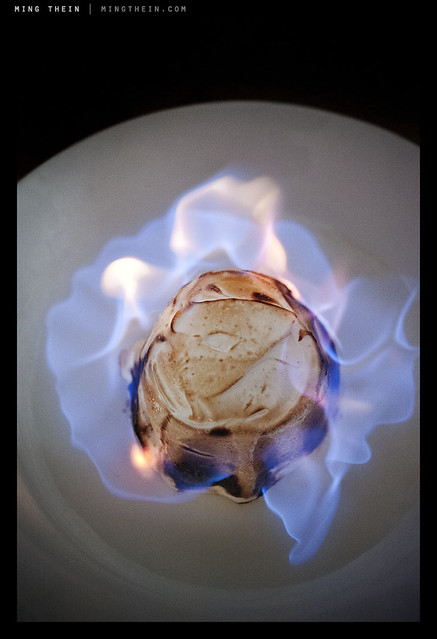
POTD: Flambé

_7060984 copy
Baked Alaska. Nikon D700, AFS 60/2.8 G Micro

Flames are a funny thing – they don’t photograph well. Simply, yellow flame is bright because it contains a lot of incandescent little particles; usually, it’s too bright to photograph well relative to surroundings – you land up losing detail in the flame if you have context, or losing context if you have detail in the flame. Blue flame is almost impossible to photograph because most of its energy is heat – there isn’t much in the way of light-emitting incandescent particles. Flames are also very random in an interesting fractal kind of way; photographically that means you’ve got to do many, many takes – four Alaskas, in the case of this shot. And dozens of frames until we got just the right flame.

The problem for food photography – specifically baked Alaskas – is that the lit brandy you pour over the dessert burns blue, which isn’t so great to shoot. Sure, you could composite flames in after, but it would both look unnatural and just be dishonest. So what do we do? Simple: add a little something to the alcohol that makes it burn brighter, and a little yellower.

Interestingly, this is where the high ISO capabilities of the D700 become useful: ISO 6400 with a good amount of remaining dynamic range and very low noise. I don’t think this shot would have worked as well with the D800. MT

POTD: Magritte Strikes Again

_8001440 copy
Magritte Strikes Again in downtown Kuala Lumpur. Nikon D800, 28-300VR

Amidst all of the chaos and panic claiming serious ‘issues’ with the new Nikon D800 (see my previous post) – I think it is important for the photographer to serenely rise above the noise (no pun intended) and remember that ultimately, the camera is a tool, nothing more, nothing less. It enables you or gets in your way. All I can say is that from this image alone, the D800 is capable of delivering some of the most accurate color I’ve ever seen. Normally I’d struggle to get the blue right and maintain the rest of the gamut – not so here. The D800 did it effortlessly, with a lens that isn’t known for the accuracy of its color transmission. I really need to get more Zeiss glass in front of this sensor. MT

POTD: One of those strange inexplicable things that happens from time to time

_M9P1_L1009159 copy
A windfall for a small gorilla. Leica M9-P, Zeiss ZM 2.8/28 Biogon

I just remembered I hadn’t posted an image today. This image has been sitting in the upload queue for some time – it reminds me that sometimes, you don’t need technical perfection for something to work; a sense of fun and whimsy can do wonders, too. MT

POTD: New car obsession

_8001335 copy
New car obsession. Nikon D800, 28-300VR

On a photographic note: the T stop of the 28-300 is much lower than the f stops would suggest, requiring higher ISO. If you want to know the difference between the two, I suggest you come back later for today’s article 🙂 What you can’t see art this size is that this was shot at ISO 1400 – yes, there’s some fine grain if you look at 100%, but guess what – it could have been ISO 50 for all intents and purposes on the web. Downsizing large images (even if noisy at the pixel level) averages out the luminance noise and leaves you with a much cleaner print than you might think.

A mark of today’s blind consumer society: I was attending the launch for the new BMW 3 series locally; overheard was a conversation between two other customers:

Person 1: “It’s so huge inside!”
Person 2: “Really? Doesn’t seem much bigger than the old one to me.”
Person 1: “But it must be, the salesman said so!”

There’s a moral to this story: firstly, don’t believe everything you read or hear: go and verify it with your own eyes, especially if you’re going to be spending your own hard earned money on it – more so these days, since inflation seems to have had a very visible effect on the pricing of goods. Or maybe it’s the aspiring middle class, or both. If something is fit for your purpose, then go ahead and disregard what others – especially those with a clear bias, like salespeople – are trying to tell you. That’s the whole benefit of choice! Remember: this applies equally to anything, be it luxury cars or cameras. 🙂 MT