
Reflections of sky, Kuala Lumpur. Leica M9-P, 35/1.4 ASPH FLE
reframing the world one picture at a time
Reflections of sky, Kuala Lumpur. Leica M9-P, 35/1.4 ASPH FLE

Breguet La Tradition. Nikon D700, 60/2.8 G + 2xSB900s
So how did I do this? It’s not that hard: watch your lighting, and watch your backgrounds. With a sufficiently dark background and perpendicular lighting (the key here is not too diffuse, else your background will also be lit) the reflective surface of the watch with shoot the light right back at the camera. Since the watch is several orders of magnitude more reflective than the background, exposing properly for the watch will completely dial out the background, or at least reduce its luminance to a level where it’s negligible. I could have burned it down to zero, but a hint of texture and delineation for the strap worked best. MT

Sunset, Prague. Leica M9-P, 50/1.4 ASPH
My inner Magritte is trying to escape again. I love the contrast between the hard edges of the silhouetted branches and the soft roundness of the cloud in the sky; there’s also a nice compliment between the warm tones of the cloud and the coolness of the sky. If you wanted to be even more philosophical, I suppose you could say that the image is a metaphor for life or existence or the human condition or something similar – the cloud (warm, fuzzy, ephemeral, fragile, etc) against the cold, harsh, unforgiving (poky?) realities of its environment. MT
Here are some suggestions that apply to everybody, regardless of what or how you shoot.
Disclaimer: As with every other article in this series, I’m assuming you know the basics already.

Prague. Leica M9-P, 28/2.8 ASPH
10: Shoot raw and expose a little bit hot. There’s always a bit of potential to recover highlights in your raw files; some cameras more than others. Know how much yours can tolerate before blowing highlights completely. It’s not just a way to expand dynamic range; exposing hot and bringing down the exposure later actually reduces shadow noise, too. For those of you using a third party RAW converter that doesn’t read proprietary image settings, crank your sharpening in camera up to maximum – it won’t affect the raw file (only the jpeg preview), but you will be able to more easily see if things are in focus or not when using the image review screen.

But we all have favorites. Billingham Hadley Pro. Leica M8, 50/1.4 ASPH
9: There is no perfect bag. Just accept it, and move on. Buy a new one if it takes your fancy but don’t expect it to solve all of your problems. Most of the time I only use a bag if I have other non-photographic items to transport. If it’s camera-only then it just goes over my shoulder.

At the station. Note clean edges and overall feel of the image. Leica M9-P, 28/2.8 ASPH
8: Watch the edges of your frame. Your subject is identified by a) light; b) position in the composition; c) context. The edges add or remove context – and with it, distractions. Use them carefully.

Spotlight. I’d have missed this if I was fiddling with my settings. Olympus E-PM1, Panasonic 20/1.7
7: Learn your equipment. You should be able to operate your cameras like it’s second nature. Muscle memory is your friend, and can make the difference between responding instinctively and getting the shot, or missing it altogether. Practice is the only way to do this.

The ephemeral sushi. Nothing is in focus, the saturation is all over the place, there are hot spots, the color isn’t accurate…but somehow, it works. Olympus E-PM1, Panasonic 20/1.7
6: Look at lots of images. Famous works. Not so famous works. Flickr. It’s a good source of both inspiration and way of helping you to hone your sense of composition.

But surely it will make me a better photographer!
5: Don’t buy new gear unless you’re sure you’re not the limitation. Make sure you know exactly what it is that your current gear isn’t doing for you and how the new gear will solve it.

Hommage a Rene Magritte. Prague. Olympus E-PM1, 45/1.8
4: Look at other mediums of art for inspiration. It could be painting, design, architecture; for instance I love the way Magritte renders clouds, and I look for that kind of light when shooting skies.

Gorilla in the shadows, Prague. Leica M9-P, 28/2.8 ASPH
3: Look for interesting light, not just interesting subjects. But of course it’s best to have both. The best photos present an unusual subject in an extraordinary way.

Precision. I waited for both the sun and the bird. Nikon D700, 24/1.4
2: Be very, very selective with your keepers. Keep only the best. I throw away 99% of what I shoot. Not because it’s bad, but because if you shoot good pictures, then keeping only excellent will make you excellent after a while; if you shoot excellent on average and keep only outstanding, then you’ll be outstanding. And so on. Continually push and challenge yourself – set assignments, practice, tasks. Go outside of your comfort zone, and the persistence will yield results.

Serendipity. Interesting things happen when you stick a compact inside a marine chronometer then do wide-angle macrophotography with it; this was my first time trying it. Ricoh GR-Digital III
1: Shoot lots. Practice, practice, practice. Experiment. If it doesn’t work, at least you’ve learned not to do it. If it does, great – another technique to add to the arsenal. I always get asked ‘how do I pick it up? How did you pick it up?’ and my answer is the same: I experimented and shot a lot. But I also made sure I made a note of what I did, so I learned something from the experience. When I started, I was probably doing a thousand frames a day – 99.9% were crap, of course – but slowly that ratio swung. Always carry a camera – even if it’s just your phone – and don’t be afraid to use it. MT

Vintage Tudor Submariner. Nikon D700, 60/2.8 G Micro + 2xSB900s
Yes, that’s a Rolex crown. Rolex is the parent company of Tudor; or, Tudor is the ‘entry level’ Rolex model. There weren’t really that many differences back then, but these days the main difference is in the movement – all of the Rolexes have in-house movements but the Tudors have Swatch Group-derived ETAs. If you’ve ever wondered how I get lighting like this, the trick is all in the diffusers; the better your lighting control, the less aggressive your specular highlights will be. I use a system of movable translucent but semi-opaque perspex panels to diffuse my flashes. (It’s custom built, so don’t bother looking for one). The other trick is that although the perspective appears to be one way, it doesn’t mean that the subject has to be shot in that orientation, only lit in that orientation and rotated later. MT
See the full series and writeup here on fratellowatches
Travel photojournalism during Golden Week in Japan – it doesn’t get much better than this. Course date from 28 April to 3 May 2012, with very limited seats – content will be tailored to the participants – with options for flights departing Kuala Lumpur or accommodation + workshop only – please contact either me or George Wong at Leica ([email protected]) for more info! MT


House near Strakhov Cloister, Prague. Olympus E-PM1, 45/1.8
The title of this shot is a bit of a red herring: yes, there is a snowflake, but no, it isn’t really visible at this size. What drew me to this scene was the balance of color; the simple geometry of house and sky; the texture of the tan wall and the two little details (visible in the full size shot) – the snowflake decorations in the window, and the moon hanging low in the early morning sky. I suspect this would make a great large print, but I haven’t had a chance to find out yet. MT
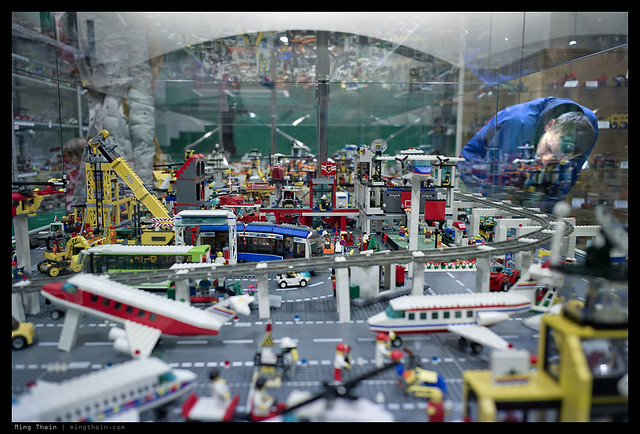
Lego Museum, Prague. Leica M9-P, 28/2.8 ASPH
I freely admit to having a fascination with Lego since a very young age. I’m pretty sure it’s because it gave the creative side of me an outlet, and the type A side of me a chance to solve problems and take on challenges which nobody else – or so I thought at the time – had done, for instance trying to build a working helicopter – which of course failed. I recently revisited it after a nearly 10 year hiatus – this time focusing on fully functional and mechanically accurate large scale cars. Part of the satisfaction for me was, and still is, being able to get around the limitations of the medium – no concentric shafts, for instance – to produce something that was still as accurate to reality as possible.
In many ways, building Lego is similar to photography. There are some technical rules and limitations, but for the most part, it’s entirely creative and up to you how you wish to follow them (or not). There are specialists, who only build one or two types of things. There are similarly dedicated online communities. It can consume a huge amount of time and money, especially if you decide to build a 12ft long aircraft carrier (I’ve seen it done) – I suppose the photographic equivalent would be going medium format digital. But above all, you get a sense of satisfaction from having created something that in all probability is both unique and will never be created again – but which still reflects your personality and personal style. (Assuming of course you’re not building a standard model from an instruction sheet).
It seems that these days, a large proportion of the sets sold are actually to adult enthusiasts. Maybe it’s because adults are wanting their childhoods back, but kids want to have Blackberries and iPads and want to grow up faster – little do they know what awaits them. Enjoy it while it lasts!
In the same way that I build very different models now to when I was five, I think I’d equip my kids with a camera as soon as they’re able to use one. It would be a very interesting exercise to see how their perspective on the world changes with age – what do they see when they’re 1 or 2 years old, vs twenty? Do I wish I’d had that opportunity? Absolutely. It’s the same reason that every year, I document life with my wife in a book – so we can look back and see how things have change twenty, thirty, forty years from now. It’s also insurance against Alzheimer’s.
I leave you with something I built a little while ago for the Porsche Club of Spain – a 917K.

For those interested, you can see some of my recent Lego Technic work here on MOCPages.

Because I couldn’t decide which shot I preferred, and because there are no rules saying I can’t post twice…
Evening silhouette. Olympus E-PM1, 45/1.8
Behind the scenes videos




If you enjoyed the content, please consider  -ing or subscribing - thanks for your support!


