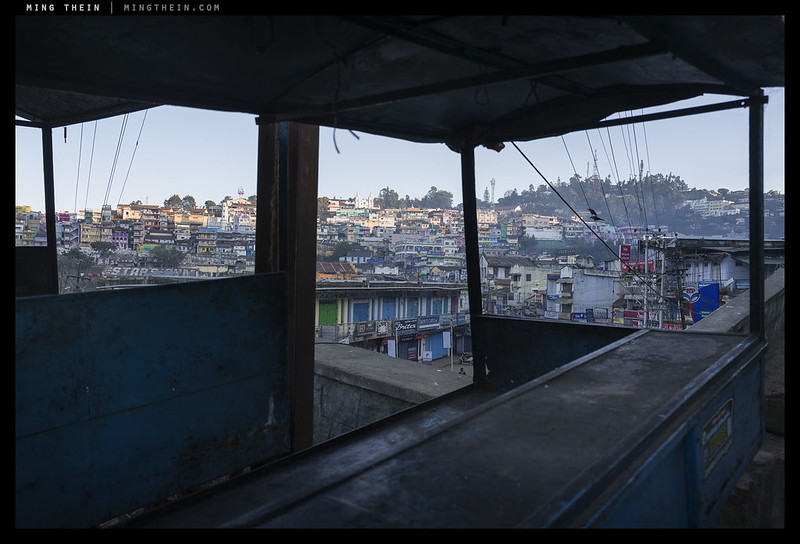
Photoessay: Waking Coonoor

_Q116_L1100369 copy

Half an hour before we were to meet our contact from the wildlife preservation department, we arrived in Coonoor, the Nilgris range, India, to find the town sleepy and barely stirring. Sunlight was just hitting the very tops of the highest buildings upslope, and the few residents stirring were dragging their feet – a massive contrast to the scene a couple of hours later, which was so different you could not imagine the place empty. As we did a quick walk through, I felt like I was observing the aftermath of the night before…a sort of crime scene worker, if you will. What follows is from the body of evidence, filed under ‘environmental context’. MT

This series was shot with a Leica Q, and post processed with PS Workflow II.
[Read more…]

Photoessay: 28mm in Tokyo

_Q116_L1070166 copy
Camouflage (urban jailbreak)

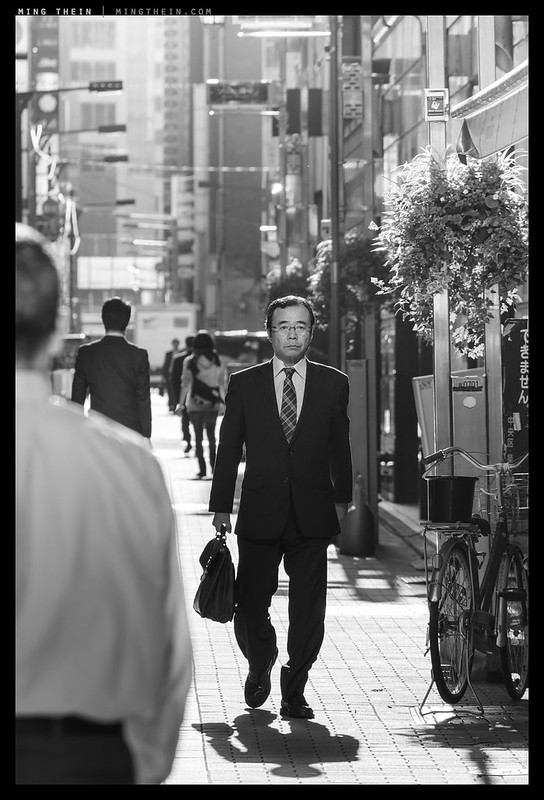
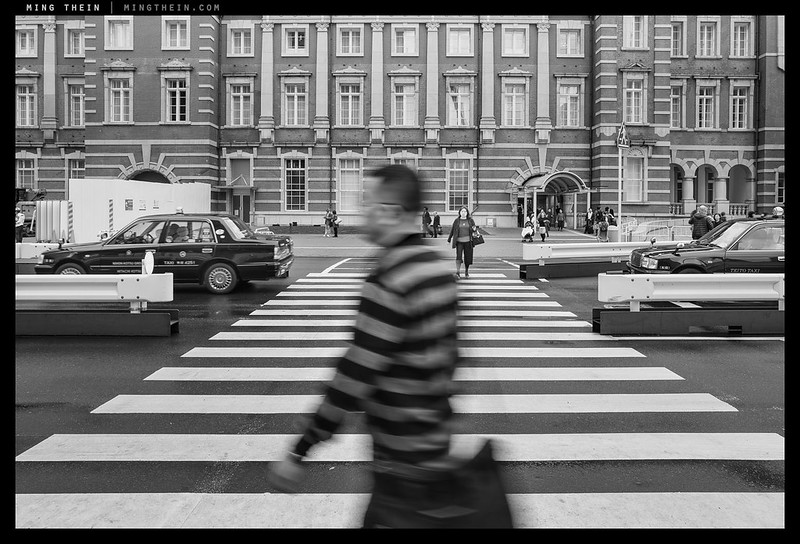
People, an urban centre, 28mm, and monochrome – is there a more ‘classical’ recipe for what might be traditionally classified as street photography? Perhaps, perhaps not. The whole genre is so fluid that I think it is impossible to define anyway; I instead think ‘snippets from the quotidian’ is probably more accurate in this case. They are vignettes and observations of the repeated, the mundane, and the boring. But the pace of the world changes so fast that who knows what the same activities will look like in twenty or fifty years? MT

This series was shot with a Leica Q and post processed with The Monochrome Masterclass. You can also look over my shoulder at the underlying postprocessing in the Weekly Photoshop Workflow series.

[Read more…]

Photoessay: student portraits

11_7R2_DSC3489 copy
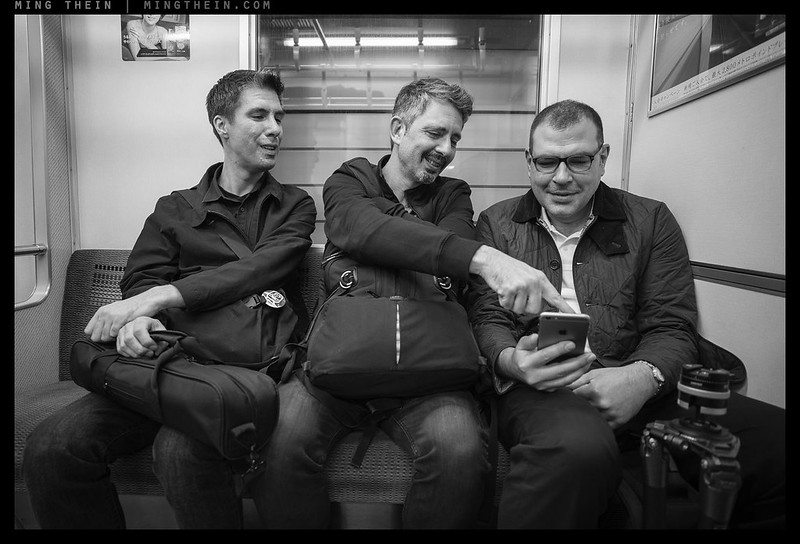
JJ, Latchezar and Pavel, Tokyo

I set myself a little project during the course of the last few Masterclasses: whilst my students are photographing, I’m photographing my students. I think of it as an exercise to hone environmental portraiture to some degree, and to keep my people-photography skills in practice. Portraiture is not something I talk much about because I think it’s far less about technique and execution than it is about building a relationship with your subject and then somehow translating that intangible into something visual. It is one of the few types of photography that perhaps relies more heavily on the subject than the quality of light – body language is far more critical than shadow direction; even if we can’t see the details, we have a feel for what the person’s posture might mean. The photographer must therefore be doing three things at once: keeping up the real connection between themselves and the subject – even if nothing is being said; being conscious of body language at a level higher than the casual observer, and beyond that, taking care of the four things. This series has been curated from the Tokyo, Chicago and Hanoi sessions. Enjoy! MT

Images shot with various equipment and processed with The Monochrome Masterclass workflow or Photoshop Workflow II. You can also look over my shoulder at the underlying postprocessing in the Weekly Photoshop Workflow series.

[Read more…]

Photoessay: People of Tokyo II

_5502278 copy

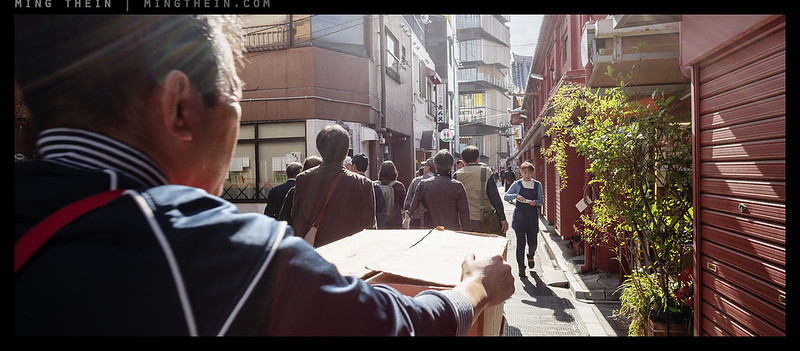
As usual, it is impossible not to be in a place like Tokyo and do at least some street photography; the very difference in the way people act and the things they do already attracts our attention because it breaks the pattern which we’re used to seeing. Furthermore, Japan’s tolerance for photography in general as a society and the close proximity in which people usually find themselves makes things even easier. It is however impossible to avoid people on phones: I still think this is the ‘hat-and-newspaper’ of the 21st century; just as life-documenting photographers eighty years ago could not avoid that cliche – which now seems quaint to us – we are locked into the era of the cellphone. It is harder to find somebody not using one. I’ve always said the best street work should be pretty close to documentary in nature, though much more personal in significance. If phones are the nature of reality today, so be it. That of course doesn’t mean there isn’t plenty else going on. I did get a feeling of longing and melancholy I didn’t observe the last time I was there; the usual conspicuous isolation was even stronger on this visit. A sign of the times for society, perhaps? MT

This series was shot with a Leica Q 116, Nikon D5500 and 55-200/4-5.6 DX VR II, Sony A7RII and Zeiss 2.8/21 Loxia and 1.8/85 Batis lenses and post processed with The Monochrome Masterclass workflow. You can also look over my shoulder at the underlying postprocessing in the Weekly Photoshop Workflow series.

[Read more…]

Photoessay: Tokyo cinematics I

_7R2_DSC3568 copy

The lights of Tokyo always form an irresistible backdrop to some interesting characters; for what must be the fourth or fifth year running, I’m back (I’ve honestly lost count) at what I consider to be the best season – autumn, before the weather gets unpleasant, the skies are still blue, and there’s an orange leaf or twenty. An unusually warm summer this year resulted in not much of an autumn – the leaves weren’t anywhere near as extensive as in 2013, and in 2014 I was a week too late – ah well, the vagaries of nature. Nevertheless, Tokyo is so extensive that I feel as though you could live there your entire life and barely scratch the surface photographically. On this trip, I tried out some different hardware for cinematic work compared to my normal 55/85 Otus – I wanted to see if smaller, lighter could also apply to cinematic work albeit with slightly reduced maximum apertures. I used the Zeiss 1.8/85 Batis (Sonnar) and the Zeiss 2.8/85 Sonnar, an older Contax design. What I found was the Sonnar actually produced a more pleasing rendering for this purpose – the Batis is razor sharp but I somehow prefer the softer, more rounded properties of the older lens – especially for out of focus foregrounds and skin. It is stronger at middle and close distances because of this; the Batis excels at longer distances because it differentiates between planes more easily. Neither is as good as differentiating as the 85 Otus, but that’s also a faster and better corrected (apochromatic) lens – the price we pay there is occasionally nervous bokeh and some onion rings under certain conditions. I digress: it is of course about applying the right tool to the right situation to get the desired images…enjoy! MT

This series was shot with a Sony A7RII, Zeiss 1.8/85 Batis, Contax Zeiss 2.8/85 Sonnar MMG and Zeiss 2.8/21 Loxia and post processed using the Cinematic workflow in Making Outstanding Images Ep.5. You can also look over my shoulder at the underlying postprocessing in the Weekly Photoshop Workflow series.

[Read more…]

Photographing babies

_Q116_L1020754 copy

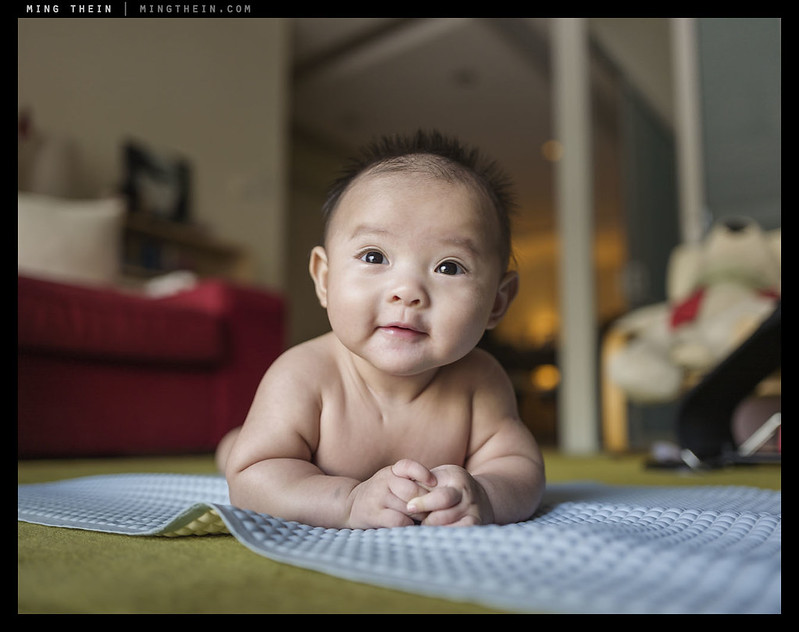
Today’s article is both somewhat off topic and an indication of how things have changed for me in the last seven months. It certainly isn’t something I’d have done or even considered previously, but when your shooting hours are severely curtailed by parental responsibility, a photographer has little choice. I’m sure we’ll be updating this post with a ‘photographing toddlers’ amendment in a year or two, but for now, I’d like to share some of the useful things I’ve learned – I’m sure there are probably a considerable number of people in the audience who might find them useful. Feel free to wait for the next article or dig in the archives for today’s entertainment if it isn’t applicable to you. And I do promise not to turn into one of those people who does nothing but post photographs of their kids…

[Read more…]

Photoessay: Chicago stories

_7R2_DSC2571 copy
You will pay…or the Don will make you pay

I’m going to try something a bit polarising today: a set of images with an imagined narrative, and knowing how many of you dislike titles, I’m almost certain that my read of the narrative is going to be completely different to yours. This may be down to cultural context, personal context/ biases, or my subconscious including ambient elements that were in the scene but not captured. Feel free to offer an alternative interpretation. MT

This series was shot with a Leica Q, D810/ Zeiss 28 Otus, A7RII/ Zeiss 85 Batis and processed with Photoshop Workflow II. You can also look over my shoulder at the underlying postprocessing in the Weekly Photoshop Workflow series.

[Read more…]

Photoessay: The Idea of Man, Chicago, part II

_7R2_DSC2937 copy

Continued from part I

I was in Chicago at the end of last year for my exhibition of the same name at the Rangefinder Gallery; what we showed was actually only 27 of the 70+ images from that series, curated from a further 10,000+ images over the course of many years of shooting. However, I’ve always thought of Idea of Man as an ongoing project; our interpretation of the philosophy of life is as dependent on ourselves as it is on whatever we happen to be observing. And there’s always a place to go or culture to experience that is foreign to us, and may well raise new questions over what is ‘normal’, ‘expected’, and ‘individual’. Thus, the show must go on.

[Read more…]

Photoessay: The Idea of Man, Chicago, part I

_Q116_L1050252 copy

I was in Chicago at the end of last year for my exhibition of the same name at the Rangefinder Gallery; what we showed was actually only 27 of the 70+ images from that series, curated from a further 10,000+ images over the course of many years of shooting. However, I’ve always thought of Idea of Man as an ongoing project; our interpretation of the philosophy of life is as dependent on ourselves as it is on whatever we happen to be observing. And there’s always a place to go or culture to experience that is foreign to us, and may well raise new questions over what is ‘normal’, ‘expected’, and ‘individual’. Thus, the show must go on.

[Read more…]

Photoessay: Germany, on the move

_7R2_DSC1032 copy

Today’s photoessay comes from a much earlier trip in the year to Zeiss HQ in Germany; I had a lot of connections and a lot of transit time. The camera naturally falls to hand and one starts observing and recording. Having personally spent a lot of time in transit in a large number of countries around the world, I always find it remarkable how developed countries are quite similar – but somehow little things make a difference in implementation and efficiency of the overall system. Whilst German public transport lacks the brutal efficiency of the Swiss, it also lacks the unpredictability of the French and Italians, so I suppose that’s reason not to complain…MT

This series was shot with a Leica Q, Sony A7RII and Zeiss 1.8/55 FE and 1.8/85 Batis lenses. You can learn the underlying postprocessing in the Weekly Photoshop Workflow series.

[Read more…]