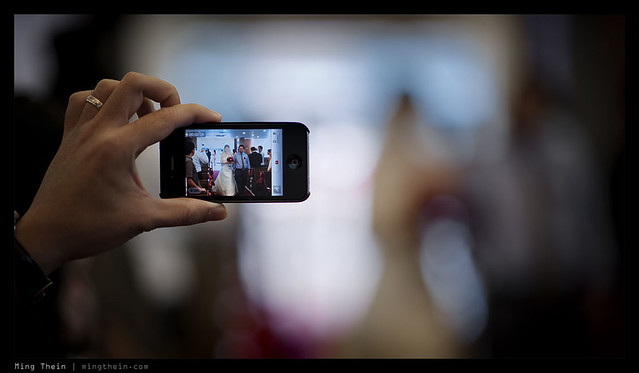
The never-ending photographic arms race got me thinking recently about sufficiency: how many pixels, fps, AF points, ISO settings, etc. are enough? The troubling thing is that I thought I used to know the answer: I’m no longer sure it’s quite as clear cut. See, the thing is that if you’re viewing images online, in theory, anything close to your screen resolution (leaving space for UI elements, text, menus etc.) should be sufficient – 1000px wide is more than enough for most purposes. The images on this site are mostly 800px wide, for reference. In theory, that should mean an iPhone is overkill. Yes and no; just because resolution sufficient, it doesn’t mean that we’re going to have enough dynamic range, or color depth (or accuracy).
This raises a hypothetical question: suppose we could have say a ‘perfect’ 3MP – in a compact camera, with a reasonably good zoom lens; if we put those 3MP into a 2/3″ or 1/1.7″ sized sensor, we could probably get a fast-sh 24-120mm f2-4 equivalent into something that would be reasonably pocketable. The relatively low pixel density would mean several things – good acuity, low noise, good color accuracy, and much higher forgiveness of the lens quality. With today’s technology, I don’t see why you couldn’t get a clean ISO 6400 and useable ISO 12800. Even with a lens of moderate speed, that’s a more than sufficient shooting envelope for most photographic purposes. Add a good optical stabilizer, fast AF, 14 bit RAW, responsive buffering and controls, and most people would be set. And with raw files that small, you could probably get 10,000 of them onto a 32GB card.
But, nobody would buy it and it would be a commercial failure. Only 3MP? Really?
That’s the kicker. If you’ve ever had a really high quality, but small-ish file, then you’ll know that you can actually do quite a lot with it; I remember seeing some images from the 2005 Wildlife Photographer of the Year competition – prints, at 40×60″ or so – which were shot with a Nikon D1H: that’s right, all of 2.7MP. Did they sing? You bet. Did they look grainy, or pixellated? Not especially so, but I’m sure you’d see the difference if you shot the exact same scene with a D800E. The shot that won would no doubt still be a great capture even twenty years from now. A hundred years from now. Does the equipment matter? Insofar as it didn’t get in the way of the capture, no.
In a more realistic scenario, a proper 300dpi print (actual pixels, not printer ink dots) looks extremely sharp. 200dpi is still acceptable; do you know what most computer screens are? Closer to 110. Sharp images still look sharp, don’t they? And the reason things appear pixellated is because the pixel mask of the screen gives each pixel a hard edge. If the edges of each dot were just a tiny bit fuzzy and overlapped the next dot, like in a print, then things would look just fine. The reality is that short of sticking yourself a few inches away from the display, you’re not really going to see the individual pixels. I have to be honest; the Macbook Pro’s 220dpi ‘retina’ display doesn’t look all that different to my 15″ non-retina from healthy viewing distances. But it requires four times the amount of graphics power to run, because guess what: every graphical element requires four times the pixels.
Most people print no larger than 6×4″, or perhaps out to 8×12″ for special images; survey a group of enthusiasts on the largest print they’ve made, and you’ll probably find 13×19″ a good end point. There are two reasons why: cost, and lack of display space. Enormous prints are great, but you’d also better have enormous walls to hold them.
So what does a 1500×2000 pixel, 3MP file get you? At 110dpi, 13.6×18.2″ – lo and behold, that’s pretty darn close to 13×19″! The one problem with this scenario is that it assumes that all photographers using the ‘sufficient’ camera have the shot discipline to get things perfect at the pixel level, and that they’re really getting the full resolution of the sensor. Sigma/ Foveon shooters will know what I mean by this – the files may be small, but the real resolving power is pretty darned high. Higher than the sensor’s pixel count would lead you to believe (but not as high as Sigma’s marketing department would like you to believe).
Even for use on a next generation ‘retina’ display, you could still get a 7×9″ image out – comfortably fitting the display size. You could probably interpolate it a little too, and not see too much degradation in quality.
Let’s put this all into context. The recently-released Sony RX100 (reviewed here) has 20MP effective – that’s a whopping 5500×3600 or so pixels, or enough for a 50×33″ print – I don’t have enough space in my house to hang more than one or two of those, and at that size, I’d struggle to think what image I wouldn’t mind looking at for hours on end. Yet there are still people crying ‘not enough resolution!’. At that sensor size, pixel density is so high that critical focusing and shooting discipline become very important; I notice that the stabilizer seems a lot less effective than lower-pixel count cameras, but I’m now starting to suspect it’s because it’s got to work quite a lot harder to maintain perfection at the pixel level.
Take the argument a notch further: okay, so there are still reasons to have something with interchangeable lenses. And those things always come with bigger sensors (okay, so not the Nikon 1 cameras, but they haven’t exactly been a commercial success – expensive, small sensor, low pixel count; even if the pixel quality is reasonably high and the cameras are extremely responsive). Bigger sensors mean more expected resolution. I’m going to bypass M4/3 and APS-C for the time being, because they all top out at reasonably similar resolutions; there isn’t that much difference between 16 and 24MP – remember, area scales with the square of length. Let’s go to full frame DSLRs – one of the most common questions I’ve received via email in the last few months is ‘I have a D700. Should I upgrade to the D800/ D800E?’ The fact that that question is even being asked signals that the marketing department has done a good job. They’ve sold you on the lure of the enormous number of pixels; you haven’t bothered to do a bit more reading to find out that a) you’re going to need much better lenses; b) shot discipline once again becomes critical; c) stability is a hot topic; d) your AF system might not be quite as accurate as you thought – especially if you’re using auto-area and letting the camera do the thinking for you.
The answer to this question is simple: how big do you print, and do you need video? If the answer to the latter is yes, go ahead and buy it; video isn’t something the D700 can do. The former is a bit more subtle: if you can’t get a good 45×30″ or so print out of the D700, then your shooting technique needs work. I’ve had images shot under ideal conditions printed to 40×60″ for exhibitions – they still looked great. Granted, the subjects weren’t crammed with fine detail like leaves and grass, but they weren’t high-bokeh content portraits, either. So, if you’re not making say 20×30″ landscapes on a regular basis – do you really need the heartache that comes from having to revaluate all of your lenses, and shunt around 50MB RAW files? Probably not. But, the bragging rights are a different matter altogether.
One of the reasons why the photographic industry is still growing despite passing saturation point some time ago is because of the photographers themselves: they don’t know when to stop. Canon will happily sell you a 50/1.2 for three or four times the price of the 50/1.4, which itself is three times the price of the 50/1.8 – simply because there are people who will pay for that extra half a stop. (And it may be an extra half a stop of aperture, but it’s almost certainly less than half a stop of transmission.) Let’s be realistic: the camera’s metering doesn’t gauge scenes that accurately; I routinely make adjustments of +/- 1 stop, and that’s with Nikon’s super-accurate matrix meter in the D700 or Olympus OM-D (I consider both to be more reliable than the D800, which has a tendency to put too much weight to the active focus area). The Sony RX100 is out by so much that I have to constantly use exposure compensation or risk an unsalvageable image. With the degree of adjustment latitude our modern sensors give us, whole stops changes are what you have to be making before you see any appreciable differences in image quality.
Here’s another curious thing: equipment with more conservative specifications often performs better than more extreme gear, even though the extreme gear frequently costs several times more. This is because we’re dealing with known technology, with greater tolerance for error: this is why there are many superb 50/2s or 50/2.8s that perform excellently wide open, but few 50/1.4s and faster that do. It’s also why lenses with higher resolving power – take the macros for instance – have modest apertures. It’s easier to correct for smaller apertures. Same thing with sensors – it’s easier to get good dynamic range and a high signal-to-noise ratio out of a sensor with a larger pixel pitch; the supporting electronics for each photosite has to be of a certain size, and if there isn’t much area to go around in the first place, that circuitry starts to make a significant and noticeable difference to the light-collecting ability of the sensor.
The bottom line is very Socratic: Know thyself. Specifically, think carefully about which pictorial limitations are due to the photographer, and which are because of the camera. Low light performance? It’s probably your gear. Poor composition? More pixels isn’t going to help you. Blurry images? More pixels definitely aren’t going to help you; examine your technique first.
The recent series on inspirations from older cameras was posted specifically to illustrate this point: just because a camera is old, it doesn’t mean that it’s no longer capable of producing good images. If somebody could use it to get the shot when they had no other choice, it means that you can still do that. The important thing to remember is that most of the time, the limitation is in the user, not the equipment. So next time, before buying more gear, think about spending money on improving your skill level first. I guarantee that you’ll see a much bigger improvement in your images. MT
____________
Visit our Teaching Store to up your photographic game – including Photoshop Workflow DVDs and customized Email School of Photography; or go mobile with the Photography Compendium for iPad. You can also get your gear from B&H and Amazon. Prices are the same as normal, however a small portion of your purchase value is referred back to me. Thanks!
Don’t forget to like us on Facebook and join the reader Flickr group!

Images and content copyright Ming Thein | mingthein.com 2012 onwards. All rights reserved




 Prices are the same as normal, however a small portion of your purchase value is referred back to me. Thanks!







Photokina 2012 commentary and opinions
The rush of product announcements is over, the collective giddy fanboy-like enthusiasm has died down somewhat, and presumably some serious business is being discussed in the back meeting rooms and dingy service hallways of the exhibition hall in Cologne, or over giant pretzels at the local bierhaus. It’s about the right time for a bit of serious reflection and commentary on some of the more interesting announcements from the last week.
The beginning of full frame for the masses.
The Nikon D600 and Canon 6D are squarely aimed at the space which the Nikon D70 and Canon 300D battled over nearly eight years ago; enthusiast-level cameras with serious image quality and a reasonably good feature set. Granted, the price point is a bit higher, but then again, inflation has moved things along somewhat, too. I actually think both of these cameras are far more capable than the average user needs, but people will buy them anyway. Commendably, Nikon actually had cameras in stock, and for sale at dealers on the day that was announced; this seems to be a rare exception in days of ‘pre-announcements’ months ahead of actual availability. And there weren’t any shortages, either – my dealer (admittedly one of the largest in Malaysia) got 60 bodies, compared to two(!) D800s. The D600 is an extremely refined camera that has no major issues anywhere – and I’m pleased to see that QC is much better this time, too; even though the camera comes from Nikon’s Thailand plant instead of Sendai. I’ll be doing a full review the D600 in the coming days, so stay tuned.
Breaking away from the traditional fixed limitations to camera software.
Nikon’s S800C is the first attempt by a large, traditionally-camera (I don’t count Samsung) manufacturer at doing quasi-open firmware; I think its success will depend on two things – the ecosystem around apps, and the level of integration with normal photographic functions. I don’t think it makes sense to have a camera that’s touch-screen only, which requires you to navigate some menus before you can even take a picture; instead, perhaps the ‘camera app’ could be loaded and running over the base OS by default, with other functional configurations loaded as required. They’ll need to retain buttons, too. And I have no idea how Android handles image processing, especially for very large files.
Wireless, wireless, wireless
Nikon, Canon and Olympus have gone big on wireless file transfer this year, each taking slightly different approaches. Nikon’s is dongle based, and allows ftp of files to any server, which is great for working professionals; Canon’s is built into camera (why aren’t they all like this?) – I haven’t used one, so I can’t comment on functionality. Olympus is card-based and requires an app on a tablet or smartphone to work, but is very well integrated with social media. I think the strategies actually represent their respective companies quite well; Nikon is still conservative and photographic-focused; Canon is a bit gadgety, and Olympus’ target market is very much the blogger and casual user. I hope that at some point the wireless standards will be sufficiently fast and well-defined enough to allow transfer of any file to any other device, or direct upload from the camera itself; Olympus’ implementation seems to work the best of the lot (as far as speed and multiple users go) – unfortunately there’s no way of having it send anything other than a jpeg to a tablet.
More mirrorless
There were a slew of offerings here: the Fuji X-E1, Panasonic GH3, Sony NEX-6/ NEX-5R, Olympus E-PL5 and E-PM2. It’s clear that smaller sensors are here to stay – remember sufficiency for the masses – and viewfinders are becoming an increasingly rare spec. The X-E1 is probably what the X-Pro should have been in the first place; I honestly found the hybrid finder in the X100 gimmicky after a while, and landed up using the EVF most of the time for more precise framing. If AF is improved as much as they claim, Leica will have competition on its hands, but then again, they probably won’t mind because they’ll just sell more lenses. The GH3 now occupies top spot in the M4/3 pyramid, and appears to be a notch above the OM-D in both spec and price. The asking money – $1299 – isn’t cheap at all. Fortunately, sensor quality in the new M4/3 cameras more than justifies it. Sony is more of the same – a cheaper NEX-7, and an evolution of the NEX-5. The hybrid AF technology with phase detect points in the imaging sensor itself was surprisingly low-key; I would have thought that something this useful would be deserving of more fanfare. Olympus’s lower-end cameras have been updated with the innards of the OM-D (though not the 5-axis gyro stabilizer). The E-P3 remains in the lineup for now, though I don’t see why anybody would buy one given the price and older sensor. I’ve got an E-PL5 here for testing, and it’s a pretty impressive camera – this is what the original E-P1 should have been. It’s fast, responsive, very nicely built, and pocketable with the body cap lens; I’ll have a full review up in the coming days.
Sony A99
Sony’s different approach to mirrorless has meant some unique value propositions at the low and mid range, and a slightly odd product at the high end – the A99 shares a base sensor with the D600, but is positioned at the price point of the D800E. At that level, you get higher fps than either camera, an excellent EVF, but a slightly odd control layout and user interface. General operation is fast enough, but I have no idea whether tracking AF is up to speed with conventional DSLRs or not; this has traditionally been a weak point of Sony cameras. I don’t think the package is compelling enough to attract new photographers to the brand, but videographers might be convinced by the quality of the output; the RX100 is seriously impressive, and that sensor is a fraction of the size of the A99’s. I still don’t think EVF’s are anywhere near good enough for critical applications, though; it’s not so much about resolution as dynamic range. I previously had a hands-on preview here.
Carl Zeiss
It seems that they’ve come back with a vengeance: first the 2/135 APO, and then the 55/1.4 Distagon, not to mention AF lenses for the X-Pro and E mount – a 12/2.8, 32/1.8 and 50/2.8 macro. It seems odd that they would skip over the much larger M4/3 market at first, though the relationship with Sony might have something to do with it. On the SLR front, although most of the lenses are capable of excellent results on even the D800E, the 50/1.4 Planar and 85/1.4 Planar have left much to be desired. It’s interesting to see that the 55/1.4 adopts their wide-angle Distagon formula; I suspect this is going to be an outstandingly good lens – it had better be, given the size (82mm filter!) and likely price. It’s apparently the first in a range of very high resolution DSLR lenses that will sit above the current ZF.2/ ZE line.
More M4/3 lenses
Olympus 60/2.8 Macro, 15/8 body cap lens and 17/1.8 announcement; Schneider’s 14, 30 and 60mm primes and Panasonic’s 35-100/2.8 were all announced. Serious glass is a good sign for system maturity. Whilst I won’t be buying the 17, Schneider 30/ 60 or Panasonic 35-100, the Olympus 60/2.8 macro has proven to be one of, if not the best lens I’ve used on M4/3, and one of the best macro lenses ever, period. I’ve acquired one for myself, along with the 15/8 body cap – it’s a fun toy, makes my E-PM1 an interesting pocket option, and is a very good street shooter thanks to huge DOF and a mechanical focus lever. Being a 28mm lover, the Schneider 14mm is definitely on my list, though the expected price tag is eye-watering. I think they will have to lower prices for this range of optics to be a success; I simply can’t see any quantity of people willing to pay this much for lenses relative to the cost of the rest of the system.
Enthusiast compacts with small sensors are still going strong
There were several announcements in this category: the Olympus XZ-2, Canon S110/ G15, Nikon P7700, Panasonic LX7, and Fuji XF1. All were evolutionary rather than revolutionary; the most exciting thing was the mechanical lens on the rather compact (and surprisingly large 2/3″ sensored) XF1. I think for this category of camera to survive, they’re going to have to get smaller and more versatile with lenses, or cheaper; Sony’s RX100 makes for stiff competition given its much larger sensor and reasonably fast lens – and it’s compact. I see the Canon S110 and Fuji XF1 doing reasonably well because of their size; the LX7 has that f1.4 lens; the rest are probably going to wither.
Leica
Aside from the new, confusing naming, Leica did what we expected them to do (and probably should have done quite some time ago) – brought live view to the M, along with a much improved LCD. Although I’m sure they’ll sell in droves anyway, what will make or break this camera as a professional tool won’t be price – rather, the quality of the sensor from the new Belgian supplier, as well as the reliability of the electronics and other parts. At least we don’t have to worry so much about rangefinder alignment; however the EVF makes things somewhat ungainly and also impossible to use flash or a thumb grip (not that that will work anyway, with the ergonomic modification and extra control dial). The M also loses one of its windows – frame lines are now LED illuminated, which is a big deal because it means much easier viewing under difficult light conditions. The M-E is a stripped down M9; I suppose there were a lot of leftover components to use up. I’m curious about the color, but that’s about it. The S has received a supposedly new sensor, though the pixel count remains the same; let us hope image quality is improved, then.
The wildcards: Sony RX1 and ‘that Hasselblad’
Perhaps this section should have been called ‘the good, the bad and the ugly’; or ‘beauty and the beast’. The RX1 appears to be a masterpiece of innovation, even though the camera isn’t as small as it appears to be, and the price is rather high. I think it’s now only a matter of time before we see great compact full frame cameras in the vein of the older Ricoh GR1v and Olympus Mju II. That can only be a good thing for those of us who don’t always want or need to carry around a D600. The Hasselblad Lunar, on the other hand, is either a masterpiece of capitalistic genius which will make them a boatload of money from the taste-challenged Middle Eastern and Chinese markets, or the beginning of the end for the brand. I suppose this is what happens when a bunch of financiers who don’t understand photography take over a camera company; for shame. Granted, Leica is doing the same thing with its rebranded Panasonics, but at least they look better than the original versions. The Lunar is so hideously ugly that it appears to have been designed by a five-year-old, rendered by a fifth form graphics design student, and then posted on April 1st. Except, it wasn’t, and it seems that nobody within Hasselblad can see that the emperor’s new clothes are missing. Having said that, a technology partnership with Sony makes perfect sense: look at the technical prowess required to create the RX100 and RX1. If anything, they could breathe new life into medium format. However, rebranding the company’s existing cameras is definitely NOT the way to go.
A note on marketing strategy
For whatever reason, companies seem to choose to announce all of their products at the same time – this is stupid. As a result, none of the products individually get the attention they could otherwise have managed if the announcements were spread throughout the year; Photokina should be an industry show where things are on display and the reps are there to answer questions and do business. I’d consider myself a fairly avid follower of the industry in general, and yet I keep finding things that I simply overlooked in the deluge of announcements – the Nikon P7700 was something I wasn’t even aware of until today, for instance. And the Zeiss and Schneider announcements got lost against the noise against the Hasselblad Lunar. Fifteen minutes of fame, yes – it just doesn’t make sense to fight with your competitors for the same fifteen minutes so that everybody at best gets five seconds each. Leica did it right with their May 10 event; I suspect the impact was much stronger than at Photokina, and they certainly got more attention in the blogosphere.
Overall, the theme for this year has been evolution and lenses; there are a lot of solidly interesting products out there, some of which I’ll review, some of those in turn which I’ll buy – but the list isn’t that long, probably just the Schneider 14/2, Zeiss 1.4/55 Distagon and 2/135 APO. I don’t see anything dramatically different or improved over what we’re currently using, but better lenses are always worth lusting after. MT
____________
Visit our Teaching Store to up your photographic game – including Photoshop Workflow DVDs and customized Email School of Photography; or go mobile with the Photography Compendium for iPad. You can also get your gear from B&H and Amazon. Prices are the same as normal, however a small portion of your purchase value is referred back to me. Thanks!
Don’t forget to like us on Facebook and join the reader Flickr group!
Images and content copyright Ming Thein | mingthein.com 2012 onwards. All rights reserved