Let’s talk DSLR: pretty much everybody’s got one, how do we get the most out of it?
Disclaimer: I’m assuming you know the basics already, but want to get serious.

10: Control your view. Use the viewfinder when you can; there’s less lag, you can brace the camera against your face to increase stability, the dynamic range and resolution are higher, it’s a more direct connection to your subject and it saves power to boot. But why not use live view if you’ve got it, especially coupled with a swiveling screen? For critical focus, odd angles, and video, it’s actually pretty handy. Though I personally avoid it like the plague unless i have no choice.

The big brass band. Not strictly an SLR shot, but live view did help me to get this angle without sticking my face on the floor. Leica X1
9: Shutter button technique matters. You’d be surprised how many people just jab the button and wonder why the camera isn’t responding. Firstly, don’t jab. Roll your finger gently to reduce camera shake. Secondly, prefocus; the shutter button has two stages – the first activating autofocus, the second, shutter release. If you have focus already going, then your lag is going to be much, much shorter than if the camera has to do all the work when you press the button – even on the fastest cameras. Finally, you’d be surprised how many people use the horizontal release in portrait orientation even if they have a vertical one – don’t. It’s less stable, and frankly you just look silly.

Night party. It looks bright, but the EXIF will tell you otherwise. I needed every single trick in the book to get this shot: stratospheric ISOs, low shutter speeds, and a fast f1.4 lens wide open. Nikon D700, 24/1.4.
8: Turn the in-camera sharpening and contrast up to maximum. What? Why? There’ll be haloes! I can hear the cries of incomprehension and derision already. First caveat: you must shoot raw. Second caveat: use a raw processor that ignores the camera’s proprietary processing tags, e.g. Adobe Camera Raw. The reason why you want to crank both of these things up is that the camera’s preview engine generates a jpeg based on these settings; if your exposure is okay with the contrast at maximum, then you know you’ll have more shadow and highlight latitude. And high sharpening accentuates the differences between in focus and out of focus.And it also accentuates noise; basically, the combination of these settings makes it easier for you to tell if you’ve nailed it or not.

Work that perspective. Nikon D3, 70-300VR
7: Don’t let zoom lenses make you lazy. Select a focal length based on perspective, not angle of view: in other words, don’t use a wide lens because you want to get more of the scenery in, or a telephoto because you want to get closer. Instead, wide is for accentuating perspective, telephoto is for compressing it.

Action. An interpretation of the famous first series of motor drive images that showed a galloping horse’s legs do in fact leave the ground simultaneously. Nikon D700, 28-300VR
6: Shoot in bursts. Events evolve. The first shot may not be the best, or you or your subject may move. A burst is insurance, and if they’re all perfectly focused and exposed, then it lets you select the best image – say for minor variations in facial expression of a portrait. Note that I don’t mean machine gunning the shutter until your buffer is full; three or four shots is usually plenty.

Fire. The balloon was firing on and off unpredictably. It would be a lot more difficult to get this shot without auto ISO. Nikon D3100, 85/1.4 G
5: Use auto-ISO, but only if it’s configurable. If the minimum shutter speed is not configurable, you don’t know at what shutter speed the camera is going to start bumping the sensitivity; if it’s too early, your images will be grainer than they need to be. If it’s too late, then you may not have enough shutter speed for a sharp shot.

Cheers. Tough lighting; how do you know what your camera is going to expose for if you haven’t tried it out? Nikon D700, 85/1.4 G
4: Know what your camera is doing: AF, metering, auto-ISO. This is actually very, very important. If you don’t know how your camera responds under a given situation, how do you know if you can get the image or not? There’s no shortcut to this other than a lot of practice and experimentation.

Alien. I prefocused on the spot where the man would be when the light was exactly behind and over him, then waited. Nikon D3, 24-70/2.8 G
3: Have some way to control your AF: either use AF-ON or AF-L, together with continuous focusing. Autofocus is an aid, not a crutch. Auto-select point systems will seldom select the point you want; they’re useful, but only in an environment where you have a lot of randomly moving subjects and need to pick the closest one. When you have something a bit more sedate, tell the camera what to focus on. Use continuous autofocus, because everything moves, if only slightly; the larger your aperture, the more this will matter because depth of field is shallower and probably won’t be sufficient to cover subject movement. I prefer to have AF activation on the shutter button and an AF-Lock button configured under my right thumb – this is so I know I can just press one button and have a high chance of getting the shot – but I also know of plenty (most sports shooters?) who configure AF-ON under the thumb, and the shutter button to capture the image only. AF Lock for that configuration is of course done by releasing the AF-ON button. Try both and see which works for you.

This was actually shot in a well lit carpark, but with a stopped down lens and fast shutter speed to eliminate ambient and have nearly 100% of the exposure provided by the flash. If I’d shot aperture priority, I’d still be able to see the surroundings. Nikon D700, 28-300VR and three SB900s.
2: Shoot aperture priority, except for flash. This is the easiest way to maximize control of your camera: aperture priority to control depth of field, manual mode if you need to balance flash and ambient lighting.
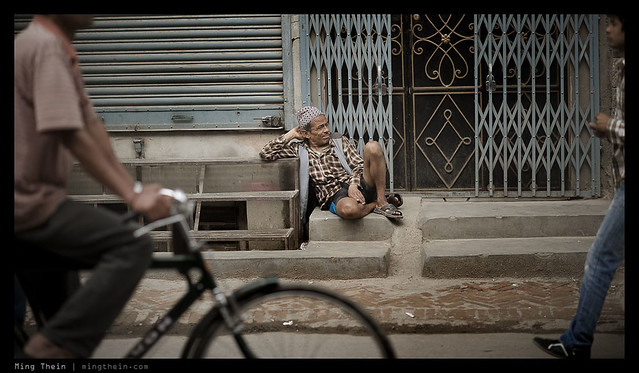
Watching the world pass by. Imagine this frame without the edge intrusions: it’d feel pretty different, wouldn’t it? Nikon D700, 85/1.4 G
1: Watch the edges of your frame. I’ll say it time and again: what usually makes or breaks a photo, or the difference between an excellent image and an outstanding one, is how well the subject stands out. This is both a function of subject lighting, positioning and focus, as well as the inverse: what other things are there in the frame that take attention away from the subject? Intrusions into edges are one of the main ones. Conversely, there are also compositions where edge intrusions are welcome, or even make the image: they suggest things that might not be there, or leave things to the imagination of the reader. Use with care! MT








CES 2012: Thoughts on the new cameras
This year seems to be yet another bonanza year of choice for photographers – and gearheads, especially. What follows is a few quick thoughts on the recent spate of introductions – specifically, those I find interesting or worth commenting on:
Nikon D800/D800E
50% more resolution – maybe as much as 75% on the E variant – and less than half the price of the D3x? It’s interesting to see just how far technology has come in the last few years. Not only is there more resolution, there’s more speed AND it’s 14 bit data off the sensor. I’m not worried about noise; downsize to say 15MP and you’ll find the files will be surprisingly clean, with very crisp detail at the single-pixel level. The resolution champion outside medium format? Easily. It’ll print well, too. I broke down and ordered a D800E via NPS. No comments on video specs, it’s just not something I do at the moment. Interestingly, it’s lighter, too. Minus points for the new battery system – what are legacy users going to do with their spares?
Warning to people who just want ‘more’: this camera is going to be punishing on both technique and lenses; poorer lenses may never get sharp at any aperture. And forget 1/focal length: you’re going to have to double that to be critically sharp at the 100% level. Sloppy photographers are probably better off sticking to more forgiving (and lower) resolutions. I know this definitely won’t be the camera I grab when I have to wear the photojournalist hat.
Nikon D4
It’s interesting to see that 16MP is considered enough for the flagship; that’s because it is. If you can’t print an enormous wall-sized enlargement that looks good from sensible viewing distances, you’re probably not doing something right. I remember the days when the D2H’s measly 4MP was sufficient for billboard work – and that was cropped down, too. Remember that as the print gets larger, you’re going to be further and further away. For fine art and pixel peepers, there may be reasons to have more resolution, but seriously – nobody was complaining when 12MP was state of the art. And these are much, much higher quality pixels than before. Again, minus points for the new battery system. Spares are expensive. I don’t see myself needing one of these – it’s too big and heavy, and has no built in flash to trigger slaves – but man those backlit buttons are cool.
Olympus OM-D E-M5, ZD 75/1.8 and ZD 60/2.8 Macro
I find myself going through phases with this one. I think the final verdict will boil down to size and sensor output quality. Not having seen either, it’s hard to make a call. It’s very difficult to tell from the product images – maybe the industry needs a standard sized hand or something. I like the idea of this camera – I really do – but frankly I think the design just isn’t that coherent. By the numbers it seems blazingly fast, though. Maybe this is what M4/3 should have been all along.
Much more interesting are the two lenses accompanying the announcement: 150/1.8 equivalent, anybody? Should make a killer portrait and fashion lens. The 60/2.8 macro is interesting to me because it a) goes to 1:1, which is really 2:1 equivalent on a full frame body; and b) it’s 120mm equivalent, which means a decent amount of working distance.
Pentax K-01
Firstly, it’s hideous. Secondly, it’s pretty intelligent: pancake lenses with most of the optics inside where the mirror box should be, keeping the size down; whilst retaining the original flange distance to allow use with legacy lenses. But sorry, the missing EVF is an unforgivable omission. I really have no idea who this camera is aimed at.
Fuji X-Pro1
Fuji is taking the success of the X100 and X10 and smacking Leica on the head with it. Then, just to make sure nobody missed their intentions, they displayed the camera with an M adaptor – which will also be released with the camera. Nobody doubts the image quality will be good. But my fear is that as with its siblings, the horrendously unstable and poorly implemented firmware is going to make or break this. I do like the initial lens choices though – the 28, 50, 90 macro combination feels like it was tailor made for me.
Canon G1X
Too little, too late. It’s bigger than competing mirrorless offerings, but lacks the interchangeable lens option; its only saving grace is going to be if the image quality is superb. I wouldn’t expect anything worse than the current crop of Canon APS-C cameras, which is to say pretty competent. But I just can’t see where it fits in for most photographers.
Final thoughts: Overall, too many of those damn confusing Xs in names. I think it’s time to get back to the photography, now.
Product images from press releases and DC.Watch.Impress