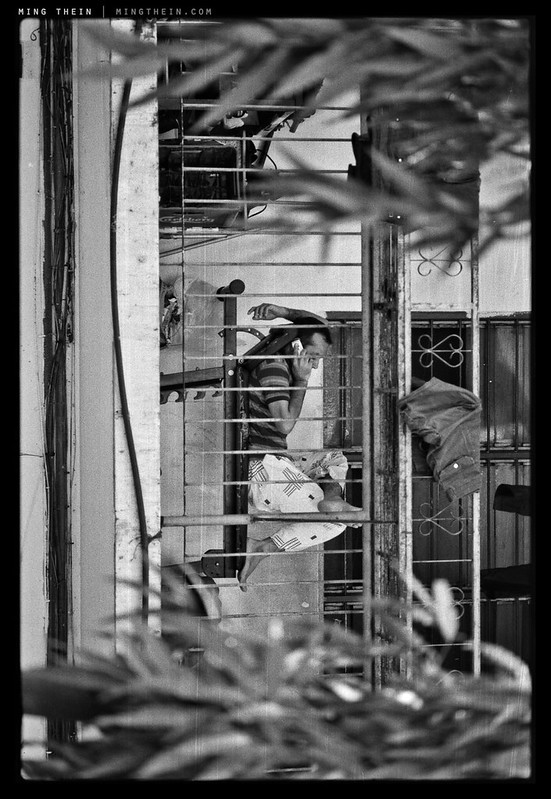
Photoessay: Cars and film

From a recent roll shot with the Nikon F2 Titan, Zeiss 2/28 Distagon and Nikon 58/1.2 Noct on Ilford XP2-400 – somehow, a good number of the images turned out to be of cars, even though they were shot a quite different times. Even more curiously there are quite a few BMWs in there…

Note: Ilford XP2-400 is a C41 process black and white film, which means it’ll give monochrome (if in my experience, slightly toned due to the development chemistry) images through a normal minilab process. However, what isn’t so well known is that the film is also developable in regular black and white chemistry; I used DDX 4:1 at 26C for five minutes, and it worked out just fine – as you can see here. Contrast needed a bit of a boost after digital copying (with my usual D800E and macro lens setup), though, and dynamic range appears to be a bit limited compared to normal black and white negative film. Still, I’m quite pleased with the results. Enjoy! MT

_8026339bw copy

_8026343bw copy

_8026340bw copy

_8026344bw copy

_8026347bw copy

_8026349bw copy

_8026373bw copy

_8026375bw copy

_8026380bw copy

_8026381bw copy

_8026379bw copy

_8026378bw copy

_8026371bw copy

_8026370bw copy

_8026367bw copy

____________

Visit our Teaching Store to up your photographic game – including Photoshop Workflow DVDs and customized Email School of Photography; or go mobile with the Photography Compendium for iPad. You can also get your gear from B&H and Amazon. Prices are the same as normal, however a small portion of your purchase value is referred back to me. Thanks!

Don’t forget to like us on Facebook and join the reader Flickr group!

appstorebadge

Images and content copyright Ming Thein | mingthein.com 2012 onwards. All rights reserved

Film diaries: medium format revisited, with the Hasselblad 501C

_8025831bw copy

Many of you might remember my earlier serious revaluation of medium format photography (article here) – and the conclusion I reached from a couple of months ago, which was that whilst there was a slight but noticeable gain in image quality, it simply didn’t work for me – not only would the solution for my regular commercial subjects be rather clunky and impractical. For my personal work, it didn’t feel different enough from shooting FX digital to force me to think different; in fact, the slow AF and generally sluggish UI made me frustrated. You’ll probably also recall that I very briefly evaluated the CF-V 39 back for the V series and quickly abandoned it because somehow it just left me confused – “…somewhere between the combination of the multiple crop lines, the left0-right inversion and everything else that was different, my brain shut down. I just couldn’t see anything other than what should have fit into the square 6×6 frame…”. Logically, this shouldn’t have been the case, given that rangefinders have far more confusing framelines, and any DSLR has a maze of AF boxes and grids and the rest inside the finder. But it did, and I summarily ruled out shooting with any of the V-series cameras.

_8025998bw copy

This actually wasn’t my first experience with the V-series. Many, many years ago, one of my students acquired a 503 and CFV-16; I played with it briefly and found that to be equally frustrating and counterintuitive. (I also remember the back just shutting down and refusing to cooperate at one point, too.) It didn’t leave much of an impression, and certainly not a positive one.

Yet somehow despite all of this, I seem to have performed an abrupt 180 degree turn in the last couple of months. I acquired a rather nice 501C, which according to its serial number, is around 17 years old. For some irrational reason – and that’s the only thing I can put it down to – I am taking to this camera in a way that I certainly didn’t with the others. It doesn’t feel counterintuitive. It doesn’t feel finnicky or fragile. And it certainly isn’t confusing. Unlike the others, it makes me want to go out and shoot; it’s also got me seeing square compositions, which I certainly didn’t do before. In fact, I like working with it so much – and of course the results it produces – that I’ve also ordered a second back and 50/4 Distagon FLE, and the 120/4 Makro-Planar to complete the kit.

_8025994bw copy

The obvious question is of course, what changed?

I’m not entirely sure myself. Other than that perhaps the shooting experience is different enough to give me the kick I was looking for; the basic controls are all still there, in a logical layout, without so many quirks that you go mad trying to remember them. Don’t get me wrong: using a V-series Hasselblad is still very much an exercise in masochism; your finder is reversed, the focus throw is extremely long, you only get 12 shots per roll (24 if you can find an A24 back and 220 film) and your shutter speed tops out at just 1/500s. Not to mention little quirks like having to remember to cock the shutter before mounting or unmounting lenses to avoid breaking the leaf shutter drive shaft, or putting the dark slide in before changing backs/ taking it out before shooting, the oddly positioned shutter release etc. And let’s not even talk about how fiddly it is to load the backs in the first place*. Somehow, the experience works for me.

*That said, unlike my first film Leica M, I managed to load it properly and not get a blank roll at the other end. I think I was just more careful this time.

It also helps that the experience is a pleasantly tactile one. ‘Serious’ cameras from the film era were built like the proverbial brick outhouse; the choice of materials and attention to detail made them objects to last, and objects that were enjoyable to use and handle. If you’re holding your camera for hours on end every day, believe me, this matters; that little, rattly, cheap-feeling plastic switch can drive you nuts after a while. The 501C, on the other hand, is every gram a real camera with a feel that is unmatched by just about every modern piece of gear, excepting perhaps the Leicas and Zeiss lenses – certainly not anything from a mass manufacturer. Historically, the cost of these things was non-trivial, and it certainly shows. What I do find amazing is that a very, very good condition complete outfit can be acquired for around the same cost as a midrange prosumer DSLR – yet I still get comments from people fawning over it as though it’s a Bugatti.

_8025990bw copy

I suspect the latter may be as much to do with the perceived (historical) costs of entry, as much as the masochism required to pilot one well which results in quite a large psychological barrier overall. I personally have no issue with meterless cameras, or manual focus; I’m training my eyes to be a light meter, and for the most part, I’m within about a stop of the intended exposure. For commercial flash work, it’s usually manual through a mix of experience and quick guide number calculations. It’s actually quite liberating to be in full control of the outcome and not have to second-guess whether the camera is going to give you what you want or not.

There are also some very clever things I like about the V system: firstly, the ability to change backs mid-roll means that you can carry a high ISO back and a low ISO back, and not waste film or miss shots. The lenses are calibrated so that turning both shutter and aperture rings in the same direction by the same number of stops maintains a certain EV exposure; most of the CF lenses even have a coupling button to lock the rings together. Not letting you take out the back without a dark slide in place (and blocking the shutter if it is in place) makes sense too, if you think about it: you don’t want to accidentally waste a frame. You can also easily interchange finders and focusing screens; later cameras also take winder grips and motor drives.

_8025992bw copy

With film, the shooting experience is only half the story. To control the output completely, you also have to develop and scan your own (assuming your output is digital rather than print). I’m still refining my process for both, so I’ll refrain from commenting too much on that for now; suffice to say that the grain is a bit large for my taste, probably because tap water here is 27 C and far too warm for slow development. As for the scanning process – I’m using a single-shot capture from a D800E and Zeiss 2/50 Makro-Planar, duplicating the negatives sandwiched between glass for flatness. The tonality and conversion process definitely needs some refinement, too.

It seems like a lot of work – and it is – but I am enjoying the process. And all up, I don’t think I’m spending much (if any) more time than I would with a digital workflow – I have fewer, but better, images to work on; the conversion process after scanning is largely written up as a macro, so I don’t have to do anything other than load my files, crop, dust spot and press a button; there is no curve or dodge and burn work involved anywhere. If I wanted that level of control and cleanliness, I’d use the D800E. That said, if they did ever offer a ‘full 6×6’ (or close to it) digital back, I’d probably mortgage a kidney and buy one. I could see myself using this thing commercially if throughput and control were faster and more consistent.

_8025987bw copy

In short: so far, so good. I’d highly, highly recommend the experience if you have any interest in shooting film, or trying something different – the best thing about it is that if you don’t like it, you can resell the camera for pretty much what you paid for it. If you do like it – I did the economics – I’d have to shoot 25,000 frames with my complete (two lenses, two backs, two finders, including film and chemical cost) 501C setup to equal the cost of a new H4D-40. And there’s no way I’d be shooting in such quantity with either camera – I have other workhorses for that. More thoughts to come soon. MT

____________

Visit our Teaching Store to up your photographic game – including Photoshop Workflow DVDs and customized Email School of Photography; or go mobile with the Photography Compendium for iPad. You can also get your gear from B&H and Amazon. Prices are the same as normal, however a small portion of your purchase value is referred back to me. Thanks!

Don’t forget to like us on Facebook and join the reader Flickr group!

appstorebadge

Images and content copyright Ming Thein | mingthein.com 2012 onwards. All rights reserved

Film diaries: the first roll

_6001446 copy

Some months ago, I acquired a vintage Nikon F2 Titan in the hopes of both fulfilling a longtime photographic dream, as well as perhaps shooting a little film again in the name of stimulating creativity. Many of you have been anxious to see the results; I bet none more so than myself. The trouble is, I feel that I’ve set a standard here that I must uphold; if the images from this roll don’t meet that standard, then I think there’s going to be a lot of hand-wringing, rude gestures and cries of ‘pah, amateur’. In this post follows the highlights of that first roll.

2012-12-13-F2T-D100

Before I show any images, I want to give some background: I’ve shot film creatively before. I’ve even processed it before, as part of my dissertation on improving measurement precision using short-wavelength laser holography (don’t ask, because I don’t really remember). But I’ve never done both, and my processing days predate my creative photography days by a considerable period of time. Finally, the last time I shot film was in mid 2009, with a Leica M6TTL. Before that was 2005, with another Nikon – an F2A. Note: EXIF data will say ‘D800E and 50mm’, because that’s what I used to digitize the negatives.

_8025538bw copy

This roll is both the first roll of true B&W I’ve shot*, processed and scanned entirely singlehandedly. It shows, too: it’s grainy considering it’s Ilford Delta 100 exposed at ISO 100; in places it’s uneven, and there’s a streaking problem from where I got impatient and decided to try to wipe the film dry with a microfiber cloth. In hindsight, one of those Dyson Airblade hand dryers would be awesome for the task.

*An embarrassing, dirty confession: all of my previous film B&W work was C41 process (BW400CN, XP2-400) for convenience – finding somebody to develop black and white film in Kuala Lumpur is not a trivial task because serious shooters do their own, and consumers don’t do it at all.

_8025536bw copy

The ‘scanning’ was accomplished with an interesting hack-rig: my product photography lightbox, lit by a speedlight within, film passed through a cardboard mask (to prevent scratches) and the camera resting above, spaced perfectly with the long hood from a Zeiss ZF.2 2/100 Makro-Planar but fitted to the 2/50 Makro-Planar which coincidentally has the same bayonet. Add a 20mm extension tube, and the spacing is not only perfect, but I now have a 4000+DPI scanner.

_8025550bw copy

I’ve spent some time in Photoshop to automate the conversion process as much as possible, to try and keep the character of the film intact and consistent, and minimize the amount of individual work required on each image. I can’t say I’m 100% happy with the results yet, but we’re getting there. If I can run an entire roll of RAW files as an automated action – cropping excepted – then the total scan and process time is actually about the same as a comparable number of digital files.

_8025545bw copy

Anyway, more on that in another article. For now, I just want to leave you with one thought: resolution both matters, and doesn’t – we’re seriously spoiled by the degree of image quality obtainable from the current state-of-the-art FF digitals. Enjoy! MT

These images were shot with a 1979 Nikon F2 Titan on Ilford Delta 100, with a mixture of lenses – Voigtlander 28/2.8, Nikon 58/1.2 Noct-Nikkor, Nikon 45/2.8 AI-P, Zeiss ZF.2 2.8/21 Distagon, Zeiss ZF.2 2/50 Makro-Planar, Zeiss ZF.2 2/100 Makro-Planar. Can you tell which is which, other than through perspective? I can’t.

____________

Visit our Teaching Store to up your photographic game – including Photoshop Workflow DVDs and customized Email School of Photography; or go mobile with the Photography Compendium for iPad. You can also get your gear from B&H and Amazon. Prices are the same as normal, however a small portion of your purchase value is referred back to me. Thanks!

Don’t forget to like us on Facebook and join the reader Flickr group!

appstorebadge

Images and content copyright Ming Thein | mingthein.com 2012 onwards. All rights reserved

_8025531bw copy

_8025525bw copy

_8025515bw copy

_8025508bw copy

_8025502bw copy

_8025495bw copy

_8025499bw copy

Film Diaries: Revisiting film under the pretext of creative development

_MT57330bw copy

Followers of my facebook page and those who joined me for the Tokyo workshop will know that I’ve recently acquired two vintage cameras, ostensibly in the name of investment, however in reality it’s simply because I enjoy using cameras of this generation; they really don’t make them like they used to.

For the curious, my acquisitions were a 1979 Nikon F2 Titan, and what is approximately a 1986 Nikon 58/1.2 Noct-Nikkor Aspherical*. In my mind, these two represent pretty much what is the pinnacle of 100% completely manual technology. The camera body is 33 years old, and looks just as pristine as the day it left the factory floor. (I doubt my D800E will be functional 10 years from now, much less 33; I think the batteries will be long dead and unavailable, and the media and file formats either unsupported or unreadable. Hell, my D2H is already dead, and judging by the slow disappearance of cameras from just six years ago on the secondary markets, it’s likely that a lot of those have either died or entered a quiet retirement too.) Testing the shutter speeds using a digital stopwatch and point-and-shoot on long exposure with the film back open is proof that despite its age, the mechanicals are still functioning perfectly. This is actually fairly amazing given the condition of the camera, because either it has not been used, or was shot by exceedingly careful and paranoid photographer. It is unclear, though unlikely, that the camera has ever undergone a CLA. At the time of writing, the accompanying lens has not yet arrived from Japan so I will refrain from drawing conclusions; however, given the relatively simple nature of the mechanics inside lenses, I’m not expecting any issues.

*In case you’re wondering why I selected this combination, there are some simple reasons: firstly, because I’ve always wanted an F2T since seeing one – the paint finish and weight are much like a modern Nikon, but the rest of the camera is entirely classical. Secondly, it’s familiar to me because I shot extensively with an F2A before; thirdly, the camera distills everything down to the bare minimum – no custom functions or AF issues to worry about; you focus where you want, you adjust exposure manually, hell, it has no meter, let alone DX coding or exposure compensation. Part of what I want to do is retrain my eyes to be my meter – I have this skill, but it isn’t accurate enough for my liking – a stop plus minus isn’t good enough for slide film or digital. At the moment while I’m learning, my Sony RX100 has now become a ridiculously over-specified meter.

For a person whose photographic credo throughout the digital age has pretty much followed the pursuit of perfection through control, you probably are going to think that the use of film is a little unexpected, to say the least. My history and experience with film so far has been somewhat chequered. Not counting my use of film cameras in the days before I had any meaningful interest in photography, I had a brief affair with a Nikon FM3a in my early digital (D70) days; I couldn’t get along with it and in the end landed up trading it in (with one of the rare black 45/2.8Ps) for a 12-24. I think I shot all of four rolls with it. Then, when I got serious, I picked up another film camera (Nikon F2A); the majority of my learning of photographic techniques was accomplished in parallel on both film and digital. In fact, I even shot watches on slide film (of all things), manually calculating guide numbers, diffusion factors, magnification factors and bracketing just to make sure. I got so used to shooting film, that I was almost treating it like digital. This led me to put on the brakes once again; I simply could not afford to pay for the amount of slide film and processing that I was running through on a weekly basis, much less find time to do the scanning.

At this point, we enter a silver halide desert. The next time I even so much looked at a roll of film was in mid 2009, when I picked up a Leica M6TTL as a backup body to my M8. The two biggest things I remember about that experience were that I completely wasted the first roll because I loaded it incorrectly, and as a result landed up with precisely zero images on it; and secondly the feel of the horizontal cloth focal plane shutter of the film Leicas is completely different – much smoother and quieter – than the vertical-travel, metal-bladed units in the modern digital Leicas. I think I must’ve used it on and off for a couple of months, and then decided I wanted the 50 Summilux ASPH more – so off it went.

By this point, I was too preoccupied with both work and the seemingly newfound degree of control that I was able to obtain through digital capture. There were also things I simply could not easily do with film – such as dodging and burning – unless I developed it myself – and I definitely didn’t have time for that. Ironically, this is one of the reasons that I am choosing to revisit film at this point. I’m finding myself spending far too much time in front of the computer post processing. It isn’t because I’m slow – far from it; it’s because I’m trying to do more with each image, and I’m simply shooting a much larger number of images these days.

Of course I am not shifting my commercial work back to film; that would just be stupid. There is no way, I can achieve the same degree of control and quality as I can with digital. And I’m certainly not going to take the risk of something unforeseen happening to the film in the intermediate process between shooting and client delivery. For the mall, there is simply no way I can keep up with the volume if I have to develop and scan every single print plus don’t forget this also dust spotting, retouching and color/ density correction required. Needless to say, I don’t think any of the clients these days would be impressed if you had to bill back the film costs – especially if you shot the same number of images as you normally would with digital.

For my pistol what however, I feel that it’s time to shift gears. I’m definitely experimenting and shooting more, but the improvement seems to be incremental and diminishing. Perhaps part of the problem is that I’m simply shooting too much. I need to be more selective before I take the picture; and again after take the picture. If this sounds like a breakdown in the editing process, that’s perhaps because in some ways, it is. Even though I usually throw away 98% of what I shoot in the quest for perfection every single frame, that 2% is starting to become quantitatively a very large number. Combined that with ever increasing file sizes, and the usual photographers attachment to the images which they shoot, and you have a recipe that’s going to eventually result in either of two things: you spend all of your time processing your personal work and doing nothing else, or you eventually give up shooting for yourself altogether. Obviously, neither of these is a ideal; the first results and you not having any income; the second, creative stagnation. (I’m not sure which is worse for a photographer. I suppose we’re all somewhat accustomed to the former.)

The unstriped come up with, is that I need to find a balance. A change to my shooting process that forces me to think even harder about the image before capture; to minimize the amount of postprocessing I have to do by ensuring that the critically important elements of a strong image are already in place before I press the shutter; and moreover something that forces me to think differently from a creative point of view. I need to play mind games with myself in order to improve to the next level. I suppose I could accomplish most of the former by forcing myself to shoot cameras with relatively small files, and even then only with a very small card – say 2GB, which is probably good for about the equivalent of two rolls of film in a D800E, or even 512MB, which would get me just over a roll from a D700.

The problem is really the creative portion. Although I find changing equipment does frequently force me to think differently, I spend just as much time figuring out how to get the most out of the equipment as shooting, which of course results in more experiments, more files, and even more computer time. This would just land me back in square one, not to mention significantly worse off thanks to the depreciation costs of new equipment. I even seriously considered switching to medium format at one point. However, this would have to be as much a commercial decision as a creative one, and the market in Malaysia, plus the majority of my overseas work being macro-centric simply does not justify the increased expenditure.

It seems as though once again there are good reasons to revisit film. In some ways, it’s much like shooting with a compact; you are removing an element of creative control so that you are forced into making the most of the others. This element of course is postprocessing and post-capture control**. The other added bonus is somewhat progress; every time you press the shutter it cost you money – I calculated to be around $.40 per shot, including processing. This makes you think very carefully before you push the button. I’ve met a lot of people say, that if you get one keep up on a roll you doing well; however, I think my keeper rate is far, far higher with film the digital; simply because it forces you to do everything you can to get the image right the first time. A nice bonus is that it’s also possible to try larger formats for not that much money; possibly because nobody seems to want the equipment anymore, and partially because the gear will be second hand, and therefore not lose a lot of value when you eventually move on and resell it. (You might well even make money on some of the rarer equipment – at least, that’s part of my plan with the F2T and 58/1.2; I also see a Hasselblad 501CM in my future.)

**Granted, I will be digitizing the negatives using one of the Nikons and a slide coping adapter, which of course creates the opportunity for me to intervene digitally at this point, but that’s not the objective of the exercise – there will be far fewer images to deal with, and I’m almost certainly not going to be doing any heavy duty RAW processing.

You’re probably wondering why there are no images to accompany this post. The reason why is simple; it’s because I haven’t developed any film yet. Instead of shooting hundreds of image a day, I’m now shooting perhaps half a dozen, if that. And I’m fairly sure (providing I didn’t mess up loading the camera), that the images I do eventually show will have helped my creative development. You’ll just have to wait and see. MT

____________

Visit our Teaching Store to up your photographic game – including Photoshop Workflow DVDs and customized Email School of Photography; or go mobile with the Photography Compendium for iPad. You can also get your gear from B&H and Amazon. Prices are the same as normal, however a small portion of your purchase value is referred back to me. Thanks!

Don’t forget to like us on Facebook and join the reader Flickr group!

appstorebadge

Images and content copyright Ming Thein | mingthein.com 2012 onwards. All rights reserved