POTD x3: Food photography with the Nikon D800

_8005414 copy

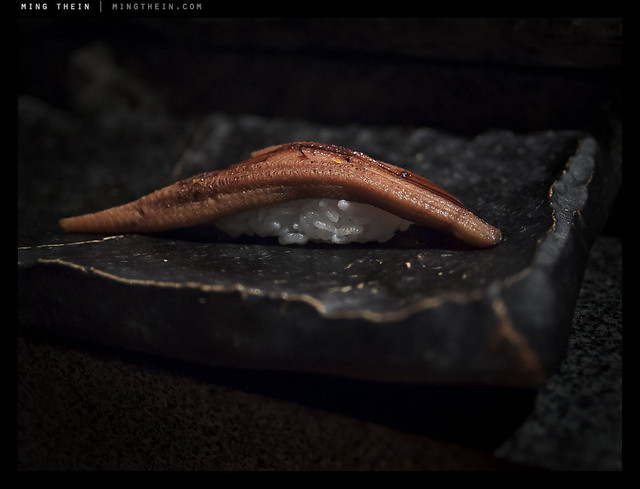
Goldeneye steamed in miso and ginger

_8005366 copy

Seared tai (seabream) with momeji oroshii chili.

_8005295 copy
Iso-bagai snail, I believe poached in mirin and soy.

This series shot with a Nikon D800, PC-E 85/2.8 D Micro, and two LED light panels. Chef – Kenny Yew at Hanare

Two of the toughest things to get right color-wise (in my experience, at any rate) are people and food. There’s something about the way organic materials reflect light – probably due to the fact that they are both reflective, transmissive, and have odd properties in the infrared and ultraviolet regions (think: flowers, or cat’s eyes) which is just a huge challenge for most cameras.

Up to this point, I was fairly convinced that the Olympus Pen Mini plus Zeiss lenses (usually ZF.2 2/28 via adaptor) delivered hands down the best color; perhaps not the most accurate, but certainly the most pleasing. The Olympus sensor’s color bias would take care of global saturation and hue, and the Zeiss glass would ensure great micro contrast and accurate color transmission. Similarly, for landscapes – anything with skies, especially – the Leica M8/M9s excelled; I still can’t match the blue with any other camera. To my eyes, the Leicas (with Leica lenses) deliver the best sky blue bar none; and a decent skin tone (with Zeiss lenses – yes, there is a difference in color transmission; it’s subtle but I’ve always felt the Zeisses are slightly warmer.) The Nikons…well, I learned to correct them, but frankly, they weren’t that accurate (thought the D700/D3/D3s was the best of the bunch to date). I think it has something to do with the way Nikon designs lenses for global contrast rather than micro contrast, which affects the transmission of subtle tonal variations. Color improves markedly with Zeiss glass, which is designed to optimize micro contrast.

After this shoot, however, I think I’ve stumbled upon the best of both worlds. The D800’s sensor delivers the best color I’ve ever seen – accurate and highly pleasing, which is an achievement (and I believe DXOMark found the same thing). Paired with the Zeiss 2/28 Distagon, it’s pretty incredible. But what if it could get better? What if you could have accuracy, saturation, micro contrast, macro contrast and everything in between? Apparently, you can. The PC-E Micro-Nikkors now take the cake for me as the best lenses to use with the D800; resolving power is there even wide open; color transmission and micro contrast are on par with the Zeisses; edge performance isn’t an issue because they were designed with enormous image circles to support the tilt shift movements; and finally, you solve the DOF vs diffraction issue through tilts or swings.

My only complaint is that focusing ring feel is rather inconsistent, for some inexplicable reason. The 24 PCE is silky smooth; the 85 PCE is so stiff and dry that it’s very difficult to move in small increments. And sadly, Nikon has changed some components internally so that moving the tilt and shift axes to be parallel now requires new internal PCBs and about $400, instead of just removing some screws. This begs the obvious question: why the hell didn’t they design it that way in the first place, since a) clearly, enough people want the lens that way that they designed a separate PCB for such cases; b) almost all of the lenses I’ve seen on ebay have been modified and c) it doesn’t make any sense photographically unless you want to do a horizontal pano! For architectural work, macro work, and everything else, you need to have tilt and rise/ fall, not tilt and shift or swing and rise/ fall. Makes you wonder if anybody is actually a photographer on the lens design team.

All of that aside, being able to shoot at wide open or nearly wide open and still have sufficient DoF is a joy. It makes small LED light panels useable as your primary light source at ISO 100, handheld even. This is great, because studio strobes and speedlights will make the food wilt in double time, and anything raw will start to look slightly parboiled under the heat if you don’t work fast. On that note, enjoy the sushi. MT
POTD: Flambé

_7060984 copy
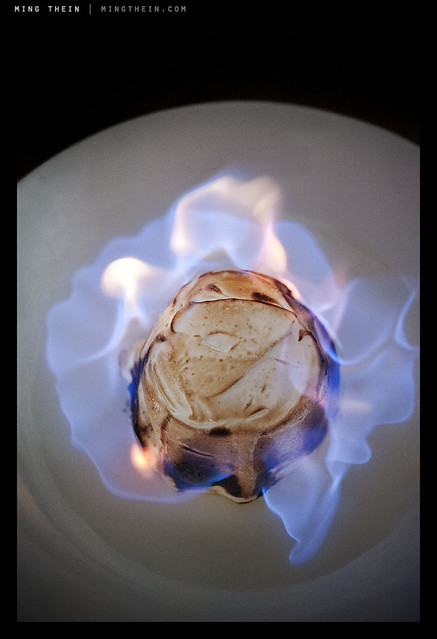
Baked Alaska. Nikon D700, AFS 60/2.8 G Micro

Flames are a funny thing – they don’t photograph well. Simply, yellow flame is bright because it contains a lot of incandescent little particles; usually, it’s too bright to photograph well relative to surroundings – you land up losing detail in the flame if you have context, or losing context if you have detail in the flame. Blue flame is almost impossible to photograph because most of its energy is heat – there isn’t much in the way of light-emitting incandescent particles. Flames are also very random in an interesting fractal kind of way; photographically that means you’ve got to do many, many takes – four Alaskas, in the case of this shot. And dozens of frames until we got just the right flame.

The problem for food photography – specifically baked Alaskas – is that the lit brandy you pour over the dessert burns blue, which isn’t so great to shoot. Sure, you could composite flames in after, but it would both look unnatural and just be dishonest. So what do we do? Simple: add a little something to the alcohol that makes it burn brighter, and a little yellower.

Interestingly, this is where the high ISO capabilities of the D700 become useful: ISO 6400 with a good amount of remaining dynamic range and very low noise. I don’t think this shot would have worked as well with the D800. MT

On assignment: Bistro food

_7060396 copy
This set shot with a Nikon D700, AFS 60/2.8 G Micro and several SB900 flashes.

I’m seeing an increasing shift in my commercial work these days towards food – as a gourmet (or perhaps as a greedy person) I’m certainly not complaining. Interestingly, food photography actually shares a lot of techniques in common with watch photography – with the huge benefit of not having any reflective surfaces to worry about. But from a lighting point of view, it’s the same.

Last week, I shot what was probably my final job with the Nikon D700 – some highlights of which are presented here. The D800 studio update will probably be towards the end of next week due to job scheduling.

I wanted to use this opportunity to say a few things about both food photography, and draw some conclusions on the D700’s use as a studio camera.

_7060499 copy

Food may not have any reflective surfaces, but it certainly presents some challenges of its own: firstly, temperature. Things don’t look optimally appetizing for that long (think ice cream) which means you’ve got to work quickly, and studio strobes are pretty much out of the question because the heat would make anything fresh wilt in less time than your fastest flash sync speed. The solution I’ve found to that is either use low-temperature LED panels or use flashes. For the most part, I use flashes because they’re more flexible in terms of light output deliverable, and have enough power to accommodate larger setups. LED panels don’t have as much throw or power, and go through batteries like crazy. And there are also color temperature issues – so far, very few panels can deliver a relatively even, neutral spectrum – and those that can are both hideously expensive and not all that bright.

_7060545 copy

The next challenge is actually detail: most people don’t want to look too closely at what it is they’re eating. I mean, a steak looks great as a whole, but I don’t think you want to start looking at meat fibers and thinking about exactly what motor function that muscle did when it was still part of the cow; there’s a huge compositional tradeoff between detail, suggestion, and emotion.

_7060248 copy

Bottom line: food images are about emotion: they must make you feel like you want to eat them. The ultimate litmus test for me is: would I want to order the dish if I saw this image in a menu? Lighting is your one control here: both softness and position of the light sources, and less intuitively, color temperature. (I’ll go into this more in a future article).

_7061864 copy

I’m going to conclude with a few words about the D700 as a studio camera. It may not deliver the most resolution, but it does have a few advantages over say a D3x or medium format – providing you don’t have clients that must absolutely have that pixel count. Firstly, there’ the built in flash with commander function – that was the #1 reason why I went for a D700 instead of a D3s, and I don’t regret it one bit. Speed isn’t an issue, but putting an ENEL4a in the MB-D10 grip gives you both speed and an incredible amount of shooting time: I can easily shoot a full day assignment on one battery. This assignment (2,000 frames in total) was completed with 60% power left over on the ENEL4a, and the ENEL3e in the camera still full. Finally, base ISO of 200 gives your speed lights a boost – and even if you don’t need the extra power, it reduces cycle time as well as extending your battery life.

_7061009 copy

Curiously, the internal flash can’t handle more than about a dozen shots or so in reasonably rapid succession before it cuts out to take a breather – unclear whether this is due to the capacitor’s limitations, or an overheat protection system of some sort to prevent your prism catching fire (which would probably be a fatal disaster considering the camera is both touching your face and made of highly inflammable magnesium.)

I’m looking forward to the quality the D800 brings, though I can’t say I’m so enthused about the amount of retouching it will require – especially for watches and other similar product. But for food, bring it on! MT

I will be attending the World Gourmet Summit in Singapore at the end of April to conduct some sessions for Leica; details to come soon. MT

_7060779 copy

Sushi, and the philosophy of photography

_PM07501 copy
Seared Wagyu beef with momeji oroshii.

Sushi is a universe in itself – there are so few components that if you get any one of them slightly wrong, the taste will be horrible. But if you get every one of them right, the experience can be magical. Specifically, your fish must be fresh and in season; precisely the right amount of soy sauce should be brushed on to the top, with a little dab of wasabi hiding between the rice and the fish. The fish itself is cut slightly concave so it drapes perfectly over the rice, itself measured to precisely the right quantity to make a mouthful and shaped by hand, not too tightly packed and not too loose, either.

_PM07411 copy
Katsuo (bonito) with ginger.

And then there’s the seasoning that accompanies the rice – a mix of mirin and rice vinegar – which must offer the right degree of tartness and sweetness to provide a counterpoint to the fish and soy sauce, but not so much that it overpowers or tastes sour. And this is before we even talk about more complicated creations that involve multiple types of fish, or searing, or additional condiments and seasoning.

_PM07492 copy
Broiled anago (freshwater conger eel).

There’s a parallel between sushi and photography (and sushi and many other things, actually) – aside from the obvious that it’s art, sushi making requires both technical skill and creativity. There are constraints, but you can work around them. It can be learned, it can be honed by experience, but there’s definitely an element of talent and intuition involved which all great sushi chefs possess. Photographs and sushi both come in small, bite-sized increments – they require little time to create if all the elements come together, and can be enjoyed in moments or contemplated for hours – I’ve eaten sushi dinners with 20+ different varieties served over many hours; I suppose that would be like going through the Magnum annual. Neither photography nor sushi is cheap, either; and mastery can take years.

_PM07485 copy
Torigai clam.

There’s even an anticipative element to it – the feeling of curiosity before you go to eat (wondering what is in season and came from Tsukiji today) is much like the feeling I get before a shoot; you’re all excited and ready to go. It’s also entirely possible that it’s just me.

_PM07471 copy
Seared katsuo

The best sushi I’ve ever eaten – so far – comes from a local chef in Kuala Lumpur at a restaurant called Hanare; Kenny Yew is an absolute genius when it comes to creating new things – for instance, seared wagyu with momeji oroshii chili – as a sushi. I need to go at least once a month or I get withdrawal symptoms and the DTs, because I just can’t eat sushi anywhere else now. The few lucky friends I’ve taken there feel the same way. It really is art – some of the pieces make me tingly and others nearly bring me to tears. I’ve eaten things there I never would have though edible, let alone ordered – and loved them. That’s much like how certain exhibitions, art or equipment inspire me to try photographic experiments that work out a lot better than expected.

_PM07446 copy
Seared hama-tai (sea bream)

And best of all, you can mix the two. The lighting conditions at that restaurant are pretty horrible, but they save me a seat at the counter which happens to have a halogen spot over it; I position my sushi carefully to be well-lit. This set might appear the same, but that’s because I wanted a consistent point of view; (and comparison)
they were also shot during the same meal. I discovered one other thing that night: the best color I’ve yet managed to achieve is delivered by a combination of Zeiss glass and Olympus cameras.

_PM07395 copy
Oo-toro. (Fatty yellowfin tuna belly)

I had the ZF.2 2/28 Distagon on the Pen Mini via an adaptor, and was utterly floored by the color when I opened up the raw files on my computer – the sushi literally looked like it had in real life. Every bit of the color, texture, iridescence and freshness was captured. I’m guessing it’s a combination of the fortuitous lighting, the great color and micro contrast of Zeiss lenses in general, and the pleasing color palette of Olympus cameras. Whatever it is, I think I’ve found my perfect sushi-camera.

_PM07426 copy
Red snapper.

My parting advice is that if you do get a chance to eat sushi made by a master, do as you would do at an exhibition of photographs by a great photographer: put away your preconceptions, go in with an open mind, and enjoy. You’ll probably be surprised. MT

_PM07424 copy
Kamburi (giant yellowtail).

On Assignment: Diner food

The majority of commercial work I do usually centers on studio work – I wish it was photojournalism, but sadly this isn’t the case. By this, I mean anything where the composition is delicately adjusted to be perfect, lit with controlled lighting – usually flash – and then retouched to perfection. Depending on what you’re shooting, the latter stage can be extremely time consuming (think watches, for instance).

_PM07622 copy Diner reflections in maple syrup. (Lame photographic irony: I used the 20/1.7 pancake on the Pen Mini to shoot a flapjack.) 

Today’s On Assignment was a photoshoot I did last week for a new diner. I originally thought the majority of the food would be shot with the Nikon D700, 60/2.8 G macro and a handful of speedlights. I brought two umbrellas, and four flashes in case I needed specular fill, or one of them failed. Landed using just two. However, the client wanted a slightly different perspective; something more dynamic. The 24/1.4 was useful for a shot or two, but simply didn’t focus close enough for most things. Luckily I’d also packed as backup the Olympus Pen Mini, a couple of LED lighting panels and a full lens set; the 12/2 saved my bacon; it focuses slightly closer than 20cm – to the sensor plane.

_7058190 copy The chef at work.

Food is a tricky beast to shoot. If the lighting is too perfect and diffuse, the food looks flat; if it’s too point-sourced, you get reflections off the little bits of oil and uneven surfaces that is, by its very nature, food. The trick is you need to use a mix of both; or use an imperfect diffuser (I consider an umbrella to be an imperfect diffuser).

_7058007 copy Big breakfast

I don’t know how many people know this, but the vast majority of food you see in photographs is not edible. What does that mean? Well, I know some menus in Japan are shot using plastic food as props; I’m not talking about that. To get food to look the way it does, there are often some cosmetic tricks – healthy applications of water and olive oil, for instance; or using colored mashed potatoes for ice cream to prevent them from melting; sauces aren’t necessarily accurate, just made of something from the right consistency and color to stop them from migrating where you don’t want them to go when repositioning the plate, for instance. There are other tricks, but I’d have to kill you if I told you. 🙂 This used to be the preserve of the food stylist, which has become a dying profession – there are precious few left, and to be honest, I prefer not to use one. I do dabble in cookery occasionally, which helps me to understand the objectives/ focus of a dish; this in turn helps me to ensure I capture the right elements to present it. I’m happy to rearrange things as required, but usually what I prefer to do is work with the chef to ensure he or she is happy with the presentation: after all, it’s their food; if it doesn’t look right to them, then chances are the end viewer won’t be getting the right impression, either.

_7058402 copy
X burger

I did discover something on this shoot though: the LED panels, which I thought would be useful for macro work (and are only good for model lighting) are actually great for food; they run cold, which keeps things fresh and not wilted; they’re adjustable in continuous steps, and you can instantly see what the effect of the light looks like – the only catch is that to get a large diffuse source, you need to either put them close or use lots of them, and that gets expensive. But I could see myself picking up another couple for future jobs. MT

_PM07590 copy
Chili con carne glow

_7058192 copy
Seasoning