Film diaries: A quick introduction to Hasselblad V-series cameras

_5015926 copy

Since acquiring and shooting with my 501C, a lot of my readers, students and photography friends have been asking for more information about these beauties. I certainly don’t claim to have the depth of knowledge of some of the longer-lived collectors or photographers, but what follows is a (hopefully) handy collation of what I do know, from the point of view of the practical photographer.

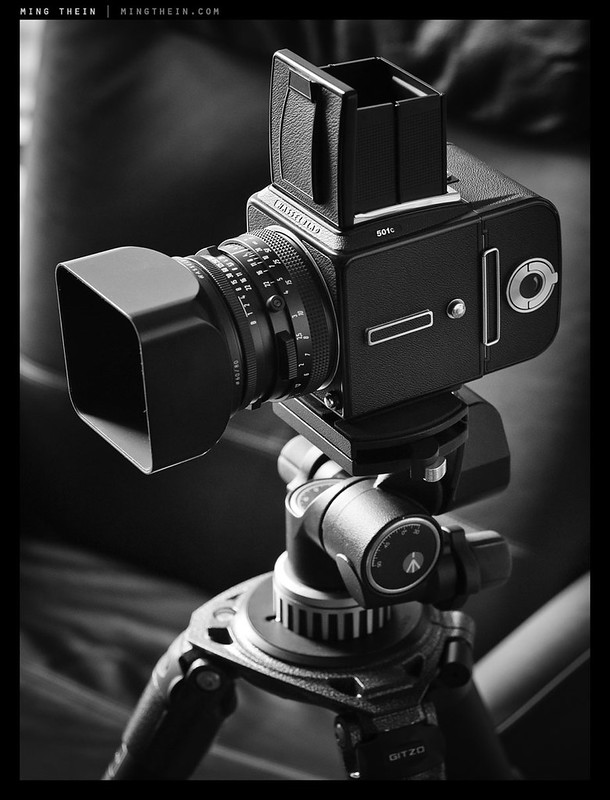
The Hasselblad V series is a system camera: that’s to say that lenses, bodies, finders, backs and other general accessories are interchangeable. The body contains the reflex mirror, film winding mechanism and secondary shutter only, plus a way of triggering and rewinding the leaf shutter in the lens, of course. Lenses of various vintages can be used on all bodies, with varying degrees of functionality. Flash sync terminals – PC sync – are in the lens, since this is triggered mechanically by the leaf shutter. Several types of backs are available, including digital and polaroid (rare) options; the same goes for finders. The ‘classic’ configuration is an 80/2.8 lens, collapsible waist level finder and A12 film back.

Bodies
Generally, for a shooter, you want to look at buy the 500-series (also known as the V series; includes 500, 500C, 500C/M, 501, 501C, 501C/M, 503CW, 503CX etc). The C means that it uses C-mount lenses which have built in leaf shutters (first Synchro-Compur and later Prontor); anything with /M means upgraded/ modified. The bodies contain the mirror, winding mechanism, and a secondary shutter to prevent light leaks. A nice user is better than a safe queen that’s never been exercised, because you must remember the whole thing is mechanical. Later versions have TTL flash metering and electronic coupling. I would go for either a 501CM or 503 of some description; the 500s are older. Mine is a 501C and dates to 1995; I also have a 1999 501CM. The 501CM and 503CW have upgraded mirror geometry that doesn’t black out at the top portion when used with longer lenses or extension tubes. The electronic 553 and 555 bodies have built in motor drives, but are bulky and eat batteries for breakfast. I think fully mechanical is the way to go; partially because of long-term reliability (gears can be fixed; small-volume electronics is often unrepairable without spares). There are also tilt shift bodies (ArcBody and FlexBody), and a super wide viewfinder camera – the 900 series (903 SWC, 905 SWC and earlier SWC and SWC/M), which has a fixed 38/4.5 Biogon but takes standard backs. Finally, we have the 200-series bodies – these have a built in focal plane curtain shutter that requires batteries to run, but permits much higher (1/2000s) shutter speeds and faster (generally by a stop) lenses; they share the same mount as the regular V series, and V series lenses can be used if the shutter speed is locked to the F position, but not the other way around – the V series require a shutter in the lens to operate, which the 200-series lenses lack.

When testing a body, the winding action should have some springy resistance, and the shutter action should be snappy – the mirror should get out of the way fast, and stay there; same goes for the secondary shutter curtains at the rear of the body. Note that the mirror doesn’t come down again until the camera is rewound. You can check mirror alignment by turning the lens all the way to infinity: find a suitably distant subject and check that it is indeed in focus with the magnifier. (The lenses have hard infinity stops.) Needless to say, there should be no loose or rattling parts inside. Check also that the lens drive shaft on the mount turns when you release the shutter and wind the crank, and that the vertical gear on the right also winds with the crank – this advances the film. Finally, the little lever that protrudes from the body on the bottom right where the back mounts should also be sharp and not worn – this advances the film status indicator.
_5015921bw copy

Related bodies
The ArcBody and FlexBody are two V-mount bodies that also take the same A-series backs and accessories (but not finders); these have bellows or bags in the middle that permit some technical camera movements; noticeably shifts and tilts. In some ways, they’re miniature view cameras. The ArcBody is primarily geared towards shifts; it has its own accompanying set of Rodenstock lenses and is ideal for architectural work. The FlexBody is mainly for tilts, and DOF control/ product photography or landscape. Personally, if I do move over to medium format for my work, I’d be looking at one of these – they also accept digital backs. Note that both are relatively uncommon and seriously expensive.

Lenses
The type you want to go with the V series are C T*, CF T*, CFE T* or CFI T* lenses. The earlier C (non T*, i.e. no fancy coating) lenses work too; they’re cheap but low contrast and relatively high flare. The T* lenses denote optics with the Zeiss T* coating – their rendition and performance is much like the modern ZF.2 series. They all also have long back focus distances, so you can mount them on your SLRs too – though the resolving power may not be as high as the latest 35mm optics.

CF lenses are the best bang for the buck. They have coupled aperture/shutter speed rings (with the exception of the 80/2.8 CF T*) and upgraded shutter mechanisms; CFE and CFI lenses are later models with electronic coupling and are several times more expensive than CF, often for no particularly good reason. The bodies almost always come with the standard 80mm – it has a similar diagonal FOV as a 50mm on 35mm, but you have to remember it’s a little bit different because you’re comparing square to 3:2 aspect ratios. The good lenses – all CF or higher – are the 40/4 Distagon FLE, the 50/4 Distagon FLE, the 80/2.8 Planar, 120/4 Makro-Planar, 150/4 Sonnar and 180/4 Sonnar. These are roughly 24, 28, 45-50, 85, 100 and 120 equivalents. The FLE lenses have a separate correction ring for optimising close-range performance.

Note that the tip of one of the shutter blades may appear bent in the lens; this is a design feature to prevent catching at high shutter speeds. The shutter action of a lens should be snappy and crisp; the slower speeds tend to be where there are problems, so it can be beneficial to test the 1/2 and 1 second speeds with a stopwatch to get an idea if they’re roughly within spec. A slightly metallic noise when changing shutter speeds is normal, especially if you are traversing large ranges of shutter speeds – this is just the internal springs changing tension. Be very, very vigilant for broken drive shafts – these cost a fortune to fix!

One final note on lenses: they require bayonet filter adaptors (designated B-something) which allow you to mount standard screw-in filters. I suppose this is for ease of changing in case the threads get munched up, but it can be a pain if you’ve lost the bayonet ring. Fortunately, they take mostly standard sizes – except for the 4/40 Distagon, which requires an enormous 93mm (!!) filter.

_5015930bw copy

Backs
Three main kinds: A12, A16 and A24. There’s also an A70 bulk rolling back – it has a 200-shot capacity. The number denotes # of shots; A12 and A16 work with 120 film, and A24 works with thinner 220 film; it has no paper backing for twice the number of shots. Note however you can’t buy 220 film here anymore (update: I did see fresh Provia 100 in 220 at Yodobashi in Tokyo in November 2013), so it’s kinda useless – don’t buy an A24. You can load 120 film into an A24, but the difference in length means that it won’t wind or count frames properly. Just avoid it. The A12 is the standard back and gives 12 6×6 shots on a 120 roll. The A16 is a 645 back that gives 16 shots per 120 roll, but requires a separate viewfinder mask to show only the 645 film area – this should be included if you plan to buy an A16. Note that it’s not very practical because shooting a waist level finder in portrait orientation is nearly impossible. Backs should come with dark slides – the little piece of metal that goes between body and back – if you don’t have this, you can’t detach the back. It’s to prevent light leaks when interchanging backs – the ability to do this mid-roll is one of the huge strengths of the system. Buy multiple backs to make the most of this. Note: some sellers will note ‘matching numbers’ which means the roller mechanism inside’s serial # matches the housing – it doesn’t make any functional difference, but it does seems to affect prices quite a bit. If you’re going to use it and not collect it, it doesn’t matter.

You might see something called a ‘Lindahl dark slide holder’ mentioned – this is a clip on that goes on the back of the back (really) that holds your dark slide while you’re shooting. It’s functionally useful, but I personally think it looks ugly because it spoils the lines of the camera. A better solution is just to tuck the dark slide into your wallet.

There are also many digital options, both from Hasselblad (the CFV series backs) and other manufacturers. Note that none of them make a true 6×6 back; there’s always some crop factor involved. The earlier CFV and Phase backs did have square sensors, but these were 1.5x crop, 37x37mm affairs that were much like using FX lenses on a DX body. The newer backs – CFV-39 and CFV-50 – use 645 aspect ratio sensors in a 1.1x horizontal crop, and a 1.5x square crop. They are accompanied by viewfinder masks that I personally find very confusing – much like trying to compose with an overlaid tennis court. Note that some backs have sync issues with purely mechanical triggering, especially if your shutter mechanism is a bit worn. The solution is to use the PC sync cable off the lens to synchronise it with the back, but this can result in issues like worn terminals from frequent lens changes, and lack of anywhere to hook up your flash.

_5015925bw copy

Finders
There are two kinds: prism and waist level. Waist level is the collapsible, left-right reversed type with a built in magnifier. It’s the standard finder. Prism finders come in metered (PME-x) flavours and unmetered flavours (PM3, PM5). It’s basically an enormous SLR finder, but in 45 degree and 90 degree (the later PME-90) flavours. They’re all interchangeable, once you take the back off. Note that the prisms are meters only, and do not transfer the settings to the camera – you still have to do that manually.

Metering
Unless you have a metered finder, the cameras are fully manual and unmetered. This means using a trained eyeball, or getting a meter prism; otherwise, the simplest solution is to use a compact camera in aperture priority mode with spot meter set. Match apertures and ISO, then transfer the shutter speed reading to the lens. Important note: if you’re using a compact, I’ve found that the Hasselblad requires half a stop to a stop less shutter speed than the compact for the same exposure (i.e. if the compact reads 1/100s, the ‘blad will use 1/150-1/200s). This is partially due to the tonal response characteristics of film, and partially due to the transmission properties of the lens: T* coated V lenses have a T stop very close to their physical F stop, whereas compacts usually don’t because of inferior coatings or complex designs with large numbers of elements.

Pricing
This is perhaps the most sensitive/ subjective topic here, but to give you an idea – a solid user condition 500CM, waist level finder, 80/2.8 CF T* or C T* and A12 back should run under a US$1,000. Price varies depending on variant and condition, of course. Later models like the 503 series will of course cost more – sometimes considerably so. That said, I still find it pretty amazing that you can buy a camera of this quality at little more than the price of a consumer DSLR kit – and you can be sure that the ‘Blad will outlast you, and probably your children. I don’t know what happened to the millions of 300D Digital Rebels they made, but I suspect that most bit the dust a long time ago.

Important notes:

  • The shutter should be stored in a cocked state, i.e. wind the back after every shot.
  • VERY IMPORTANT: DO NOT MOUNT OR UNMOUNT THE LENS IF THE SHUTTER IS NOT COCKED. The drive shaft for the lens (to cock the leaf shutter in the lens) can break if it is not in the correct orientation.
  • The dark slide needs to be inserted before removing the back
  • The dark slide needs to be removed before shooting (shutter button is blocked)
  • When you shoot, hold down the shutter button – do not release it immediately after pressing. The secondary curtains in the body only stay open as long as the button is held down.
  • Don’t lose or bend your dark slides; you won’t be able to insert them, and without the dark slide in, you can’t remove the back, and there’s nothing to block the shutter from firing accidentally in a bag. Get spares, if you can.
  • Always wind the camera before attaching a back – if not, when you wind it, you’ll lose a frame. The right procedure for assembling a camera is 1. wind body; 2. attach lens (check that the little slot in the lens’ mount lines up with the dot, if it doesn’t, use a coin or screwdriver to turn it in the direction of the arrow – this is to cock the lens shutter); 3. slide in finder of choice; 4. load and attach back – this is a whole separate section on its own.

I’m now wondering how many of you are going to give it a try…MT

The best place to find vintage gear is on the secondary market in Japan – send an email to Bellamy Hunt of Japan Camera Hunter; he can source to spec and budget. I get a good chunk of my stuff from him and can’t recommend him highly enough. Send him an email and tell him Ming sent you!

____________

Enter the January 2012 black and white challenge – win a multispectral Sony NEX-5 B&W machine modified by yours truly!

If you enjoyed this post, please consider supporting me via Paypal (mingthein2@gmail.com). Visit our Teaching Store to up your photographic game – including Photoshop Workflow DVDs and customized Email School of Photography; or go mobile with the Photography Compendium for iPadYou can also get your gear from Amazon.comhere. Prices are the same as normal, however a small portion of your purchase value is referred back to me. Thanks!

Don’t forget to like us on Facebook and join the reader Flickr group!

appstorebadge

Images and content copyright Ming Thein | mingthein.com 2012 onwards. All rights reserved

Film diaries: Picking a camera

_D90_DSC4146 copy

If my recent forays into the whys and hows of film have gotten you curious enough to try it (or revisit it) yourself, the next question you’ll probably be asking is also the one that’s natural for all photographers: which camera should I buy? Fear not: it’s a pretty simple question to answer, and the best thing is that there are two enormous advantages that film has over digital in this regard: image quality, and price.

What? Image quality? Specifically, consistency: cameras that shoot the same format are capable of producing comparable results, assuming there aren’t huge deviations in the lenses. Grain, color etc (note that I didn’t mention sharpness or resolution here, because that is lens-dependant) of course depend more on your film type than your camera; an enormous Nikon F5 will give you the same noise level as a compact Olympus Mju II if loaded with the same film. (Of course, you may get different results under the same shooting conditions, given that you can get an f1.4 lens for the Nikon, but you’re stuck with the fixed 35/2.8 on the Olympus.)

I mentioned two advantages: the second has to do with price. These days, outside of Holga (and similar Russian equivalents) and Leica, there are almost no 35mm film cameras still in production and available new. This means that you’re going to be buying on the secondary market; it also means that there’s relatively little financial risk involved in buying a camera, trying it, and then reselling it if it’s not to your liking – not something that can also be said for anything digital. Couple that with the fact that prices appear to be at an all-time historical low* and it’s very much a buyers’ market. I don’t know how much longer this is going to continue, though.

*The aforementioned Nikon F5s are going for a song these days – remember, the F5 was Nikon’s flagship back in the late 90s: the D4 equivalent of today, and priced in the same ballpark, too.

Whilst it’s almost a given that we’ll never again see a similar proliferation of high end film cameras as we did in the late 90s or early 00s, the good news it that most of these were made in sufficient numbers that there still both relatively easy to find and affordable – limited editions aside, of course. That period in photography represented what I like to think of as the height of the Goldilocks camera: compact, full-frame 35mm cameras that were pocketable but uncompromising on optical quality or control; something which is only now being approached with the likes of the Sony RX1, and even that still doesn’t quite get the formula right: it’s more electronic gadget than proper camera. In some ways, we appear to have regressed.

Before I examine some of the more interesting options available, there are a few things to bear in mind when hunting for a film camera:

  • Format: realistically, 35mm or 120?
  • Age: the older the camera, the more likely it is to a) break and b) be difficult to repair. There are of course exceptions to this rule. Although modern electronic cameras (under 10 years old) are more likely to be in perfect working condition, older mechanical cameras are more likely to last – simply because a spring or lever can be re-fabricated fairly easily, a chip or circuit board can’t. It’s probably also safe to say they were better made back in the day…
  • Usability and ergonomics: I was lent a Rolleiflex by a friend: I still haven’t used it because I’m not sure how to load it, and neither is he. Awkward controls, difficult loading, beware. I’d add any model-specific quirks to this category, too.
  • A slightly marked, well-looked after and regularly-exercised user is probably a better buy than a 40 year old safe queen or photojournalist’s beater; especially with mechanical cameras, you want something that’s been regularly exercised; lack of use is just as bad for mechanical cameras as abuse. Such cameras are also likely to be more reasonably priced than perfectly mint examples. Think of it as a vintage car that’s never been driven: I don’t know about you, but I’d probably send it for a complete overhaul before taking it out on the road.
  • The lenses matter, much more so than digital: you can’t realistically sharpen or add contrast or correct color; otherwise you might as well be shooting digital, it’s just easier.
  • Somewhat tangential, but almost all mechanical cameras should be stored with the shutters uncocked to avoid weakening the springs; the one notable exception are the Hasselblad V series, which should be cocked – otherwise you won’t be able to remove the lens without breaking the leaf shutter drive shaft, plus you’ll lose a frame if you cock it after mounting a back.

Let’s break things down into a few categories to make it a bit easier. Note that I’m going to ignore Lomos and the like for the most part to focus on serious photographic tools; they’re both unmetered and have almost zero manual control, so I don’t consider them serious photographic tools. (In any case, I’m guessing you probably wouldn’t be reading this blog if that’s what you were looking for…)

_8027250 copy

35mm compact
There are a lot of great choices here: interestingly, none of them seem to have come down much in price from when they were new; or if they did, I missed the slump and subsequent rise. I think the market is recognizing that these cameras were both the pinnacle and end of an era. In this category, the best picks as shooters are all fixed with moderately wide lenses and mostly pocketable. At 40mm, there’s the Leica CM; 35mm gives you the Nikon 35Ti, Contax T2/ T3, Yashica T4 (the T2/3/4 have Zeiss lenses; the T3 even has synthetic sapphire viewfinder windows to prevent scratches), Konica Hexar AF, the Olympus Mju II (also known as the Stylus Epic), and if you don’t mind something a bit older, the Rollei 35S, Minox 35GT and Olympus XA/ XA2. The Mju II is even splashproof. Going wider, at 28mm we have the Ricoh GR1/GR1s/GR1v; Nikon 28Ti and Minolta TC1. Even wider still, there’s the Ricoh GR21 at 21mm. If you’ve got friends in Japan, Fuji made a limited run of Natura cameras with a fixed 24/1.9 lens – the fastest and widest available in a compact.

Note that all of these cameras were high-end products, and are built accordingly. They’re pleasant to handle, have (often very nice) built in viewfinders, fast, high-quality lenses, and some degree of manual override; usually aperture priority, exposure compensation and sometimes also zone focus. They all meter accurately enough to shoot slide film with, though I suspect none have spot meters, sadly. Almost all of them have little gremlins and foibles, too – the GR1 is notorious for LCD problems, for instance; the CM had electronic issues, and the T3 has idiotic settings that revert to defaults every time the power is cycled. Some Minox 35s use mercury batteries that are no longer available. Oh, and the Rollei 35s are upside down: the wind lever is on the bottom of the camera.

You’ll notice I haven’t suggested anything with a zoom: this is for good reason, because zoom lenses on compact cameras have horribly slow apertures – I think the worst I’ve seen was something like f8-f13. That means you’re stuck using flash all the time, and you can be almost certain the optics are a very poor compromise.

Expect to pay anywhere up to $800 for a nice black Contax T3 or Leica CM at the high end, down to a few bucks for a beaten up Mju II at a garage sale. My favorite of the bunch, the Ricoh GR1v, runs between $400-600 depending on condition.

_D90_DSC4124bw copy

35mm rangefinder
If anything, this is an even broader field than the compacts: you’ve got the Leica Ms and Barnack cameras, Voigtlander Bessas, Konica Hexars, Yashica Electros, Canon Cannonets, Nikon S’ and Zeiss Ikons – and that’s just some of the manual focus options available – not to mention of course the Contax G series, which had autofocus. Most of these also have the benefit of interchangeable lenses; a lot of them are also Leica M or screwmount, which means they can be used even on modern digital versions like the M9 and M Type 240. This also means that used lenses aren’t always cheap – and they almost certainly aren’t up to the quality of modern glass.

With the exception of the Leica MP, M7 and Voigtlander Bessas, the rest are out of production – even the Ikon was discontinued recently. The electronic models suffer from potential battery availability issues, as well as limited replacement parts should something go wrong; the earlier mechanical models have become very collectible and commensurately priced. I doubt you’ll find anybody buying a mint condition original Nikon SP to shoot with.

The obvious choice here is a Leica M of some description – M6es are a good place to start; they’re reasonably priced in the US$1,000 range, relatively modern, still serviceable, and have a meter. They do have a known rangefinder flare issue that made the RF patch difficult to see under some lighting conditions; modifications to later versions solved this. The M7 adds aperture priority but requires batteries to operate; personally, the MP would be my pick – fully manual, wonderfully tactile, all speeds work without batteries, but you do have the benefit of a meter if you’re not sure. Avoid the Bessas unless you shoot wide – the rangefinder base length is too short to accurately focus very fast or telephoto lenses; but they are the only cameras with built in 21mm frame lines (Bessa R4M). The Yashica Electros are interesting budget options, but note that they have fixed lenses and non-TTL meters; this is probably only important if you’re shooting slide film.

If you’re particularly masochistic, you can try a screwmount Barnack Leica (I, II, III and variants) – it’s not for everybody. Slow shutter speeds are on a separate dial; the rewind crank is a stiff knob, and you have separate (and tiny) viewfinders for focusing and framing; also, the only built in frame line is 50mm – everything else requires an external finder. They’re very nice cameras as engineering objects and vintage objects, but a total pain to shoot with.

The final interesting option is the Contax G series; they were offered with a set of excellent Carl Zeiss AF lenses, have unique zoom finders (rather than variable frame lines, as with the Leica Ms) and seem to be pretty much the final evolution of the rangefinder; in many ways, they remind me of an interchangeable lens version of the high end T series compacts.

_6001494 copy

35mm SLR
If anything, we’ve got even more choices here. The confusing part is that some of the newer, cheap entry-level AF SLRs are very competent indeed, and are probably more camera than one needs. I’m talking about things like the Nikon F55 (N55 in the USA) – not particularly nice as an object, but will get the job done, and coupled with say a cheap AF 50/1.8 D, capable of providing some excellent output – afterall, it’s the optics that make all the difference. I realize that there’s no way I can provide a rundown of even the major cameras in this category, so instead I’ll single out interesting options. The F55-class would not be my choice at all: though cheap, frankly, they’re nasty to handle, and a load of cheap-feeling plastic isn’t the kind of thing that inspires one to get out and shoot.

Since these are system cameras, the primary consideration will be lenses: what’s available, and at what cost? Systems with longevity – Nikon F and perhaps to a lesser extent, Pentax K – are the best choices here. Not only is excellent glass still available, chances are you’ll probably already have some. The reverse is also true – AI/ AIS lenses are still relatively easy to find and not too expensive on the secondary market, and will work just fine on most of the midrange and higher DSLRs. I can use the same excellent Carl Zeiss ZF.2 lenses on my D800E and F2 Titan – despite a 40 year age gap between the cameras. Note that the modern Nikon electronic-only G series lenses will not work fully on anything earlier than the F5.

In the Nikon stable, the F series and FM series are the ones to go for – not only were they constructed as befits the flagships of the day, they’re also reasonably cheap, easy to fix, and easy to find – for the most part. The original F is probably not the best shooter because of its removable back and (most cameras) lack of metering; it’s also not very ergonomic and has an oddly-placed shutter release. I like the F2 a lot, both because I’m biased towards it as my first serious foray into film, and because apart from the FM series, it’s the only F that is fully functional without a battery. The F2 is available in metered and unmetered versions; fortunately the latter is a lot easier to find than the former, and oddly, cheaper, too. The K screen is ideal for focusing – it has a microprism ring and split prism, as well as wonderful focusing ‘snap’. A user in nice condition user will set you back no more than $300-400 or so, but prices range into the thousands if you want a mint condition Titan. Just check the foams (mirror, back) and shutter speeds, because remember: these are entirely mechanical cameras. The timing system – especially for the faster 1/2000 speeds – functions much like a mechanical watch. Watch out for any slack in the rewind crank or hesitation at slower shutter speeds.

Personally, I’d avoid the F3 and F4 because they feel too much like transition cameras; you get some of the odd ergonomic holdovers from the mechanical era without the full integration of electronics. The F100 is very much a mini-F5, and much lighter and less battery-hungry too, though it won’t do 8fps. I personally like the F5 anniversary because of its titanium prism, and the F6, because in many ways it is and was the ultimate film camera ever made – and almost certainly the final incarnation in the line. Interestingly, all of the Fs – even the electronic, motorized ones – have a mechanical rewind crank so you can get the film out in case you run out of power. Of course, with the F2 and and it siblings, power is never an issue – I suppose that’s one of the joys of shooting with one of these cameras; I know it’s almost certainly going to outlast me.

The FM3A gives you the benefit of both mechanical shutter speeds up to 1/4000s (without batteries even), as well as aperture-priority and match-needle metering if you do put a battery in. It even has backlight compensation and AE-lock, in a smaller and lighter body than the unmetered F2 – though admittedly, it simply doesn’t feel as nice in the hand. These are not cheap on the secondary market, and sell for pretty much their original retail price – around US$700-800 or so for one in excellent condition, or ~$450 for a beater.

There are a few other interesting systems worth mentioning: notably, Canon FD. Canon abandoned all of its legacy users with the shift to EOS in the 80s; as expected, resale value for these cameras and lenses fell through the floor. A friend recently picked up an excellent+ condition AE-1 Program and two lenses for about $50 – granted, the cameras have some operation quirks, but if you can get used to them, are of course capable of delivering great results. And L glass from the FD era is both good and cheap.

I’ve always been intrigued by the Contax RTS system with it’s Zeiss lenses (this particular C/Y mount series of optics are very popular for conversion amongst filmmakers due to their look) and of course the Leica Rs; but the relative expense and difficulty in obtaining spares and accessories is somewhat off-putting. Better to buy into a familiar, cheaper system and spend the rest on film…

_5015917bw copy

120 (medium format) SLR
Though there are quite a few options in this category, the main contenders are of course the Hasselblad V and Pentax 645/ 67 systems; the former represents the higher end of the market, and the latter the lower – but we’re talking relative pricing here, as a nice Hasselblad 501C kit with waist level finder, A12 magazine and 80/2.8 will probably go for around the US$1k mark. Pentax 645 or 67 beaters can be found below $200. There are also the Mamiya RB/ RZ systems, Rollei SLX etc. but these are comparatively rarer, with the latter being quite pricy. It’s worth noting that there are Russian (Kiev) or Chinese clones for most of these; some of the parts are even interchangeable with the originals (Hasselblad prisms, notably). I make no secret of the fact that personally, I love my Hasselblad 501C – look for a future article on an introduction to the Hasselblad V system. It’s the only one of these options that can accept digital backs (though there’s a digital version of the Pentax 645 – imaginatively, the 645D.)

It’s worth noting that almost none of these cameras can be shot handheld unless you’ve got astronomically high shutter speeds or hands of stone, because the mirror slap is enormous – if you really want to make the most of the large negative, you’ll need a sturdy tripod and low-ISO film; then prepare to be surprised by the tonality and detail of the negatives, even if you’re a DSLR shooter.

120 (medium format) TLR
Your only two real options here are either a Rolleiflex of some description, or a Segaull; I wouldn’t personally go for either. There are a lot of disadvantages with TLRs – parallax, size, non-interchangeable lenses, potential alignment/ calibration issues – and only one advantage: almost no shutter vibration thanks to leaf shutters and no mirrors/ focal plane shutters, which means that the cameras are hand-holdable to very low shutter speeds. Expect to pay $1-2k for a clean Rollexiflex, or a few hundred for a new Seagull.

120 (medium format) rangefinder and compact
Here’s an interesting segment: you can still buy a lot of these cameras new. Fuji still makes both medium format rangefinders – notably the GF670 normal bellows rangefinder (which also has a Voigtlander counterpart) and the wide GF670W – as well as fixed lens, autofocus ‘point and shoots’ (GA645 and variants). They’re not small, but they’re not as bulky as the SLRs or TLRs, either. And they’re fun to use. The rangefinders have fixed lenses, and run in the $2k range; the GA series are more like $600-1k depending on condition. There’s also the older GSW series – available in 670 (6×7 negative), 680 (6×8 negative) and 690 (yep, you guessed it, 6×9 negative) flavors. They all have fixed lenses, though their predecessors – the G series – had interchangeable lenses. Expect to pay something in the $500 region for one of these.**

**Trivia: these cameras came to be known as the ‘Texas Leicas’ due to their similarity in appearance, but considerably larger size and cruder finishing.

The other major option are of course the Mamiya 6 and 7 series rangefinders. The Mamiyas are electronic, leaf-shutter (read: low vibration) cameras with some slight differences. The 6 shoots a 6×6 square negative, and allows collapsing of the lens into the body to save space; the 7 drops this feature, but produces 6×7 negatives and allows the use of a 43mm ultrawide lens. These are reputedly amongst the best lenses available for medium format, thanks to their conservative apertures and short back focus distance. Unfortunately, they’re also costly: the bodies run in the $1200-1600 range, and lenses are easily another $1000 or more apiece. 43 (for the 7), 50, 80, 150 and 210mm lenses were available. One interesting design feature is the use of a polarized viewfinder to enhance contrast, and thus improve ease of focusing.

On a closing note, the Plaubel Makina might also be worth a look – a collapsible-bellows rangefinder producing 6×7 negatives, equipped with Nikkor lenses – legend has it that after developing the camera, there was no money left over for the optics. Not a bad thing in this case, if you ask me. The downside is that these cameras have become quite collectible, and aren’t cheap – $1800 for a beater, to $3k and upwards for a mint one.

Large formats: 4×5″ and upwards
I’m not even going to go there.

Well, there you have it – film cameras in a nutshell. Personally, I’m shooting with a Hasselblad 501C, Nikon F2 Titan and Ricoh GR1V – what I consider to be a representative spread of the genre, cameras that are beautifully engineered objects, and (perhaps with exception of the GR1V) something which I hope to be enjoying for some forseeable time in the future. Unlike the current crop of DSLRs and compact digitals, there’s a very tangible tactile pleasure to using these cameras – I just don’t the same sort of emotional connection with my digital tools as I do with the fully mechanical vintage film cameras; I can only hope that some of the current manufacturers eventually understand how important this is. In the meantime – there’s no reason not to enjoy the secondary market. MT

____________

Enter the January 2012 black and white challenge – win a multispectral Sony NEX-5 B&W machine modified by yours truly!

If you enjoyed this post, please consider supporting me via Paypal (mingthein2@gmail.com). Visit our Teaching Store to up your photographic game – including Photoshop Workflow DVDs and customized Email School of Photography; or go mobile with the Photography Compendium for iPadYou can also get your gear from Amazon.comhere. Prices are the same as normal, however a small portion of your purchase value is referred back to me. Thanks!

Don’t forget to like us on Facebook and join the reader Flickr group!

appstorebadge

Images and content copyright Ming Thein | mingthein.com 2012 onwards. All rights reserved

Film diaries: thoughts on the viability of film in the digital age

_8026176bw copy
Closet abstractions. Hasselblad 501C, 80/2.8 CF T* on Ilford Pan F

I’ve had several experiences with film. In what I consider to be my pre-photographic days, we’d shoot it on occasions for documentary purposes or while on family holidays; I took it a bit more seriously (i.e. shot a bit more) when I purchased my own camera – small was good, so I went for APS – and then discovered how horrendously expensive processing was. During my first trip to Japan in 2001, I shot eight or nine rolls of 40 – which was a huge number of images. I still remember being asked by my family – ‘why are there so many photos without people in them?’ To be honest, the processing cost turned me off just as much as the annoyingly large gap between what I saw in the scene and what came out in the prints – of course at that point I had no idea that the type of film mattered just as much as the chemistry and the printing process.

Skip to 2004, shortly after my first DSLR, I purchased a Nikon FM3A – which I couldn’t really get the hang of, and subsequently traded it in for a 12-24/4 (oh, the regret). 2005 saw another dalliance with an F2A and slide film, whose colours and visual punch I enjoyed, but whose costs I didn’t – I think at one point I was spending nearly $1,000 a month on film and processing. I did learn a lot about nailing exposure, though. Later followed an M6TTL in 2009, which I embarrassingly mis-loaded on the second roll and didn’t produce any images; I cleared the balance of film in my fridge and then gave up shortly thereafter. Here we are now in early 2013, and I’m now regularly shooting most of my personal work in black and white with a Hasselblad 501C, Nikon F2 Titan and Ricoh GR1V.

There are a few things to think about before considering film as a medium: firstly, availability of media and processing; secondly, your output medium; thirdly, your workflow; finally, limitations. I’ll cover these one by one.

Availability of media and processing

Film is very much not dead. Whilst Kodak seems to be disintegrating and continually pruning its offerings, at least its popular Portra and T-MAX are still available in various flavours. Fuji and Ilford have maintained a decent selection. I think Agfa still makes a few types, too. There’s also a lot of cheap film out of China – the infamous ‘Lucky’ brand, whose name perhaps refers to the quality of one’s results – which is good for experimentation and learning. Although it’s not as easy to get film these days – chemists don’t stock it, nor do popular tourist attraction kiosks, or even most camera shops for that matter – it isn’t that hard, either. Here in Kuala Lumpur, I’ve watched as over the last five or six years, I’ve gone from being able to buy Velvia 50 from most mass market camera shops to nearly being unable to find it at all.

Processing is probably more of an issue. There are only a small handful of decent pro labs left in Kuala Lumpur; to be honest, the results from even these places are a pale shadow of their former selves, and they weren’t even the best of the bunch back in the day. Realistically, this means that unless you have access to a decent local lab, or don’t mind mailing your films out for processing – with all of the risks that entails – you’re going to have to do it yourself. For black and white, this isn’t so hard. E6 (slide) and C41 (colour negative) films are going to be a bit more challenging as they’ll require several chemical baths at very specific temperatures.

_8026171bw copy
Finding balance. Hasselblad 501C, 80/2.8 CF T* on Ilford Pan F

Workflow

Assuming you have some way to convert your exposed film into clean negatives, the next step is output: whilst you can project slides, you certainly can’t do the same with negatives, and thus either printing or scanning is required. Minilab prints these days – assuming you have a local minilab at all – are not optical. The negatives are scanned digitally and printed on your 4×6″ or 5×7″ using a dye-sublimation printer; (this is just one of the reasons why the negatives are often much better than the final prints) those files are available on a CD if you want – but note that even at 300dpi, you only need 1200×1800 pixels to make an excellent 4×6″ – most of the time, it’s going to be even less than this to increase throughput. Getting proper digital scans or optical enlargement prints is certainly an option – but both have been relegated to the realm of the specialist, with the expected accompaniment in pricing. A drum scan – again, if you can find a lab that will do one for you – costs about $40 per roll of 35mm, at least in this part of the world. Even the mail-order scanning businesses that have sprung up in the ‘States mostly use film scanners like the Nikon Coolscan or a dedicated flatbed with a lamp in the cover.

Although optically enlarged prints are probably the best way of appreciating your images, it’s simply not practical most of the time unless you plan to do it yourself. I admit that since I started shooting film again in December, I’ve not made a single optical print – firstly, my wife would kill me because of the chemical smell in the house, secondly, I don’t have an enlarger.

There is good news, however. Digital has brought most people DSLRs; couple with a good relay lens – a flat-field, high-resolution short focal length macro is ideal- these are actually ideal copying devices. 35mm film doesn’t have more than the equivalent of about 8-10MP of information; this means that pretty much any DSLR today will out resolve film. (Something like a D800E is positively overkill, but it does do a wonderful job with medium format negatives.) You can either buy a slide copying adaptor that simply screws on to the filter threads of your macro lens – perhaps with an adaptor ring or two in-between – or if you’re industrious, build yourself a stand to hold the camera perfectly perpendicular to the film you’re copying, with a diffuse light source underneath to light it. I use my macrophotography lightbox and a jig made out of Lego that clips on to the end of either the Zeiss ZF.2 2/50 Makro-Planar, or the Nikon AFS 60/2.8 G – depending on how lazy I’m feeling on the day.

Converting your DSLR ‘scans’ to output should be relatively easy. A little Photoshop action can be made to convert the negatives into positives, with the right tonal qualities; you’ll still need to do some manual dust spotting, but not much. If you get your action right, the tonal values should look great without too much – if any – extra work on your part. I’ve not done any dodging or burning or local adjustments to my negatives; they go through my action* and out again, otherwise unmolested. If I wanted the tonal qualities of digital, I’d shoot digital. Finally, don’t forget that you need to have a place to store your negatives – sleeves work just fine, though they’re becoming increasingly hard to find. My advice? Buy in bulk online.

*Some of you are probably going to ask if I’m going to make these actions available; the answer is that there’s no point because it will depend heavily on several factors: your input brightness/ contrast, the tonal response of your copying camera, and the film you’re using. The action I’ve got for the D800E and Ilford Delta 100 won’t work for a T-MAX negative copied with a 5DIII.

Your output medium

I’m writing this assuming that like most people, your output medium – i.e. for final viewing of the images – is going to be digital or some variation thereon, whether it’s online social media or on an iPad. You can even make a very nice print from a decent scan, so physical media isn’t out of the question, either. As with all images, unless your viewing medium supports the full tonal range and colour gamut of your capture medium, it’s going to be a poor representation of the original. The minute your output goes digital, just be aware that you’re going to have to deal with the restrictions induced by your monitor, colour spaces, profiling etc.

_8026181bw copy
Planter boxes. Hasselblad 501C, 80/2.8 CF T* on Ilford Delta 400

Limitations

In my mind, the largest limitations have got to be colour, high ISO and resolution – with the latter two suffering in tandem. I say colour because almost all film these days is daylight balanced; even back when there were a lot of film choices, you got tungsten balanced film, and that was about it – anything else had to be corrected for with gels or filters. Of course, to get accurate colour we need to get our white balance right – and this is nigh on impossible with film. You can get pleasing colour quite easily, but not accurate colour. Anybody who complains about the retina-searing ‘vivid’ modes in camera has obviously not shot with Velvia. It gets worse: finding a good colour lab locally – at least in Malaysia – is nigh on impossible. And DIY colour developing is not something I’d like to entertain due to the complexity of the process; it might be worth doing if you shoot a lot of it, but I can’t see any hobbyist doing it in volumes to make it worthwhile. Stick to digital for colour applications.

Although there are films as fast as 3200 available, and push-processing techniques to take you into the five-digit ISO realm, the results frankly look like crap. Even at 3200, grain is the size of golfballs and you can kiss goodbye to fine detail or smooth tonal transitions; I wouldn’t want to go much higher than 800 on a 6×6 negative, personally. And even then, things get pretty ropey. Let’s be honest: in this arena, digital has long surpassed film; ISO 6400 images from the D800E have more detail and less noise than an ISO 400 medium format negative. This gets even worse when it comes to 35mm, since the negative is smaller. Of course, you could actually like the way the grain looks – I don’t mind it, but I’d rather have as little of it as possible – in which case, push away.

There’s one final fly in the ointment (silver?): I’ve been searching for a term to describe it, but the closest I can come is lack of security. There are no do-overs: if you mislead the film, you won’t have any images. If you accidentally expose the film before processing, you’re toast. If you mishandle the film while loading it into your developing tank’s spooler, you might land up with scratches or uneven developing. If your bag or room isn’t totally light-tight, then you’ll have fogging. If you are shooting high-sensitivity film, stay away from X-ray machines. If you mess up the developing, your images might not appear, or be too dark or too light. If your negatives get lost in the mail to or from the lab or scanning house, you’ve got no backup. There’s no dual card slot RAID for film. Basically, until you get the film digitised and stored in a few places, that one set of negatives are the only place your images exist, anywhere. And that makes me very, very nervous when it comes to using film for any mission-critical applications. I suppose it’s a good thing that my light meter also happens to be an RX100.

You’ll note that I haven’t said much about equipment. The reality is that there are very few 35mm film cameras being made today – I think there’s not a lot between Lomo and Leica; the proliferation of high quality compacts and various SLRs are long dead. The majority of new film cameras produced and introduced are medium and large format, where technology hasn’t really changed in the last decade – you can still buy a new Hasselblad 503CW, which for all intents and purposes is the same camera as forty years ago. (I’m quite happy with my 1995-vintage 501C, thanks.) This means that if you want anything else, you’re going to have to look at the second hand market. There’s a proliferation of choices – I’ll cover this more extensively in another article – but a similar number of pitfalls thanks to failing electronics, mechanical issues, limited availability of spares etc – not to mention many of these cameras becoming cult objects in their own right, with commensurately inexplicable prices. The good news of course is that you can get an excellent simple SLR and some lenses – say a Nikon FM2 or Canon AE-1 Program – for not a lot of money at all; less than a midrange point and shoot.

With all of these shortcomings and restrictions, you’re probably wondering why bother with film at all. Hint: it’s not about quantity, it’s about quality and the idea. I’m convinced that having just 12 or 24 or 36 shots available to you makes you both antsy (to finish the roll) and more discerning. This in turn means that you may spend more time per image processing, but you probably have better material to work with. You force yourself to see with a more critical eye, with a higher consciousness of the quality of light. And that in itself will help to make you a better photographer. There is also of course the fringe benefit of getting to play with some beautifully built machinery; I think one shouldn’t underestimate tactile pleasure in the grand scheme of things. After all – commercial work notwithstanding, for which film is not really viable except for fine art – isn’t that what photography is all about?

In short: film isn’t dead. It definitely has some limitations, and I personally wouldn’t use it for critical or demanding applications. I’m not 100% sure what I’m going to get a lot of the time because of the various unpredictabilities in tonal response, processing etc, meaning that there’s both an interesting anticipation and extra satisfaction in the process when it comes out as you envisioned, or sometimes, even better. And that’s the second major strength of shooting film: aside from the fun and satisfaction factor, the tonal map of a good B&W negative is almost impossible to duplicate with digital; one can come very, very close, but it requires a lot of work and the results still aren’t quite perfect.

____________

Visit our Teaching Store to up your photographic game – including Photoshop Workflow DVDs and customized Email School of Photography; or go mobile with the Photography Compendium for iPad. You can also get your gear from B&H and Amazon. Prices are the same as normal, however a small portion of your purchase value is referred back to me. Thanks!

Don’t forget to like us on Facebook and join the reader Flickr group!

appstorebadge

Images and content copyright Ming Thein | mingthein.com 2012 onwards. All rights reserved

Film diaries: thoughts, truths and realizations

During the course of the last few months – shooting a grand total of a roll and a half, and processing one – I’ve had a few thoughts. Admittedly, these may be premature given that I haven’t even seen what came out of roll 2 yet, but I’ve already had a number of observations along the way which I thought I’d share with you all here.

_8025534bw copy
Muse at work. F2T, Delta 100, 45/2.8 P

The look is very different. I think it’s very polarizing: what you gain is highlight headroom, at the expanse of shadows (to some extent). And there’s grain everywhere, even in the highlights; but it’s non-uniform, non-digital, and varies in size enough that it adds texture rather than distraction. I find that I definitely like it when the light is directional; I don’t like it at all under harsh sun/ midday especially in the tropics, because it seems you lose most of the midtone definition. Here, digital’s linearity seems to help considerably with exposure latitude.

Digital passed film resolution a long, long time ago. Even shooting fine grain film and processing it in a reasonably clean developer – Delta 100 in DDX – the grain is still very noticeable. Oddly, it doesn’t seem to affect the ultimate resolving power of the medium, but what fine details are there are somewhat indistinct compared to what can be achieved with digital (duh, due to the digital nature of the constituent medium – i.e. uniform block pixels.) I will try PANF in colder developer next time to see if that helps. The last time I shot/ scanned seriously, I came to the conclusion that there was at most somewhere between 8 and 10 MP of equivalent resolution in a good negative or slide – I don’t think that’s changed; I’m just not seeing any more of that regardless of the lens used. In fact, if I had to compare the output, I’d say Delta 100 feels much like a D700 shot at ISO 3200+, with similar tolerance for lenses. I must have messed something up in the developing, because I don’t remember Provia 100 being this grainy. Bottom line: we’re utterly spoiled by modern digital; even the RX100 handily outresolves 35mm film – if it had better dynamic range, I’d probably use this as my copying solution instead. Whoever is still complaining about resolution out to have their head seriously examined, probably with a baseball bat.

_8026198bw copy
The Vase. Hasselblad 501C, 80/2.8 CF T* on Ilford Delta 400

That said, I’m seeing a very healthy amount of detail from my Hasselblad negatives: single pixel detail is being resolved at the 20MP level (the magnification limit of my ‘scans’), and I suspect that there may be about ~40MP worth of real detail in a low-ISO 6×6 negative. This makes sense, since the area is approximately four times the area of a 35mm negative.

The Noct-Nikkor has some noticeable focus shift issues wide open. Even on film, you can see the focus plane move as you stop down (or shoot wide open). I think this lens is going to have to be partnered with the D700 for future use, or a D600 with live view and an LCD magnifier.

35mm film is very forgiving of lenses. By f5.6 and sometimes even before, all of my ~50mm lenses (45P, 2/50MP, 58 Noct) all look equally sharp and pleasing. I actually prefer the 45P’s rendition wide open because its slight field curvature I feel adds to the image in the same way the 2/28 Distagon’s does. The good lenses, remain good, of course; some of that magic still comes through – the 2.8/21 Distagon comes immediately to mind – but it’s not as obvious as on a D600 body, let alone a D800E.

_8025548bw copy
Graphic inverse. F2T, Delta 100, Zeiss 21/2.8

I like the negatives more than the positives sometimes. This appears to be a consequence of the scanning process (or, specifically, the D800E imposing its own tonal response curve onto the reproduction) more than anything; still, some of the really abstract, graphic images seem to work better if tone-adjusted and kept as a negative. Perhaps there’s a creative avenue to explore here…

I work faster with film than digital – even if my camera has no meter. The inability to chimp or make iterative improvements to subsequent shots means that subconsciously, you put all of your effort into getting it right the first time and being absolutely sure before you shoot: this is both efficient, and makes you better. One, or at most two, frames, and I’m on to the next shot. This definitely wasn’t the case with my previous experiences – perhaps my skill level has improved a bit since then.

Each roll is a bit like receiving an old-fashioned letter. Both in the fact that you have to open the container to see what’s inside, but more so because you aren’t 100% sure how it’s going to turn out – you remember most of the images (I suppose that’s like anticipation when you see the sender’s address) but there’s enough variables in the developing that the tone – no pun intended – of the message might not quite turn out how you’d expect – either good or bad. I suppose there’s also the aspect of ‘will-it-or-won’t-it-arrive?’ anxiety when you’re doing your own developing, too.

_8025501bw copy
Zigzag. F2T, Delta 100, 58/1.2 Noct

Individual style is much more difficult to impose without lighting or postprocessing. I suppose this seems obvious in hindsight, but I’d say that 50% (or more, if you rely on filters and HDR) of an individual’s style is imprinted during the postprocessing phase. I know that personally, it affects my tonal map and color signature; the latter is gone with B&W film, and the former is highly dependent on the film type, developing and scanning process (and subsequent conversion). I’m trying to write a conversion action that takes my raw file and turns it into something approximating the image I expected at the time of shooting; it’s not easy because there are multitudinous variables. I suppose I could process each one individually, but that would defeat the point of shooting film: I actually don’t want that much control, otherwise I might as well shoot digital – there are fewer steps to achieving an output image, and far more repeatability.

I’m not really seeing any differently with 35mm, but the shots that work are not the ones I expected. I think compositionally, nothing much has changed. But I’m even more acutely aware of the quality of ambient light now; situations in which I’d make up any deficits in the scene for with postprocessing (uneven light, overly harsh light, colour casts etc.) are pretty much no-go with film. The positive upshot is that the scenes that work are simply gorgeous in tonality. I suppose this does actually affect the way you compose, since shadows always define the shape of an object.

It’s different for medium format, though: 6×6 really has a neat zen balance about it that I’m rather enjoying.

_8025999bw copy

For film, bigger is definitely better. Or harder/ faster/ stronger/ whatever adjective you prefer. And if you’re going to be shooting it in old, manual, quirky cameras without meters anyway, it’s never, ever, going to be convenient – so you might as well go large. Different story with digital, of course.

I keep forgetting to remove the damn dark slide. Enough said. One of these days, I’m sure I’m going to bend or lose it when I’m in a hurry.

Developing is both simple and hard. There aren’t that many steps to it – mix chemicals, open cannister, load reel, put inside tank, seal tank; add developer and time; rinse; add fixer and time; rinse. Hang to dry. Scan, or print to taste. The trouble is, many of the critical steps are both impossible to repeat exactly one time to the next, and there are several of them. And batches of film aren’t always consistent. I’m sure there’s an art to all of these things, but that’s something much like digital processing: you can only get a feel for it through experience. Perhaps once I’ve developed enough rolls I might get some of the touch too; and maybe then I’ll write about it (i.e. when I have something worthwhile to say). Also, 120 film is considerably more difficult to load on the reels than 135; I suspect it’s because the film is both wider and seemingly slightly thinner, too.

To say a particular film has a ‘signature’ seems to be as much a fallacy as saying a particular sensor has one. The development process affects the outcome to such a large extent that I don’t think it’s possible to separate it from the outcome – i.e. it’s really not all down to the film. I certainly don’t have the experience yet, but I’m pretty sure I could make most B&W films turn out the way I expect once I have some handle on their native tonal characteristics and that of the chemistry – much like the various raw files from different cameras.

I need to figure out this drying business. By sheer dumb luck, my first roll turned out okay; the problem was drying it. I rather unwisely decided to hasten the process by wiping the film with a microfiber cloth – it worked fine for the first few frames, then really buggered up the ones at the end with streaks and scratches (presumably from something that got stuck in the cloth). Moral of the story: go buy some hydroflow agent, hang and have patience. Or maybe a rubber squeegee thingy.

_8025984bw copy

Dust spotting isn’t as bad as I remember it to be. It seems that my early slides picked up a considerable amount more dust than these B&W negs – no idea why. But what used to be easily 10+ minutes of spot removal is perhaps 30s on a bad image – a very fragile-emulsion negative such as PAN-F, for instance; and one or two strokes on a clean one. Incidentally, it’s the same technique that I use for retouching dust on watches.

Highlight roll-offs are gorgeous. I suspect this is because most of the dynamic range is in the highlights – something to do with reciprocity error or perhaps the underlying photochemistry of the medium. There’s always a bit of gradation left in even the brightest zones, and nothing ever seems to truly overexpose (unless you do so by more than three or four stops).

That said, there’s not as much dynamic range as I expected. Perhaps this is not entirely accurate. The dynamic range is there, it’s just not distributed as I expected; I’m used to the extreme linearity of the D800E and its brethren, which let you basically expose to the right and be almost sure that all of the shadow information will be there. With film it appears the cost of the wonderful highlight tonality are very compressed shadows. Personally, this means to get the tonal style I’mm after, I’ll have to expose my primary subject highlights in zone 7-8 and let the rest fall where it may, but specifically look for scenes which work with heavy shadows.

How much of the tonal qualities of them D800E are being imposed on my ‘scans’? Unfortunately, without printing, there’s no real way to know – any digital conversion is going to result in some…reinterpretation, I suppose, of the original tonal values.

I doubt I can get anywhere near the same color accuracy with film. Although color films have some latitude to their working ambient light Kelvin temperatures, there’s simply no way you can have film that works at 5500K for one shot, and 4375K for the next – but you can with digital. For this reason, I’m just not going to bother with color film – for now.

_8026160bw-2 copy
Inverse (this is the negative). Hasselblad 501C, 80/2.8 CF T* on Ilford Delta 400

Ah, grain. I’ve always been of the opinion that there’s nothing wrong with it, so long as your image is in focus and your idea is clear; film has just made me recalibrate my expectations. Hell, ISO 1600 from the OM-D looks better at equivalent magnifications than ISO 100 35mm film…

So far, it’s been an interesting experiment – both creatively and in an attempt to better understand some of the technical and artistic history behind photography and why some particular images look the way they look. For instance, I now understand why most film street photography is both grainy and very high contrast; similarly, I’ve developed a new appreciation for Salgado’s developer and printer – I would still love to see his negatives though, to figure out how much of his look is down to light at the scene, how much is down to developing voodoo, and how much of it is down to skillful printing. In the meantime though, I think so long as I’m shooting with a serious focus on creative development, film is probably here to stay for me. Time to pick up more 120 for the ‘Blad; I have a feeling I won’t be doing much 35mm film shooting because it isn’t quite the creative break I wanted. 6×6, on the other hand, is absolutely magnificent. MT

____________

Visit our Teaching Store to up your photographic game – including Photoshop Workflow DVDs and customized Email School of Photography; or go mobile with the Photography Compendium for iPad. You can also get your gear from B&H and Amazon. Prices are the same as normal, however a small portion of your purchase value is referred back to me. Thanks!

Don’t forget to like us on Facebook and join the reader Flickr group!

appstorebadge

Images and content copyright Ming Thein | mingthein.com 2012 onwards. All rights reserved

Film diaries: medium format revisited, with the Hasselblad 501C

_8025831bw copy

Many of you might remember my earlier serious revaluation of medium format photography (article here) – and the conclusion I reached from a couple of months ago, which was that whilst there was a slight but noticeable gain in image quality, it simply didn’t work for me – not only would the solution for my regular commercial subjects be rather clunky and impractical. For my personal work, it didn’t feel different enough from shooting FX digital to force me to think different; in fact, the slow AF and generally sluggish UI made me frustrated. You’ll probably also recall that I very briefly evaluated the CF-V 39 back for the V series and quickly abandoned it because somehow it just left me confused – “…somewhere between the combination of the multiple crop lines, the left0-right inversion and everything else that was different, my brain shut down. I just couldn’t see anything other than what should have fit into the square 6×6 frame…”. Logically, this shouldn’t have been the case, given that rangefinders have far more confusing framelines, and any DSLR has a maze of AF boxes and grids and the rest inside the finder. But it did, and I summarily ruled out shooting with any of the V-series cameras.

_8025998bw copy

This actually wasn’t my first experience with the V-series. Many, many years ago, one of my students acquired a 503 and CFV-16; I played with it briefly and found that to be equally frustrating and counterintuitive. (I also remember the back just shutting down and refusing to cooperate at one point, too.) It didn’t leave much of an impression, and certainly not a positive one.

Yet somehow despite all of this, I seem to have performed an abrupt 180 degree turn in the last couple of months. I acquired a rather nice 501C, which according to its serial number, is around 17 years old. For some irrational reason – and that’s the only thing I can put it down to – I am taking to this camera in a way that I certainly didn’t with the others. It doesn’t feel counterintuitive. It doesn’t feel finnicky or fragile. And it certainly isn’t confusing. Unlike the others, it makes me want to go out and shoot; it’s also got me seeing square compositions, which I certainly didn’t do before. In fact, I like working with it so much – and of course the results it produces – that I’ve also ordered a second back and 50/4 Distagon FLE, and the 120/4 Makro-Planar to complete the kit.

_8025994bw copy

The obvious question is of course, what changed?

I’m not entirely sure myself. Other than that perhaps the shooting experience is different enough to give me the kick I was looking for; the basic controls are all still there, in a logical layout, without so many quirks that you go mad trying to remember them. Don’t get me wrong: using a V-series Hasselblad is still very much an exercise in masochism; your finder is reversed, the focus throw is extremely long, you only get 12 shots per roll (24 if you can find an A24 back and 220 film) and your shutter speed tops out at just 1/500s. Not to mention little quirks like having to remember to cock the shutter before mounting or unmounting lenses to avoid breaking the leaf shutter drive shaft, or putting the dark slide in before changing backs/ taking it out before shooting, the oddly positioned shutter release etc. And let’s not even talk about how fiddly it is to load the backs in the first place*. Somehow, the experience works for me.

*That said, unlike my first film Leica M, I managed to load it properly and not get a blank roll at the other end. I think I was just more careful this time.

It also helps that the experience is a pleasantly tactile one. ‘Serious’ cameras from the film era were built like the proverbial brick outhouse; the choice of materials and attention to detail made them objects to last, and objects that were enjoyable to use and handle. If you’re holding your camera for hours on end every day, believe me, this matters; that little, rattly, cheap-feeling plastic switch can drive you nuts after a while. The 501C, on the other hand, is every gram a real camera with a feel that is unmatched by just about every modern piece of gear, excepting perhaps the Leicas and Zeiss lenses – certainly not anything from a mass manufacturer. Historically, the cost of these things was non-trivial, and it certainly shows. What I do find amazing is that a very, very good condition complete outfit can be acquired for around the same cost as a midrange prosumer DSLR – yet I still get comments from people fawning over it as though it’s a Bugatti.

_8025990bw copy

I suspect the latter may be as much to do with the perceived (historical) costs of entry, as much as the masochism required to pilot one well which results in quite a large psychological barrier overall. I personally have no issue with meterless cameras, or manual focus; I’m training my eyes to be a light meter, and for the most part, I’m within about a stop of the intended exposure. For commercial flash work, it’s usually manual through a mix of experience and quick guide number calculations. It’s actually quite liberating to be in full control of the outcome and not have to second-guess whether the camera is going to give you what you want or not.

There are also some very clever things I like about the V system: firstly, the ability to change backs mid-roll means that you can carry a high ISO back and a low ISO back, and not waste film or miss shots. The lenses are calibrated so that turning both shutter and aperture rings in the same direction by the same number of stops maintains a certain EV exposure; most of the CF lenses even have a coupling button to lock the rings together. Not letting you take out the back without a dark slide in place (and blocking the shutter if it is in place) makes sense too, if you think about it: you don’t want to accidentally waste a frame. You can also easily interchange finders and focusing screens; later cameras also take winder grips and motor drives.

_8025992bw copy

With film, the shooting experience is only half the story. To control the output completely, you also have to develop and scan your own (assuming your output is digital rather than print). I’m still refining my process for both, so I’ll refrain from commenting too much on that for now; suffice to say that the grain is a bit large for my taste, probably because tap water here is 27 C and far too warm for slow development. As for the scanning process – I’m using a single-shot capture from a D800E and Zeiss 2/50 Makro-Planar, duplicating the negatives sandwiched between glass for flatness. The tonality and conversion process definitely needs some refinement, too.

It seems like a lot of work – and it is – but I am enjoying the process. And all up, I don’t think I’m spending much (if any) more time than I would with a digital workflow – I have fewer, but better, images to work on; the conversion process after scanning is largely written up as a macro, so I don’t have to do anything other than load my files, crop, dust spot and press a button; there is no curve or dodge and burn work involved anywhere. If I wanted that level of control and cleanliness, I’d use the D800E. That said, if they did ever offer a ‘full 6×6’ (or close to it) digital back, I’d probably mortgage a kidney and buy one. I could see myself using this thing commercially if throughput and control were faster and more consistent.

_8025987bw copy

In short: so far, so good. I’d highly, highly recommend the experience if you have any interest in shooting film, or trying something different – the best thing about it is that if you don’t like it, you can resell the camera for pretty much what you paid for it. If you do like it – I did the economics – I’d have to shoot 25,000 frames with my complete (two lenses, two backs, two finders, including film and chemical cost) 501C setup to equal the cost of a new H4D-40. And there’s no way I’d be shooting in such quantity with either camera – I have other workhorses for that. More thoughts to come soon. MT

____________

Visit our Teaching Store to up your photographic game – including Photoshop Workflow DVDs and customized Email School of Photography; or go mobile with the Photography Compendium for iPad. You can also get your gear from B&H and Amazon. Prices are the same as normal, however a small portion of your purchase value is referred back to me. Thanks!

Don’t forget to like us on Facebook and join the reader Flickr group!

appstorebadge

Images and content copyright Ming Thein | mingthein.com 2012 onwards. All rights reserved

Film diaries: the first roll

_6001446 copy

Some months ago, I acquired a vintage Nikon F2 Titan in the hopes of both fulfilling a longtime photographic dream, as well as perhaps shooting a little film again in the name of stimulating creativity. Many of you have been anxious to see the results; I bet none more so than myself. The trouble is, I feel that I’ve set a standard here that I must uphold; if the images from this roll don’t meet that standard, then I think there’s going to be a lot of hand-wringing, rude gestures and cries of ‘pah, amateur’. In this post follows the highlights of that first roll.

2012-12-13-F2T-D100

Before I show any images, I want to give some background: I’ve shot film creatively before. I’ve even processed it before, as part of my dissertation on improving measurement precision using short-wavelength laser holography (don’t ask, because I don’t really remember). But I’ve never done both, and my processing days predate my creative photography days by a considerable period of time. Finally, the last time I shot film was in mid 2009, with a Leica M6TTL. Before that was 2005, with another Nikon – an F2A. Note: EXIF data will say ‘D800E and 50mm’, because that’s what I used to digitize the negatives.

_8025538bw copy

This roll is both the first roll of true B&W I’ve shot*, processed and scanned entirely singlehandedly. It shows, too: it’s grainy considering it’s Ilford Delta 100 exposed at ISO 100; in places it’s uneven, and there’s a streaking problem from where I got impatient and decided to try to wipe the film dry with a microfiber cloth. In hindsight, one of those Dyson Airblade hand dryers would be awesome for the task.

*An embarrassing, dirty confession: all of my previous film B&W work was C41 process (BW400CN, XP2-400) for convenience – finding somebody to develop black and white film in Kuala Lumpur is not a trivial task because serious shooters do their own, and consumers don’t do it at all.

_8025536bw copy

The ‘scanning’ was accomplished with an interesting hack-rig: my product photography lightbox, lit by a speedlight within, film passed through a cardboard mask (to prevent scratches) and the camera resting above, spaced perfectly with the long hood from a Zeiss ZF.2 2/100 Makro-Planar but fitted to the 2/50 Makro-Planar which coincidentally has the same bayonet. Add a 20mm extension tube, and the spacing is not only perfect, but I now have a 4000+DPI scanner.

_8025550bw copy

I’ve spent some time in Photoshop to automate the conversion process as much as possible, to try and keep the character of the film intact and consistent, and minimize the amount of individual work required on each image. I can’t say I’m 100% happy with the results yet, but we’re getting there. If I can run an entire roll of RAW files as an automated action – cropping excepted – then the total scan and process time is actually about the same as a comparable number of digital files.

_8025545bw copy

Anyway, more on that in another article. For now, I just want to leave you with one thought: resolution both matters, and doesn’t – we’re seriously spoiled by the degree of image quality obtainable from the current state-of-the-art FF digitals. Enjoy! MT

These images were shot with a 1979 Nikon F2 Titan on Ilford Delta 100, with a mixture of lenses – Voigtlander 28/2.8, Nikon 58/1.2 Noct-Nikkor, Nikon 45/2.8 AI-P, Zeiss ZF.2 2.8/21 Distagon, Zeiss ZF.2 2/50 Makro-Planar, Zeiss ZF.2 2/100 Makro-Planar. Can you tell which is which, other than through perspective? I can’t.

____________

Visit our Teaching Store to up your photographic game – including Photoshop Workflow DVDs and customized Email School of Photography; or go mobile with the Photography Compendium for iPad. You can also get your gear from B&H and Amazon. Prices are the same as normal, however a small portion of your purchase value is referred back to me. Thanks!

Don’t forget to like us on Facebook and join the reader Flickr group!

appstorebadge

Images and content copyright Ming Thein | mingthein.com 2012 onwards. All rights reserved

_8025531bw copy

_8025525bw copy

_8025515bw copy

_8025508bw copy

_8025502bw copy

_8025495bw copy

_8025499bw copy

Film Diaries: Revisiting film under the pretext of creative development

_MT57330bw copy

Followers of my facebook page and those who joined me for the Tokyo workshop will know that I’ve recently acquired two vintage cameras, ostensibly in the name of investment, however in reality it’s simply because I enjoy using cameras of this generation; they really don’t make them like they used to.

For the curious, my acquisitions were a 1979 Nikon F2 Titan, and what is approximately a 1986 Nikon 58/1.2 Noct-Nikkor Aspherical*. In my mind, these two represent pretty much what is the pinnacle of 100% completely manual technology. The camera body is 33 years old, and looks just as pristine as the day it left the factory floor. (I doubt my D800E will be functional 10 years from now, much less 33; I think the batteries will be long dead and unavailable, and the media and file formats either unsupported or unreadable. Hell, my D2H is already dead, and judging by the slow disappearance of cameras from just six years ago on the secondary markets, it’s likely that a lot of those have either died or entered a quiet retirement too.) Testing the shutter speeds using a digital stopwatch and point-and-shoot on long exposure with the film back open is proof that despite its age, the mechanicals are still functioning perfectly. This is actually fairly amazing given the condition of the camera, because either it has not been used, or was shot by exceedingly careful and paranoid photographer. It is unclear, though unlikely, that the camera has ever undergone a CLA. At the time of writing, the accompanying lens has not yet arrived from Japan so I will refrain from drawing conclusions; however, given the relatively simple nature of the mechanics inside lenses, I’m not expecting any issues.

*In case you’re wondering why I selected this combination, there are some simple reasons: firstly, because I’ve always wanted an F2T since seeing one – the paint finish and weight are much like a modern Nikon, but the rest of the camera is entirely classical. Secondly, it’s familiar to me because I shot extensively with an F2A before; thirdly, the camera distills everything down to the bare minimum – no custom functions or AF issues to worry about; you focus where you want, you adjust exposure manually, hell, it has no meter, let alone DX coding or exposure compensation. Part of what I want to do is retrain my eyes to be my meter – I have this skill, but it isn’t accurate enough for my liking – a stop plus minus isn’t good enough for slide film or digital. At the moment while I’m learning, my Sony RX100 has now become a ridiculously over-specified meter.


For a person whose photographic credo throughout the digital age has pretty much followed the pursuit of perfection through control, you probably are going to think that the use of film is a little unexpected, to say the least. My history and experience with film so far has been somewhat chequered. Not counting my use of film cameras in the days before I had any meaningful interest in photography, I had a brief affair with a Nikon FM3a in my early digital (D70) days; I couldn’t get along with it and in the end landed up trading it in (with one of the rare black 45/2.8Ps) for a 12-24. I think I shot all of four rolls with it. Then, when I got serious, I picked up another film camera (Nikon F2A); the majority of my learning of photographic techniques was accomplished in parallel on both film and digital. In fact, I even shot watches on slide film (of all things), manually calculating guide numbers, diffusion factors, magnification factors and bracketing just to make sure. I got so used to shooting film, that I was almost treating it like digital. This led me to put on the brakes once again; I simply could not afford to pay for the amount of slide film and processing that I was running through on a weekly basis, much less find time to do the scanning.

At this point, we enter a silver halide desert. The next time I even so much looked at a roll of film was in mid 2009, when I picked up a Leica M6TTL as a backup body to my M8. The two biggest things I remember about that experience were that I completely wasted the first roll because I loaded it incorrectly, and as a result landed up with precisely zero images on it; and secondly the feel of the horizontal cloth focal plane shutter of the film Leicas is completely different – much smoother and quieter – than the vertical-travel, metal-bladed units in the modern digital Leicas. I think I must’ve used it on and off for a couple of months, and then decided I wanted the 50 Summilux ASPH more – so off it went.

By this point, I was too preoccupied with both work and the seemingly newfound degree of control that I was able to obtain through digital capture. There were also things I simply could not easily do with film – such as dodging and burning – unless I developed it myself – and I definitely didn’t have time for that. Ironically, this is one of the reasons that I am choosing to revisit film at this point. I’m finding myself spending far too much time in front of the computer post processing. It isn’t because I’m slow – far from it; it’s because I’m trying to do more with each image, and I’m simply shooting a much larger number of images these days.

Of course I am not shifting my commercial work back to film; that would just be stupid. There is no way, I can achieve the same degree of control and quality as I can with digital. And I’m certainly not going to take the risk of something unforeseen happening to the film in the intermediate process between shooting and client delivery. For the mall, there is simply no way I can keep up with the volume if I have to develop and scan every single print plus don’t forget this also dust spotting, retouching and color/ density correction required. Needless to say, I don’t think any of the clients these days would be impressed if you had to bill back the film costs – especially if you shot the same number of images as you normally would with digital.

For my pistol what however, I feel that it’s time to shift gears. I’m definitely experimenting and shooting more, but the improvement seems to be incremental and diminishing. Perhaps part of the problem is that I’m simply shooting too much. I need to be more selective before I take the picture; and again after take the picture. If this sounds like a breakdown in the editing process, that’s perhaps because in some ways, it is. Even though I usually throw away 98% of what I shoot in the quest for perfection every single frame, that 2% is starting to become quantitatively a very large number. Combined that with ever increasing file sizes, and the usual photographers attachment to the images which they shoot, and you have a recipe that’s going to eventually result in either of two things: you spend all of your time processing your personal work and doing nothing else, or you eventually give up shooting for yourself altogether. Obviously, neither of these is a ideal; the first results and you not having any income; the second, creative stagnation. (I’m not sure which is worse for a photographer. I suppose we’re all somewhat accustomed to the former.)

The unstriped come up with, is that I need to find a balance. A change to my shooting process that forces me to think even harder about the image before capture; to minimize the amount of postprocessing I have to do by ensuring that the critically important elements of a strong image are already in place before I press the shutter; and moreover something that forces me to think differently from a creative point of view. I need to play mind games with myself in order to improve to the next level. I suppose I could accomplish most of the former by forcing myself to shoot cameras with relatively small files, and even then only with a very small card – say 2GB, which is probably good for about the equivalent of two rolls of film in a D800E, or even 512MB, which would get me just over a roll from a D700.

The problem is really the creative portion. Although I find changing equipment does frequently force me to think differently, I spend just as much time figuring out how to get the most out of the equipment as shooting, which of course results in more experiments, more files, and even more computer time. This would just land me back in square one, not to mention significantly worse off thanks to the depreciation costs of new equipment. I even seriously considered switching to medium format at one point. However, this would have to be as much a commercial decision as a creative one, and the market in Malaysia, plus the majority of my overseas work being macro-centric simply does not justify the increased expenditure.

It seems as though once again there are good reasons to revisit film. In some ways, it’s much like shooting with a compact; you are removing an element of creative control so that you are forced into making the most of the others. This element of course is postprocessing and post-capture control**. The other added bonus is somewhat progress; every time you press the shutter it cost you money – I calculated to be around $.40 per shot, including processing. This makes you think very carefully before you push the button. I’ve met a lot of people say, that if you get one keep up on a roll you doing well; however, I think my keeper rate is far, far higher with film the digital; simply because it forces you to do everything you can to get the image right the first time. A nice bonus is that it’s also possible to try larger formats for not that much money; possibly because nobody seems to want the equipment anymore, and partially because the gear will be second hand, and therefore not lose a lot of value when you eventually move on and resell it. (You might well even make money on some of the rarer equipment – at least, that’s part of my plan with the F2T and 58/1.2; I also see a Hasselblad 501CM in my future.)

**Granted, I will be digitizing the negatives using one of the Nikons and a slide coping adapter, which of course creates the opportunity for me to intervene digitally at this point, but that’s not the objective of the exercise – there will be far fewer images to deal with, and I’m almost certainly not going to be doing any heavy duty RAW processing.

You’re probably wondering why there are no images to accompany this post. The reason why is simple; it’s because I haven’t developed any film yet. Instead of shooting hundreds of image a day, I’m now shooting perhaps half a dozen, if that. And I’m fairly sure (providing I didn’t mess up loading the camera), that the images I do eventually show will have helped my creative development. You’ll just have to wait and see. MT

____________

Visit our Teaching Store to up your photographic game – including Photoshop Workflow DVDs and customized Email School of Photography; or go mobile with the Photography Compendium for iPad. You can also get your gear from B&H and Amazon. Prices are the same as normal, however a small portion of your purchase value is referred back to me. Thanks!

Don’t forget to like us on Facebook and join the reader Flickr group!

appstorebadge

Images and content copyright Ming Thein | mingthein.com 2012 onwards. All rights reserved