Exclusive premiere: The full Leica X2 review

_7064180 copy

This morning has seen a flurry of news: the M9 Monochrom first (with a useable ISO 10,000 apparently!), then the Hermes M9-P, the 50/2 APO-Summicron-ASPH (ouch what a price tag), and trailing, the X2 and V-Lux 40. I wasn’t lucky enough to go to Berlin, so reviews of the first items will have to wait a bit. But I did manage to get a final production X2 in advance. The full review follows. Note that you can click through all images to larger versions on my Flickr page – the link takes you to the image landing page, and then the magnifying glass icon or ‘all sizes’ will take you to the larger images.

Leica’s 2009 X1 (my review is here) was a modern throwback to the Barnack era in many ways – fixed focal length lens, very simple controls, and that ‘elongated cylinder’ look. In short, it was a handsome camera that was, and still is, capable of delivering outstandingly good images; the sensor actually outperforms the M9 at ISO 1600 and above, deliver lower noise. I owned one of these for several months and used it as my daily camera, until I was lured by the siren song of the (flawed) X100.

_7064197 copy
X marks the spot.

_7064146 copy
The new flash mechanism

However, it was crippled in a number of ways – the moderate f2.8 lens speed being one, but focusing speed being by far the main one. A firmware update improved things somewhat, and brought a much improved manual focus mode (driven off the rear thumb wheel) which showed both distance and an in-focus scale that varied with the aperture selected.

_X21_L1020079 copy
Work in progress from above. Leica X2

The Leica X2 was officially launched in Berlin yesterday, along with a number of other products (which I hope to get my hands on soon); I’ve had a final production model for several days now, courtesy of Leica. It’s been enough time to shoot several hundred frames with the camera, get to know its quirks, and probe the elasticity of its files with every tool known to ACR and a Wacom tablet.**

_X21_L1020070bw copy
Lagerfeld-style cool. Leica X2

**A note and advance disclaimer on processing: I ran the X2’s DNG files through ACR 6.7 and CS5.5, using my normal workflow. I process every file as though it was a final client delivery or exhibition piece, and that means two things: firstly, I’ll use every trick in the book I know to maximize image quality, but I do that with every camera I shoot, so that’s consistent; secondly, I shoot with the end in mind, especially once I get used to the tonal response of the sensor. For this reason, please don’t ask for out of camera JPEGS or RAW files, that’s not the way I work because it isn’t representative of the end use of the equipment. Some tests – the noise comparisons, for instance – are direct conversions via ACR with no additional work done on them. Where this is the case, it’s stated. One final thing: after the D800E vs S2 review, I think it’s necessary to also add the caveat that my observations are based on looking at full size 16 bit uncompressed files on a calibrated monitor, which will necessarily give rise to different conclusions than if you just see the compressed web size JPEGs in the article.

_X21_L1020061 copy
Taxi drivers (and dynamic range torture test). Leica X2

The first thing that strikes you is that it somehow feels better than the X1 – I am aware that this is a dangerously subjective comment to make – but the choice of materials seems a bit more solid; in fact, it seems like the camera has a bit more ‘stuff’ inside it. According to Leica, it’s about 30g heavier, which doesn’t sound like a lot, but you can feel it. It also seems like the body shells are a bit thicker, which contributes to the impression of solidity; the Leica X2 feels much closer to a mini-M than the X1 did. Perhaps it’s the black chrome and leather covers mine had. (I’m told it’ll also be available in silver).

_X21_L1020058 copy
Fitting the frame. Leica X2

Now would be a good time to talk about improvements. This list is by no means exhaustive, but it’s what you’d notice and appreciate as a serious photographer:
– AF speed is a LOT faster
– The top plate dials are much stiffer, and now don’t rotate accidentally
– Greatly improved LCD; supposedly still the same number of dots, but side by side with the old X1, it seems a lot clearer and more fluid.
– EVF shoe, and matching tiltable EVF which has great resolution.
– Battery life is significantly better
– Burst mode is faster.

_X21_L1020057bw copy
Lazy observation. Leica X2

Let’s work down that list.

AF on the X1 was so slow that I’d use it only for static subjects, and zone focus the rest of the time. Not so here – it’s fine for casual snapshots, but like every contrast detect system, AF-C is best avoided. Even the best of the mirrorless cameras falls flat on its face (I’m looking at you, OM-D) – perhaps with the exception of the Nikon 1 system, but that’s cheating because it has phase detect photosites on its sensor. Subjectively, I’d say it’s definitely faster than my X100 was; about the same as my NEX-5 (sorry, haven’t used as 5N to compare) and similar to most of the Panasonic M4/3 cameras. Not as fast as the Olympus M4/3s, though. But just fast enough to stop you from feeling like you’re waiting for the camera.

_X21_L1020046 copy
Clouds and angles. Leica X2

The best news, however, is that it doesn’t slow down much in low light; so long as there’s a decent amount of contrast, focus acquisition speed remains about the same. And unlike the X-Pro1 and X10, it doesn’t freeze the image when focusing – the view remains live, so you can see what’s going on in your frame. Interestingly, the ‘H’ (high speed settings that did freeze the image) options for AF and macro focus settings are gone; the camera is faster than the H options now, and it will automatically switch to it if required. Sadly 30cm remains the near limit, however.

_X21_L1020032bw copy
Images convert well to B&W, too. Leica X2

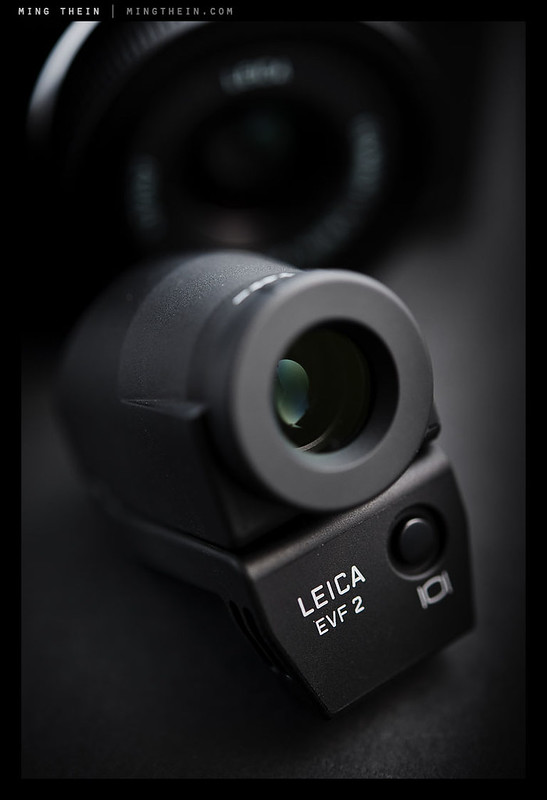
The X1’s LCD was pretty coarse; the X2’s is a significant improvement, but I don’t think it’s as good as say the Ricoh GRD IV – which has an amazing 1 million+ dot screen. Nevertheless, it’s now much easier to judge focus. Refresh rate seems to be a lot faster too; I’d say 60Hz instead of 30Hz. You can still use the optical finder if you want, but you’re still going to miss knowing exactly what the camera is focusing on; for the price and bulk, I’d much rather have the EVF, which is excellent. The fonts look grainy, but that’s only because it seems the UI designer didn’t specify enough DPI when encoding; the image itself is very, very fine indeed – you can’t really see individual pixels. It gains up well in low light, and isn’t too grainy.
_7064155 copy

I did an experiment with the EVF out of curiosity – the plug looked like any one of the existing EVF plugs. Expecting it to fit my D-Lux 5 Titanium, I was surprised when it didn’t; but it did fit my Olympus OM-D and Pen Mini. Even more interestingly, it worked! Draw whatever conclusion you wish; it’s a very nice EVF all the same, and my preferred way of working with the camera. Oh, and it tilts, too, and locks securely in the down position (something not all tiltable EVFs seem to manage.)

_X21_L1020107 copy
Through the keyhole. Leica X2

During the last few days, I shot over 500 frames with the Leica X2. With the X1, this would have meant two battery changes; I actually had three spares for mine, which would leave me with one left over after a heavy day of shooting. (I’m the kind of person who can finish off an entire EN-EL4a on a day’s assignment and add a five figure mileage to a camera in short order). The X2 showed half – that’s a pretty darn impressive performance, considering either the LCD or EVF were on the whole time, and I was using it frequently enough that it didn’t have time to slip into power save mode. It could be the effect of a more efficient sensor (the previous sensor was a relative of the one in the D90, which was notoriously power hungry in live view) or processing internals. This is on par with my current mirrorless long-life battery champ, the Pen Mini – which will easily hit a thousand frames per charge if used carefully.

_X21_L1020099 copy
Artificial everything. Leica X2

Finally, if you’re a flash shooter, good news! The leaf shutter remains, which means 1/2000s sync speeds (unheard of for most cameras) and the popup mechanism has been redesigned. It looks a lot more complicated, but I suspect that this is actually going to be more robust than the old press-to-raise-and-lower design – I’ve heard a lot of complaints about it being easy to break.

_X21_L1020093bw copy
Untitled. Leica X2

You’ll notice I haven’t said anything about the sensor up til this point; that’s because you’re not going to notice it immediately upon shooting (duh). But what you will notice is an ISO 12,500 (no idea why it isn’t 12,800, i.e. double 6400) setting. It’s APS-C, so I didn’t expect it to be useable. What’s nice to report is that the new 16.5 MP CMOS used is class leading in every way. It even manages 5fps continuous shooting for eight frames, but the penalty is that you have to wait while the camera writes the files – it doesn’t seem to buffer in parallel. This is true whether you shoot one or eight frames. As for the sensor, I suspect we may actually have seen a relative of it before in other products, most notably one with three zeroes or an N in its name. This is a good thing.

_X21_L1020128 copy
Obligatory night test shot. ISO 3200. Leica X2

Let’s get noise out of the way: it’s all luminance. Shooting DNG, with zero noise reduction, I’d happily use ISO 3200 with a bit of work; there’s a big jump in noise to ISO 6400, which renders that and the top 12500 setting strictly for those shots of the Loch Ness Monster assassinating JFK. Or perhaps they might work well for you if you like extremely grainy B&W conversions. Even with NR zeroed out in ACR, I’m seeing some smearing at 3200 and up, but it’s less obvious at the two highest settings because of the overriding luminance noise. You might be able to retain more acuity by shooting 1600 and underexposing a stop, then bringing it up again in the raw converter afterwards. It isn’t too bad, but you’ll notice it’s there. All in all, the Leica X2 is up there with the best of the APS-C cameras, and frankly feels like it would give my D700 a run for its money on luminance noise, but loses out on dynamic range. Pixel level acuity remains excellent, though some files seem to require an extra sharpening pass – it may be the effects of diffraction starting to creep in at f8 and up.

X2-noisecrops1 copy
Some noise crops follow below. Click on the links for 100% versions.
Crop one
Crop two
Crop three

The X2 seems to have its own color signature that is different enough from the X1 that my initial experiment to use the same ACR profiles was unsuccessful. It’s tonal map also doesn’t match the Ms; dynamic range seems to be somewhat bunched in the shadows (which I don’t see on the more linear-response CCD sensors in the M and S cameras) and the relatively low noise floor responds well to shadow recovery. If anything, the color is much closer to being ‘accurate’ than any Leica to date – the skin tones are great, at least in RAW. White balance is similarly excellent – I made very, very few corrections to color; this is highly unusual for my workflow. Have to watch the red channel closely though, it doesn’t take much to hit saturation. Note that neither display gives an accurate idea of exposure or color, though. Using the histograms is highly recommended.

_X21_L1020149 copy
Pudu Plaza. Any photographer in KL will recognize this place. They’ll also recognize that the reds are both accurate and not accurate; they’re a little hot but the tone is mostly right. Leica X2

Although I’d never personally shoot JPEG with any camera, given the option – especially something whose files have as lot of processing latitude, like the Leica X2 – I know a lot of potential buyers might well do so, so I also had a close look at the native JPEG image quality. I’m pleased to report that it produces crisp, detailed files with very few artifacts; there are some customization parameters if you have a particular preference for how your files look. However, by default, the output is best described as neutral. Skin tones are still definitely better in DNG; there’s something about skin color that just seems out of gamut for most in-camera JPEG conversions.

_X21_L1020090 copy
Yellow men. This color is accurate, and identical to the scene. Leica X2

A comment on file formats, and a gripe I had with the original X1 – I don’t know why the camera can’t write DNG only – you have to do DNG+JPEG, which seems like a waste of space and buffer. Still, for single frame shooting (I can’t actually think why you’d use bursts on this camera) there isn’t any noticeable penalty in operation.

_X21_L1020051 copy
The fountain. Leica X2

There are a few other minor things that could be improved – as always. We can never have AF that’s too fast, or too continuous; in all fairness, this is a comment leveled at every camera, and the latter to mirrorless cameras in particular. The rear control dial is now far too loose and difficult to turn in single increments – especially when trying to apply exposure compensation. What would be nice is that when shooting, exposure compensation is the default setting like on the M9; but we’d definitely need a stiffer dial for that. The odd electronic stabilization ‘feature’ remains; I’d avoid it because it just gives me double images. A proper optical stabilizer would be nice, but at least we have the option not to use it.

_X21_L1020050 copy
Yawn; just another camera? Certainly a very stealthy one; nobody once gave me a second look when I was shooting them. Especially if using the finder flipped up at 90 degrees. Leica X2.

I have a little beef with the top plate dials. On every other Leica, all exposure adjustments move in half stop increments/ detents. On the X1 and X2, you get whole stops for shutter speeds, and third stops for aperture – what’s up here? Size of the shutter dial can’t be a reason, because the M9 has more speeds and is the same size – and still gives half stop detents. I like the increased dial tension, but can we please have consistency in exposure increments?
_X21_L1020030 copy
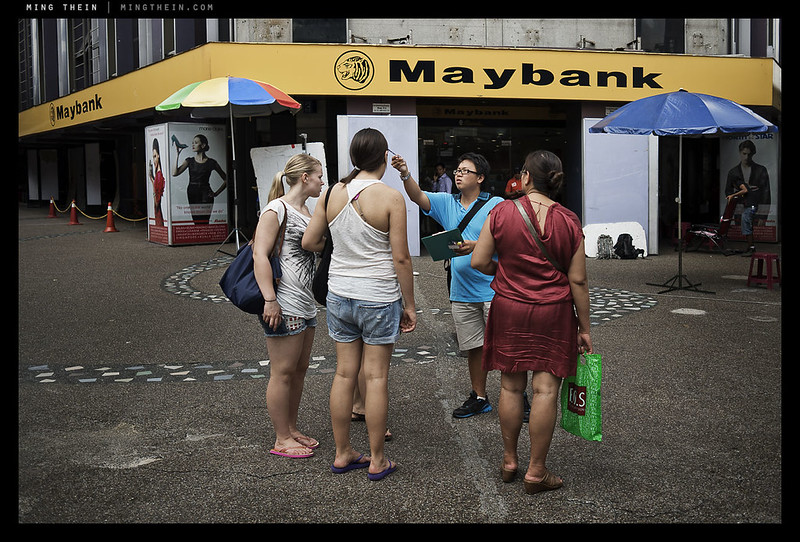
‘Hi, I’m doing a survey. Let me probe your brain for a moment.’ Leica X2

Finally, there’s the lens. It gives me mixed feelings. On one hand, it’s an excellent optic; the biting sharpness, excellent corner performance (it was after all, supposedly designed for full frame originally) microcontrast structure and general transparency which was one of the image quality hallmarks of the X1 is still there. On the other hand, it’s relatively slow at f2.8 – not a problem given the newfound low-light capabilities of the sensor; however, it doesn’t really allow isolation, and that’s one of the things people seem to expect from a Leica. Another stop – or even two – might make for some beautiful bokeh (I know I’ve seen it from the 24/1.4 Summilux-ASPH M, but then again that’s also a physically enormous and hugely expensive lens).

_X21_L1020012 copy
Reflections. Some of you might recognize this building. Leica X2

Whilst the lens delivered almost perfect results from wide open on the X1, the X2’s slightly higher density sensor seems to be pushing the resolving power a little – images shot at f2.8 are definitely a little softer than f4; it’s almost as though there’s a slight AA-filter effect at f2.8. This is easily solvable with a second sharpening pass, and doesn’t seem to materially affect the microcontrast structure of the image. Thereafter everything is good until you run into diffraction, a hint of which is visible at f8 and obvious by f11.

_X21_L1020040bw copy
Yes? Yes? Not today. Leica X2

Technical improvements are all well and good for the spec sheet and marketing people, but where does this leave us in terms of real-world usability? The X concept was almost certainly conceived by a photographer; it’s a combination of M and point and shoot that should in theory allow anybody to create images with that ‘Leica look’ (which I think most lay people mistake for bokeh, but is actually a combination of that, color transmission, sharpness, focus transition and microcontrast – but let’s not get started here) with minimal fuss. It failed fundamentally because it was too slow to be useable. However, it did have one overriding redeeming quality – the image quality was truly outstanding.

_X21_L1020037 copy
Untitled. Leica X2

The X2 takes the image quality even further, but more importantly now feels like a mature product. It’s a better distillation of the M gestalt, and definitely easier to use for the simple reason that it’s more responsive to shoot with. During the course of testing, I never felt like I lost a shot because the camera was too slow; I definitely did with the X1 and X100. There’s no single feature or area that makes you go WOW, but the combination of improvements makes it a very compelling little camera that just does its thing and delivers the most important thing – image quality – in spades. Here’s an interesting thought: if you shoot in low light a lot, you’ll probably want to get one of these instead of an M9 – the sensor is that good.

_X21_L1020014bw copy
The escape route. Leica X2

What does the future hold for the X system? Purely speculating, I think it’s unlikely we’ll ever see interchangeable lenses – it doesn’t make sense to develop new lenses given there’s already M mount, and M mount has a digital solution; the cost of developing an all-new mount and AF lens lineup is going to be pretty staggering, which would price the camera in M territory. Rather, that would make sense as a future evolution of the M line – something compatible with new autofocus lenses, as well as the older manual focus lenses. I can’t see how a rangefinder fits into this, though – the end product would probably be very Fuji X-Pro like, which overly complicates things and is far from the Leica design philosophy. But at the very least, I think the X2 needs a telephoto or long normal companion – this would be a killer studio camera due to the leaf shutter and high speed sync. And a pair of those would cover most travel photographers’ needs, without sacrificing image quality.

Time will tell. In the meantime, deciding which mirrorless camera to augment your primary system just got a lot tougher for us photographers. MT

_X21_L1020018 copy
Review complete; happy hour. Leica X2

Addendum, 10.30am 11 May 2012: My sleep-depreived brain has just remembered there’s one thing I forgot to mention: movie mode, or the lack of it. Whilst this sensor must clearly be video capable to produce the live feed, Leica has chosen not to implement a movie mode of any sort; I personally don’t see this as as huge issue as I don’t do video anyway. In any case, the inability to easily follow focus is probably a bigger impediment for moviemaking than the fixed focal length. I’d see video capability here as a nice to have, but not critical. Besides, the V-Lux 3 and D-Lux 5 are much easier to use for video, if you must have a Leica. I’ll be sticking to my D800E for the few times I do need video. MT

The Leica X2 is available in both black and silver here from B&H and Amazon.

____________

Visit our Teaching Store to up your photographic game – including Photoshop Workflow DVDs and customized Email School of Photography; or go mobile with the Photography Compendium for iPad. You can also get your gear from B&H and Amazon. Prices are the same as normal, however a small portion of your purchase value is referred back to me. Thanks!

Don’t forget to like us on Facebook and join the reader Flickr group!

appstorebadge

Images and content copyright Ming Thein | mingthein.com 2012 onwards. All rights reserved

Some of my favorite lenses

I thought some of you might be curious about what I consider to be my staples. There are some lenses that I consider best-in-class, or best for a special purpose, but I don’t own because it’s impractical, expensive or I simply wouldn’t use often enough; there are others that are workhorses for me and happen to be excellent. Some I like simply because they have interesting quirks that make for unusual or unique image rendition.

Rule #1: Don’t compromise on glass. I can’t remember who told me this, or where I read it, but it’s true: the lens makes the image, and it makes the most obvious difference, too. If you know that lens X is the best for what you shoot, but you decide to save a few hundred dollars and buy lens Y which will do the job but isn’t as good, you’ll probably land up regretting it and buying lens X anyway. Best case – you manage to sell lens Y without too much of a loss, and land up paying more than had you just bought X in the first place; worst case, you land up having to pay for both.

With that in mind, let’s start at the wide end and move on from there.

_PM04496 copy
Mmm, lenses. Most of my current equipment, except the Leica 35/1.4 ASPH FLE is missing.

Superwide
This is not really a class of lens I use often, but if I did, my money would go to the Nikon AFS 14-24/2.8 G. It’s an incredibly impressive piece of glass that’s sharp in the corners wide open and almost entirely free of CA. It’s an achievement for a prime, let alone a fast aperture zoom. I did actually own one when I had a Nikon D3.

_3030433 copy
What was actually a very small restaurant. Somewhere near Nara, Japan. Nikon D3, 14-24/2.8

Wide
Wide and fast is an important combination for photojournalism, especially available light work; I like the Nikon AFS 24/1.4 G, Leica 21/1.4 Summilux-M ASPH, Zeiss ZM 2.8/21 Biogon and curiously, the 28/1.9 equivalent on the Ricoh GR-Digital III, but my all time favorite lens in this category is the Zeiss ZF.2 2/28 Distagon. This lens shares the same optical formula as the much vaunted ‘Hollywood’ in Contax mount; except it has a chip to meter on Nikon bodies. Bokeh is exceptional, it focuses very close, has biting sharpness at all apertures, and above all, a very unique rendition that emphasizes the subject because the plane of focus is curved in a spherical section, with the camera at the center. That means edge subjects are rendered oddly, but if you stick to the border zones you’ll be fine. And the micro contrast structure is beautifully detailed, which works well with the lens’ high native color transmission to deliver a very 3D image. Note: I haven’t included the Olympus 12/2 in this list, because whilst it’s technically pretty good, it’s frankly also characterless. Kinda like ordinary vanilla ice cream.

_7009593 copy
Film making. Nikon D700, Zeiss ZF.2 2/28 Distagon

Wide-normal
This range has usually been no-mans’ land for me; I tend to prefer a wider or longer perspective. However, I’m rediscovering the joys of a conventional view with the Leica M9-P; in my mind there is only one lens in this range – the Leica 35/1.4 Summilux-M ASPH FLE (Floating Lens Element – though technically it’s a group of elements). It’s about as close to a technically perfect lens as you can get; sure, we could ask for a closer minimum focus distance, but that isn’t really possible with a rangefinder due to parallax issues on framing. It even works incredibly well for super macro work with a bellows on the M9-P, or extension tubes and an adaptor on the D700. Who’d have thought? A distant second in this category would be the Panasonic 20/1.7 for Micro Four Thirds.

_M9P1_L1009886 copy
Inversion. Leica M9-P, 35/1.4 ASPH FLE

Normal
Again, another desert for me. I’ve owned a lot of lenses in this range – from Nikon alone, the 45/2.8 P, AF 50/1.8 D, AF 50/1.4 D, AFS 50/1.4 G (two of them, embarrassingly), pre-AI 55/1.2 SC, AF 60/2.8 D Micro and AF 60/2.8 G Micro. Except the macro lenses, somehow none of the standard lens offerings for SLRs have inspired me at all. They’re either characterless or surprisingly bad, considering the low demands; the only exception is the brief impression I got of the new Nikon AFS 50/1.8 G, which contains aspherical surfaces and has a bite to it that’s sorely lacking in the faster or older versions. However, I’d give the gong to the Leica 50/1.4 Summilux-M ASPH, which if you get a good copy, is absolutely incredible. It’s sharper wide open than most lenses ever get stopped down; the subject separation is amazing, and your frame is literally dissected into planes. I think it has to do with the transition from in-focus to out-of-focus being very abrupt; it shoots much more like a telephoto than a normal lens. Special mention should be given to the Leica 50/0.95 Noctilux-M ASPH, which is special because it delivers performance very close to the Summilux ASPH, but over one stop faster. It isn’t a practical lens though, due to size, weight, long focus throw, criticality of rangefinder alignment, minimum 1m focus distance, cost…I could go on. And the swirly bokeh (caused by uncorrected residual spherical aberration) of the old Noctilux is gone – I don’t miss it, to be honest. But I’ve been amazed by it every time I’ve used it, which is thankfully frequent due to my relationship with Leica. A commended award go to the Zeiss ZM 2/50 Planar; it doesn’t really have any character of its own, but it is a very competent, transparent lens.

_M9P1_L1007858 copy
Convergence. Shot out of the window of a moving train. Leica M9-P, 50/1.4 Summilux-M ASPH

_M9P1_L1001196 copy
Smoke fountain. Leica M9-P, 50/0.95 ASPH

Short telephoto
Tough call, actually. There are two contenders for this prize: the Nikon AFS 85/1.4 G, and the Zeiss ZF.2 85/1.4 Planar. If I could have both, I would; their rendering styles are quite different. The Nikon performs like modern aspherical glass – sharp, saturated, contrasty, creamy smooth bokeh, fast transition between in-and-out of focus, but a little clinical. The Zeiss is more lyrical and definitely less perfect; it does suffer from CA at high contrast edges, and edge sharpness isn’t as good as the Nikon (which somehow manages to maintain pin sharp corners even at f1.4). It’s bokeh can present as odd cats-eye shapes from light sources that aren’t centered. But oh boy, the tones! Especially for black and white work. It’s unbeatable. And the way it renders micro contrast is slightly more refined and textural than the Nikon. Since I have to choose, I’ll give it to the Nikon, by a hair; I can consistently get useable images with that, but the Zeiss isn’t so easy to nail focus with because it’s manual – even with my modified D700 (F6 micro prism screen, precise mirror alignment and screen shimming, DK-17M).

_7048556 copy
Levitation. Nikon D700, AFS 85/1.4 G

_7008086 copy
If This Looks Like It Was From A Commercial, That’s Because It Was. Nikon D700, Zeiss ZF 85/1.4 Planar

The difference in micro contrast rendition betweens the two lenses is pretty obvious even at this size – the Zeiss is just more refined, somehow. But there’s no question that the Nikon is punchier. Same camera, too – so it’s like to like.

Telephoto
I used to shoot telephoto a lot during my birding days – relying primarily on the Nikon AI 500/4 P (because it was cheap, light and optically excellent) and later on, the Nikon AFS 300/2.8 VR – which I still think is one of the best lenses ever made, if a little short. Tough to give an award here because I haven’t tried many of the available options, but from what I’ve seen, I’d still probably give it to the 300/2.8 VR.

_MT84782 copy.jpg
Scarlet ibis. Nikon D2H, AI 500/4 P

special purpose
This category includes macro, tilt-shift, pinholes, toy lenses, and other weird and wonderful optics. I love the Nikon PC 85/2.8 tilt-shift macro; it offers both incredible sharpness and great control over your depth of field thanks to its built in movements. But sadly it only reaches 1:2, and doesn’t do so well with extension tubes – which makes it significantly less useful for my purposes, so I sold it. If they made a 1:1 version, I’d be all over it in a heartbeat. My current mainstay in this range is the Nikon AFS 60/2.8 G Micro; it’s excellent but again, a little characterless and suffers from longitudinal chromatic aberration (‘bokeh fringing’) which can be quite annoying on specular highlights, i.e. most watch cases. It does require special processing to remove, which can be tricky if you want to maintain the underlying color of the original object. I’d love to try the Coastal Optics 60/4 APO-UVIR Macro; except it’s in the same price range as a Noctilux. The output from that lens looks incredible – between the completely apochromatic behavior and high transmission throughout the spectral range, color accuracy should be superb.

_DSC0405bw copy
Extended depth of field control. Girard-Perregaux Opera Two. Nikon D2Hs, PC 85/2.8 Micro

There is one upcoming lens I’m looking forward to, also; chief of these is the new Olympus 75/1.8 for Micro Four Thirds – it should be a very cinematic lens, if the 45/1.8 is anything to go by. MT

____________

If you enjoyed this post, please consider supporting the site via Paypal (mingthein2@gmail.com) or via Ming Thein’s Email School of Photography – learn exactly what you want to learn, when you want to learn it.

You can also get your gear from Amazon.com clicking through this referral link. It doesn’t cost you any more, but a small portion of your purchase value is referred back to me. Thanks!

Don’t forget to like us on Facebook!

Photography equipment is a circle…

…and not because the lenses and control dials are round.

[Tongue in cheek] The phases of equipment euphoria go something like this:

Absolute newbie: Buys the sexiest, smallest point and shoot they can find. Then gets frustrated that it’s slow or the pictures look horrible in low light.

Modern alternative: Cameraphone.

_D90_DSC4534bw copy
Canon IXUS SD780IS. It was the sexiest, smallest, point and shoot I could find at the time. But I had my reasons for buying it, as you’ll see later.

Beginning hobbyist: Upgrades to a prosumer thing, the more buttons and dials the better; a longer zoom is just a bonus, as is if it looks like a DSLR – take that Nikon thingy with the 24-1000mm lens, for instance. 1000mm!

_0012295bw copy
Leica D-Lux 5.

Amateur: A DSLR is a must. But why bother with the SLR bit if you’re going to hold it at arms’ length and use live view?

_D90_DSC0506bw copy
Nikon D40, swallowed by 400/2.8VR hood.

Serious amateur: A bigger, more serious DSLR. Maybe the same one as before, but with a battery grip and telephoto lens. Carries it around everywhere they go, complete with backpack containing 1001 other ‘essentials’ such as cleaning supplies, chargers, spare tripod heads, etc. Given a few years, will develop into an aspiring pro.

Semi-pro: An anomaly: may just use whatever midrange DSLR is given by their company, or use serious amateur gear.

P1070221 copy.jpg
Why choose between systems when you can have both?

Aspiring pro: Always has the latest and greatest; a pair of pro bodies, full set of f2.8 zooms and f1.4 primes, carbon fiber tripods, and…no work to pay for it all.

Pro: Only carries what they need; usually a matched pair of bodies for redundancy, with one lens each, and maybe a flash. No superfluous gear, because they know how much of a pain it is to carry. After several years, will develop a pronounced lean towards the shoulder that carries the spare body and a stoop from carrying 5kg around their necks.

_7048856bw copy
Going light. Olympus Pen Mini.

Old hand: May or may not have been a pro, but now forced to sell some or all of their gear to cover chiropractor bills and divorce settlement after wife got ignored on too many holidays in favor of sunsets and sunrises and magic hour reflections; still can’t quite let go of the photography bug, so they look for the lightest thing they can find that just manages to do the job, but at the same time not require eating ramen or baked beans for a year.

And guess what: we’re right back where we started.

Now, you’re probably wondering why I’ve got photos of all of this gear: at some point or other, I went through it. Read carefully, and seriously, learn from my costly mistakes before you have both a bad back and an empty wallet. You have been warned. MT

Long term review: the Leica M9-P

First things first: this isn’t going to be a technical review, because there are sites that do it much better than I can; it’s going to be subjective because there are things I do in my processing workflow that might not necessarily be reflective of everybody else’s, but I am consistent in how I treat my cameras, which means that results are comparable between different cameras. Specifically – I shoot raw with auto-WB, expose slightly hot, adjust exposure and WB in Adobe Camera Raw, and take care of final sharpening, curves and color adjustments in Photoshop. What this review – and future equipment reviews – will be is a subjective but hopefully useful insight into how a piece of gear performs under professional use conditions, and whether there are any serious limitations to my style of shooting (and my subjects). With that out of the way, let’s move on.

_7052691 copy

I suppose it may be a little late in the product’s life-cycle to be doing a review now – given that the M9 was launched in September 2009 and is now 2.5 years old, which is ancient in the digital era. But let me explain. Firstly, I think it’s still a relevant product today – perhaps even more so, given the increased resurgence of late of compact ILCs and rangefinder-a-likes. The Leica M still remains the benchmark product that all strive to be judged better than, and it’s lens system is still the one everybody makes mount adaptors to fit. (Notice Fuji launching an in house M-mount adaptor with the X-Pro1). There are other reasons, too. The original M8 is still in circulation on the secondary market, where prices have stayed constant around the US$2,200-2,500 mark from the launch of the M9; this is extremely surprising behavior for a digital camera of any sort, let alone one that will be six years old this year, and one that has its fair share of flaws (don’t get me started; I owned two and shot with five examples in total; they all required UVIR filters for accurate color, had buffer overflow/ firmware stability issues, hot spots, banding, etc.). You can bet a D2x isn’t worth what it was three years ago. The sole reason this is the case is because they represent a relatively accessible entry point for rangefinder photography; you can buy second hand Zeiss and Voigtlander lenses and not spend much more on the whole system than if you bought a midrange DSLR. Sure, you might not get the high ISO performance or frame rates, but then again you also don’t have to live with the weight. This price may change with the widespread availability of the Fuji X-Pro, but I don’t expect it to – they’re completely different beasts, and the X-Pro has more in common with the mirrorless ILCs than digital rangefinders.

_M9P1_L1005460bw copy
A Hitchcock scene in Prague. Wide and hyperfocal is where rangefinders excel. Leica M9-P, 28/2.8 ASPH

In the same way, the M9 will remain a relevant product beyond its life cycle. All rumors point to a replacement sooner rather than later, though with Leica’s partner Kodak having sold off its sensor division, it’s anybody’s guess as to where the sensor is going to come from. What would make sense is a Sony sensor – perhaps a full frame version of the 16 or 24 MP APS-C models – but with a custom micro lens array to deal with RF optics. Would I want that many megapixels? No, but we’re digressing. More on the sensor issue later.

The final reason it’s taken me until 2.5 years after the release of the camera to write a review is quite simple: I haven’t had the chance to shoot with one extensively until November last year, after becoming an official partner of Leica. Whilst you can do RF photography on the cheap with a used M8, a new M9 kit and top flight lenses will set you back big, big money – the kind that could easily also buy a luxury automobile. I’ve used the M9-P with the 50/0.95 Noctilux-M ASPH, 35/1.4 Summilux-M ASPH FLE, 50/2.5 Summarit-M, 50/1.4 Summilux-M ASPH, 28/2.8 Elmarit-M ASPH and Zeiss ZM 2.8/28 Biogon and ZM 2/50 Planar.

_D90_DSC7248 copy
My previous rig, used for 90% of my shots. I was so practiced and familiar with this lens and camera that I could zone focus accurately at f1.4, and compose without seeing either finder. That’s what happens when you shoot >1000 frames per day with the same gear. Alas, I don’t shoot anywhere near that much, so I lost the ability. The M9-P is also a lot more sensitive to precise focus because of the pixel density.

A bit of background: I shot almost exclusively Leica in 2009-early 2010 with a pair of M8s, the Leica 35/2 ASPH, 21/1.4 ASPH (primary lens) and 50/1.4 ASPH. I also used the Voigtlander 15/4.5 and 50/1.1 and Zeiss ZM 21/2.8 extensively. Total count: nearly 70,000 frames – so I’m not new in the RF world by any means. I also had an M6TTL.

Did I have issues with the M8s? Yes. Specifically,
1. They’d lock up if you overshot the buffer; and you’d have to pull the battery and card to get the camera to restart, sometimes losing images on the card and definitely losing whatever was in the buffer at the time.
2. Banding, especially at high ISO or if underexposed.
3. A very sensitive meter; if there were any point light sources in the frame, you can be sure the camera would underexpose horribly.
4. No easy way of dialing in exposure compensation – the workaround for that was to meter on something else, AE lock with a half press of the shutter, and then focus on the subject
5. Very poor high ISO performance. I’d keep things below 640, 1250 in emergencies, and seeking out the fastest lenses possible – which with 28mm as my favorite focal length, turned out to be horribly expensive.
6. No idea how much battery life you really had left, and a very, very slow (5-6 hours!) charger.
7. I like to shoot at 28mm; it just feels natural to me. That’s 21mm equivalent due to the M8’s crop factor. But there’s only frame lines for 24mm (31mm equivalent) which isn’t wide enough, so I have to use an external finder. Oh, but you still require focusing precision with fast lenses especially; so you have to use the RF to focus and an external finder to frame. Pain. I eventually landed up shooting with two eyes open, focusing with the RF, guesstimating the frame with my open eye and ignoring the external finder unless I was shooting at hyper focal distances.
8. Very notchy-feeling shutter release – it’s difficult to release smoothly, even with a soft release installed. Why does it need three stages – can’t they just use a smooth two-stage like all of the other professional cameras? Even the film Leicas had much better feeling shutter button actions than this.

_M9P1_L1007182bw copy
The librarian, Strahov Cloister. Leica M9-P, 28/2.8 ASPH

Have any of these things been fixed?
1. It won’t lock up and require a battery-pull, but you still have the same small buffer. Seven shots or so while the barrel is hot; I liken it to shooting a revolver. Count your frames and you should be fine when it comes to sequences. It won’t do more than 2fps anyway, so you’re best off in single shot mode.
2. Banding is much improved – in fact, I haven’t seen it in any of the 12,000+ frames I’ve shot so far.
3. Nope, same meter.
4. You can dial in exposure compensation on the rear dial or menu, but it doesn’t really show in the finder except for a really small, difficult to see dot between the numbers. I found a better workaround – if I’m at base ISO (you know because your shutter speed is above the AUTO ISO threshold you set) then I’ll just choose a lower shutter speed, guesstimating whatever I think it should be. Lots of photography makes you have a pretty good internal meter. If I’m shooting at night, I’ll fix my ISO and go fully manual.
5. It’s better, but not that much better. Reality is that at the pixel level, I now find 1250 to be the limit, with 2500 for emergencies only. However, because there are many more pixels, you can print at the same size and gain roughly another 1/2-2/3 stop. It’s not in D700, let alone D3s territory by any means, but at least its much more useable than the M8 was. I can use f2.0 lenses without too much issue – which is great, because they’re both cheaper and tend to be better optically.
6. There’s now a very accurate percentage meter and a faster (2-3 hour) charger. Both things help your battery management greatly, though I still carry a spare battery especially for heavy shooting days. One battery will get me around 1,000 frames if I limit review time to the bare minimum.
7. The widest frame line is now 28mm, yay! Unfortunately, the eye relief is insufficient to see it with glasses. 35mm is the widest frame I can comfortably see unless I wear contact lenses – which I do for serious shooting.
8. Nope, not changed. But at least they made the power/self timer switch tighter, so you don’t accidentally select the timer and wonder why the camera isn’t taking the shot.

_M9P1_L1003662 copy
Evening tram. Leica M9-P, 50/1.4 ASPH

So, for the most part, things are better. The menu system is still simple and snappy; although there is a tendency to do odd things with some Sandisk cards – specifically lockups when browsing or protecting files in long series; I haven’t noticed this with other brands, though.

What else has changed? Surprisingly little. Why fix it if it isn’t broken? Frankly, if Leica could get hold of the D3s sensor and innards somehow, then they’d have a killer machine. I wouldn’t even need to shoot anything else. Oh yeah, there are some small cosmetic changes – the corner where the little round LCD was on the M8 is gone, and the finishes are now black paint or gray chrome for the regular M9, and silver chrome or black paint for the M9-P which omits the Leica dot in favor of top plate engraving and a sapphire LCD cover, but is otherwise the same camera. I was given a silver M9-P, which is my preference aesthetically too.

_M9P1_L1005830bw copy
The hidden gorilla. Leica M9-P, 28/2.8 ASPH

The things I like very much about the M system, and specifically the digital Ms, remain. The sensor is a CCD, not CMOS – in real terms, that means much more pleasing tonal and color response at the expense of base noise. There’s a color richness yet tonal transparency that’s difficult to describe; it reminds me of the old Nikon D2H and medium format cameras, which for the most part use CCD sensors. There is of course no anti-aliasing filter, which means that the resolving power is extreme. Is moire an issue? No, but I’m not a fashion photographer.

What is much more important than your filter pack is the alignment of your rangefinder. This affects resolving power hugely, especially if you’re shooting fast lenses wide open. The best practice is to send everything back to Leica for calibration, but since we can’t easily do that in the field, we must learn to calibrate our own rangefinders* (to be the subject of a future article.) – to the shallowest depth of field lens you’ve got, providing it doesn’t suffer from focus shift. If it does, calibrate to your most frequently used lens and remember to adjust for the focus shift when you’re shooting your fastest. A rangefinder with a well-calibrated rangefinder is one of the most accurate focusing mechanisms devised; much better than manual focusing most SLRs because their viewfinders won’t have been perfectly aligned or shimmed, either. Not quite as good as magnified live view on the LCD, but that isn’t practical for photojournalism work or anything without a tripod. Where rangefinders excel is focusing anything wide up to about 75mm; fast is no problem. In fact, with regular practice I find I can focus just as fast or faster on static subjects than with an autofocus camera. (The AF camera will report that it’s found focus, but you can’t always tell if it’s focused precisely on what you want it to.

_M9P1_L1004918bw copy
When you shoot a Leica, you inevitably find a protest in the most unlikely of locations. Demonstrators protesting Kabila’s reign in the Congo, Vienna. Leica M9-P, 28/2.8 ASPH

So, given a properly calibrated rangefinder, resolution and sharpness aren’t a problem. In fact, there’s more resolution in a good M9 file than anybody really needs, unless you’re making wall-sized prints that are to be inspected at nose distance. It’s more resolution than I can normally use, especially for photojournalism or street photography where everything is moving fast, light conditions are challenging, and your exposure is probably borderline for getting a critically sharp shot. I’m the limitation, not the camera. It’s great for shooting people, though; subjects tend to be more curious about the vintage looking camera than intimidated (as is usually the case if you point an enormous pro DSLR at them). You tend to get much more natural and open portraiture as a result.

_M9P1_L1001901 copy
I don’t quite know what she was demonstrating here either. Leica M9-P, 50/0.95 ASPH

I use the camera for architecture and urban landscapes too; it excels at that for the most part, but the nature of the viewfinder and it’s vague-ish frame lines mean that compositions aren’t always precise; I sometimes have to violate my personal rule of no-cropping to trim things I didn’t think were in the frame at the time of shooting. The frame lines are conservative.

The last thing I use the M9-P for is watch photography – this only of late, and it hasn’t fully replaced the D700 because I still haven’t got a complete setup. What it does excel at so far is extremely high magnification macros; we’re talking minimum 3:1 and usually up to 5:1 or even 6:1. This is where the Visoflex III and Bellows II (both vintage, probably 40-50 years old) come into their own in a surprisingly but very ungainly way. (For more info on macro with the M system, see this earlier post.

_M9P1_L1003384 copy
Shadows, Vienna. Leica M9-P, 28/2.8 ASPH

So am I happy with the M9-P?

For the most part, yes. The image quality, within its optimal range, is stunning – as good as the output of any 35mm/ FX camera I’ve seen to date (the D800E may be a different story when it arrives). It isn’t that great at high ISO, but you can usually get a workable and pleasing image in all but the darkest condition. My earlier On Assignment post about shooting the Thaipusam festival was a surprise to me – it performed far better than I expected, but it wasn’t easy to achieve those results because of the limitations of a rangefinder with moving subjects.

_M9P1_L1008733 copy
Master Sushi Chef Kenny Yew. Leica M9-P, Zeiss ZM 2/50 Planar

It’s relatively small, portable and easy to use; it doesn’t get in the way or require separate carrying solutions or bags. Most of the time I just go out of the house with the camera slung over one shoulder, suspended by a single lug since it’s easier to access and much more comfortable to shoot without a strap digging into the web between your index and third fingers. It is deceptively heavy, though, especially with the Noctilux 0.95; I think that rig weighs more than my D700 and 85/1.4. It also desperately needs a grip to hold securely, because there’s nowhere on the back of the camera for your thumb to find secure purchase. (The film Ms didn’t have this problem because you usually braced your thumb on the winder crank to be ready for the next shot anyway.) I’ve used ThumbsUp grips on all of my digital Ms and find them to be indispensable – they make a huge difference to the handling properties of the camera. This should be a built in ergonomic feature of future Ms, not an expensive aftermarket accessory. While we’re on ergonomics, did I mention that it’s far too easy for you to put your finger into one of the rangefinder windows? I find it immensely annoying when somebody does that after they request to have a look at your camera; you can’t see a damn thing or focus easily if there’s a fingerprint obscuring every window. I keep mine scrupulously clean and take care not to stick my fingers in. Having said that, I guess it’s a limitation of the RF design; a recessed window would be difficult to clean, and one that sticks out would probably get chipped or scratched more easily.

_M9P1_L1000955 copy
The paradox of clean energy. Leica M9-P, 50/0.95 Noctilux-M ASPH

There is one thing that the M9-P especially has that nothing else does (except perhaps an M8) – tactility. I don’t personally like the painted finishes; I do like the slightly rough chrome surface and the solid, cold, metal feeling of the control points; the rubber is nice but leather would be nicer (although impractical in the sweaty tropics – I suppose at least people would think twice about asking to use your camera). It’s just a beautiful design object and something that makes you want to handle, fondle and use it; this isn’t something that I can say of any of my other cameras, except oddly perhaps the Ricoh GR-Digital III. And that makes me shoot it more; which in turn makes me experiment and produce images that I probably wouldn’t otherwise have done without the camera. For all of its quirks and foibles, I just like using it.

_M9P1_L1007838bw copy
Self portrait, lucky timing with two opposing moving trains and a whole load of surprise with the ensuing gust of wind. Leica M9-P, 50/1.4 ASPH

I think the real verdict is that I’m now using the M9-P as my primary camera, even for things that it was not designed for, even when I have the choice to use something else. This is not at all what I expected going in; I suppose in that sense it succeeds beyond expectations.

_M9P1_L1003919bw copy
Fog, Schonbrunn Palace, Vienna. Leica M9-P, 28/2.8 ASPH

That doesn’t mean I don’t have a long list of things that could be improved for the next digital M; realistically, we’re going to see evolutionary rather than revolutionary changes, because after all, it is still a Leica M – if you want AF, buy the Fuji. With that, I leave you with the list:

1. Bigger buffer. I can count shots, but I’d rather not – 15-20 would be plenty. The new Nikon D4 reportedly has a 95-frame RAW buffer(!)
2. Live view. I think this is probably inevitable, given the capabilities of all of the current crop of sensors; I personally want it so I don’t have to use the clunky Visoflex for macro work.
3. More speed, especially with image processing – specifically review and magnification.
4. A better LCD. More pixels are useless if I can’t tell whether I’m using them all properly or not. I can see why the body will not accommodate a 3″ unit for design and aesthetic reasons, but a higher resolution 2.5″ unit with better color would make a huge difference.
5. A built in thumb grip on the back; a ThumbsUp built into the body would be perfect. They could even bring back the winder ala Epson to save battery power.
6. Softer, better-feeling shutter release button.
7. A little more information in the viewfinder; shutter speed in aperture priority and ISO is all I need.
8. A meter that doesn’t go crazy if there’s a point light source in the frame.
9. Improved high ISO, but it’s not actually that critical.
10. More robust firmware, and less sensitivity to particular brands of SD cards.
11. More eye relief in the finder – especially useful for photographers with glasses

Notice I haven’t asked for video, more pixels, AF, or 12fps, or LCD finder overlays; I think the fundamental concept is great, but it could use a few little tweaks to keep it relevant in today’s world of options – especially when historical trends point towards this camera being even more expensive than its predecessor. MT

*Disclaimer: I am not responsible if you damage your camera or void your warranty.

_M9P1_L1006378 copy
The police are everywhere. Leica M9-P, 28/2.8 ASPH

____________

If you enjoyed this post, please consider supporting the site via Paypal (mingthein2@gmail.com) or via Ming Thein’s Email School of Photography – learn exactly what you want to learn, when you want to learn it.

You can also get your gear from Amazon.com clicking through this referral link. It doesn’t cost you any more, but a small portion of your purchase value is referred back to me. Thanks!

Don’t forget to like us on Facebook!

CES 2012: Thoughts on the new cameras

This year seems to be yet another bonanza year of choice for photographers – and gearheads, especially. What follows is a few quick thoughts on the recent spate of introductions – specifically, those I find interesting or worth commenting on:

Nikon D800/D800E
50% more resolution – maybe as much as 75% on the E variant – and less than half the price of the D3x? It’s interesting to see just how far technology has come in the last few years. Not only is there more resolution, there’s more speed AND it’s 14 bit data off the sensor. I’m not worried about noise; downsize to say 15MP and you’ll find the files will be surprisingly clean, with very crisp detail at the single-pixel level. The resolution champion outside medium format? Easily. It’ll print well, too. I broke down and ordered a D800E via NPS. No comments on video specs, it’s just not something I do at the moment. Interestingly, it’s lighter, too. Minus points for the new battery system – what are legacy users going to do with their spares?

Warning to people who just want ‘more’: this camera is going to be punishing on both technique and lenses; poorer lenses may never get sharp at any aperture. And forget 1/focal length: you’re going to have to double that to be critically sharp at the 100% level. Sloppy photographers are probably better off sticking to more forgiving (and lower) resolutions. I know this definitely won’t be the camera I grab when I have to wear the photojournalist hat.

Nikon D4
It’s interesting to see that 16MP is considered enough for the flagship; that’s because it is. If you can’t print an enormous wall-sized enlargement that looks good from sensible viewing distances, you’re probably not doing something right. I remember the days when the D2H’s measly 4MP was sufficient for billboard work – and that was cropped down, too. Remember that as the print gets larger, you’re going to be further and further away. For fine art and pixel peepers, there may be reasons to have more resolution, but seriously – nobody was complaining when 12MP was state of the art. And these are much, much higher quality pixels than before. Again, minus points for the new battery system. Spares are expensive. I don’t see myself needing one of these – it’s too big and heavy, and has no built in flash to trigger slaves – but man those backlit buttons are cool.

Olympus OM-D E-M5, ZD 75/1.8 and ZD 60/2.8 Macro
I find myself going through phases with this one. I think the final verdict will boil down to size and sensor output quality. Not having seen either, it’s hard to make a call. It’s very difficult to tell from the product images – maybe the industry needs a standard sized hand or something. I like the idea of this camera – I really do – but frankly I think the design just isn’t that coherent. By the numbers it seems blazingly fast, though. Maybe this is what M4/3 should have been all along.

Much more interesting are the two lenses accompanying the announcement: 150/1.8 equivalent, anybody? Should make a killer portrait and fashion lens. The 60/2.8 macro is interesting to me because it a) goes to 1:1, which is really 2:1 equivalent on a full frame body; and b) it’s 120mm equivalent, which means a decent amount of working distance.

Pentax K-01
Firstly, it’s hideous. Secondly, it’s pretty intelligent: pancake lenses with most of the optics inside where the mirror box should be, keeping the size down; whilst retaining the original flange distance to allow use with legacy lenses. But sorry, the missing EVF is an unforgivable omission. I really have no idea who this camera is aimed at.

Fuji X-Pro1
Fuji is taking the success of the X100 and X10 and smacking Leica on the head with it. Then, just to make sure nobody missed their intentions, they displayed the camera with an M adaptor – which will also be released with the camera. Nobody doubts the image quality will be good. But my fear is that as with its siblings, the horrendously unstable and poorly implemented firmware is going to make or break this. I do like the initial lens choices though – the 28, 50, 90 macro combination feels like it was tailor made for me.

Canon G1X
Too little, too late. It’s bigger than competing mirrorless offerings, but lacks the interchangeable lens option; its only saving grace is going to be if the image quality is superb. I wouldn’t expect anything worse than the current crop of Canon APS-C cameras, which is to say pretty competent. But I just can’t see where it fits in for most photographers.

Final thoughts: Overall, too many of those damn confusing Xs in names. I think it’s time to get back to the photography, now.

Product images from press releases and DC.Watch.Impress

Because somebody will eventually ask…

…”what gear do you use?” is the most common question I get from aspiring photographers or keen amateurs.

Gear doesn’t matter. Practice, on the other hand, does. I’ve got images in the Getty library that were shot on digital medium format; I’ve also got images shot with my iPhone. But I admit, like every other photographer, there is an element of gearhead geek in me. So here’s the current list:

Primary – Leica M (I’m Leica sponsored); M9-P chrome, 35/1.4 Summilux-M ASPH FLE, 50/0.95 Noctilux-M ASPH, 90/4 Macro-Elmarit-M (on it’s way, I’m told). Zeiss ZM 2.8/28 Biogon, ZM 2/50 Planar. I’ve also got a Visoflex III and Bellows II for macro work, and a home-made hotshoe mount PC sync cable that fits under the Visoflex housing to trigger my flashes.

Primary, special purpose – Nikon FX; D700+MBD10, D800E (on it’s way), AFS 24/1.4 G, AFS 60/2.8 G Micro, AFS 85/1.4 G, AFS 28-300/3.5-5.6 VR G. Zeiss ZF.2 2/28 ‘Hollywood’ Distagon. A whole bunch of extension tubes and adaptors. Three SB900s and one SB700.

Compact – M4/3; Olympus Pen Mini E-PM1, ZD 12/2, ZD 45/1.8, ZD 14-42/3.5-5.6 IIR. Panasonic Lumix G 20/1.7. Contemplating the upcoming ZD 75/1.8 and ZD 60/2.8 macro.

Point and shoot – Leica D-Lux 5 (incoming), Ricoh GR Digital III and of course the iPhone 4.

_PM04499bw copy

…”how do I get better?” comes from people serious about learning.

As I said before: practice, practice, practice. Also, look at other people’s work; famous work; what don’t you like, what do you like? Can you figure out how they did it? Can you figure out why the shot works, or doesn’t? Critical analysis of an image often yields insights into composition that will help you instinctively arrange your frame when you look through the finder. And the two most important tips are a) watch the edges of your frame and b) make sure your subject is clear: if you don’t know what it is, then it’s almost certain nobody else will, either. And that makes for a very weak photograph.

…”how much do you (or should I) charge?” comes from people who want to turn pro.

How much do you think your work is worth? What is your opportunity cost? If you’re asking how much I charge, if we were in head to head competition, could you justify what you’re asking?

…”what’s your workflow like?” comes from professionals.

RAW > ACR > Photoshop – nothing else gives me enough control over individual files, and even batches of files. I don’t like libraries; I don’t like batch editing; and I don’t believe in using JPEG unless you don’t have a choice, or your image is baked and done (and it’s appropriate for the final intended use).

…”what’s your day job?” is what I inevitably get from old hands who’ve seen the game change from film to digital to social media and wonder how on earth there can be so much content out there – some truly great and probably only made accessible by the digital era; yet so little appreciation for art.

A job is a means to an end: sadly, yes, I do have a day job that provides the backbone of my income. Suffice to say it isn’t photography, or even photographically related 🙂