On Assignment: Diner food

The majority of commercial work I do usually centers on studio work – I wish it was photojournalism, but sadly this isn’t the case. By this, I mean anything where the composition is delicately adjusted to be perfect, lit with controlled lighting – usually flash – and then retouched to perfection. Depending on what you’re shooting, the latter stage can be extremely time consuming (think watches, for instance).

_PM07622 copy Diner reflections in maple syrup. (Lame photographic irony: I used the 20/1.7 pancake on the Pen Mini to shoot a flapjack.) 

Today’s On Assignment was a photoshoot I did last week for a new diner. I originally thought the majority of the food would be shot with the Nikon D700, 60/2.8 G macro and a handful of speedlights. I brought two umbrellas, and four flashes in case I needed specular fill, or one of them failed. Landed using just two. However, the client wanted a slightly different perspective; something more dynamic. The 24/1.4 was useful for a shot or two, but simply didn’t focus close enough for most things. Luckily I’d also packed as backup the Olympus Pen Mini, a couple of LED lighting panels and a full lens set; the 12/2 saved my bacon; it focuses slightly closer than 20cm – to the sensor plane.

_7058190 copy The chef at work.

Food is a tricky beast to shoot. If the lighting is too perfect and diffuse, the food looks flat; if it’s too point-sourced, you get reflections off the little bits of oil and uneven surfaces that is, by its very nature, food. The trick is you need to use a mix of both; or use an imperfect diffuser (I consider an umbrella to be an imperfect diffuser).

_7058007 copy Big breakfast

I don’t know how many people know this, but the vast majority of food you see in photographs is not edible. What does that mean? Well, I know some menus in Japan are shot using plastic food as props; I’m not talking about that. To get food to look the way it does, there are often some cosmetic tricks – healthy applications of water and olive oil, for instance; or using colored mashed potatoes for ice cream to prevent them from melting; sauces aren’t necessarily accurate, just made of something from the right consistency and color to stop them from migrating where you don’t want them to go when repositioning the plate, for instance. There are other tricks, but I’d have to kill you if I told you. 🙂 This used to be the preserve of the food stylist, which has become a dying profession – there are precious few left, and to be honest, I prefer not to use one. I do dabble in cookery occasionally, which helps me to understand the objectives/ focus of a dish; this in turn helps me to ensure I capture the right elements to present it. I’m happy to rearrange things as required, but usually what I prefer to do is work with the chef to ensure he or she is happy with the presentation: after all, it’s their food; if it doesn’t look right to them, then chances are the end viewer won’t be getting the right impression, either.

_7058402 copy
X burger

I did discover something on this shoot though: the LED panels, which I thought would be useful for macro work (and are only good for model lighting) are actually great for food; they run cold, which keeps things fresh and not wilted; they’re adjustable in continuous steps, and you can instantly see what the effect of the light looks like – the only catch is that to get a large diffuse source, you need to either put them close or use lots of them, and that gets expensive. But I could see myself picking up another couple for future jobs. MT

_PM07590 copy
Chili con carne glow

_7058192 copy
Seasoning

On assignment: Thaipusam 2012

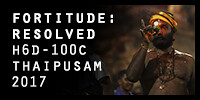
_M9P1_L1010892 copy Master of the cave. M9P, 35 FLE

Kuala Lumpur, Malaysia. The limestone Batu caves are alive with primal energy through the night as millions of Hindu devotees bring offerings to the temple of Lord Murugan after a 25km trek from the companion temple in downtown Kuala Lumpur.

_7024626 copy
The main cave in 2011, but this year looked much the same. I didn’t have the right lens for this perspective, for reasons I’ll get into later. D700, ZF.2 2/28 Distagon

_M9P1_L1011300 copy
The offering dance. M9P, 35 FLE

This person – it’s not clear if it’s a man or woman – was very much in a trance, holding the bowl of fire and dancing in a haunting way. Her/his eyes were closed almost all of the time, but knowing when to pause to let an assistant or friend pour more oil into the bowl to keep the fire going. Leaves were waved through the fire, ostensibly for purification or offering. Lit mostly by the fire and the dim lights inside the cave, by her/himself she would have been a spectacle. Yet this was just one of dozens, or even possibly hundreds, of similar scenes going on at the same time. One can’t help but admire millions’ dedication to their faith – and yet at the same time wonder where the divergence lies, because if all religions fundamentally preach the same thing, why do people still lie, cheat, steal and kill? Why is there less and less honor and honesty in this world? I can’t answer that. Towards the end of shooting the sequence, one of her/his assistants advised me not to take so many photos; I probably wouldn’t sleep well that night. Things visit people, he said. I thanked him and left; I’d finished anyway. Most nights I don’t sleep that well, unless I’m absolutely exhausted. Strangely enough, I slept like a deep, satisfying dreamless sleep that night – for a solid eight hours, a lot more than the two or three I normally manage.

_M9P1_L1011526 copy
Release. M9P, 35 FLE

What makes people act the way they do? What determines the nature of self? These are the two questions that come to mind after watching a devotee get released from their trance by what is presumably a priest of some sort (bald, at left) though I have also seen the procedure performed by another devotee. The releaser grips the head of the devotee and blows on his forehead; a grimace of pain and he collapses, supported by his friends or family. It can’t be physical pain, becuase he carried a heavy portable shrine 20+km on foot from the main temple in downtown Kuala Lumpur, with offerings of lime and milk pots attached to his flesh via hooks; it looks to be spiritual pain as something is separated inside and his own self is restored. Where does the self go? Why is there pain when it returns, not a sense of happiness or at least familiarity? Instead we see devotees slumped exhausted (understandable) and looking confused, lost and vulnerable. We are but a small, unimportant and impotent part of this world. And timing and luck are pretty much our only ways of being in ‘control’ – for instance, if I wasn’t exactly where I was with exactly the right camera settings and focus set, I wouldn’t have gotten the shot. Could I have controlled the elements, replicated the emotion of the subject? No.

_M9P1_L1011399 copy
Proof that they do bleed. M9P, 35 FLE

_M9P1_L1011346 copy
Exhaustion after the event. M9P, 35 FLE

Let’s revisit this exercise from a photographic point of view.

I’ve shot this event three times – in 2008, with a D3; 2011 with a D700; and this year with an M9P. Which was easiest? Without a doubt, the D700. I was using f1.4 or f2 primes with a very capable 8fps low-light body. Which was the hardest? Duh – this year. The M9P is a great photojournalism camera, but very, very challenging to use under these conditions. Subjects were fast moving. Light was uniformly very low, and very erratic; the center weighted meter on the M9P is very careful to protect your highlights, so if you have a few point sources in your frame, you’ll find the camera reporting 1/2000 at ISO 160 is sufficient at night. That means you’re both metering and focusing manually, all when the world is moving around you at a million miles per hour. Oh, and I only had one lens – the 35/1.4 Summilux-M ASPH FLE (which is truly outstanding, by the way.)

But which images did I like the best? Again, the nod goes to the M9P set. There is a disconnect in the D700 images, which are more mature than the D3 images – if I can’t say I’ve improved as a photographer in four years, then I’m not trying hard enough. This year’s set has a rawness and direct connection that is lacking in the other sets; it’s more obvious the further after the event we get. Do I think I could do better next year? I certainly hope so. Would I change equipment? Probably not, actually. MT

The full set is available here on flickr.