Photoessay: Autumn near Bandai

_7R2_DSC4830 copy

Today’s photoessay is a quick landscape reminiscence from the end of last year; and I mean quick in both execution and conception. I captured these in approximately an hour, from two locations – one, not far from the ryokan at which I stayed during my visit to the Sigma factory outside Aizu, Japan; two, at a bridge overlook again very close to the Sigma factory (for which I requested a quick vehicle stop after seeing what was underneath it, and the unique perspective afforded by the height of the bridge). Nevertheless, I find we often encounter these single very strong locations that yield a large number of views and images (something similar happened in the Arrow River Delta outside Queenstown, New Zealand); they feel like brief chance encounters with random strangers with whom you just ‘click’ and promise to keep in touch with again; whether or not that transpires is another matter entirely. Many are in fact a sort of portrait of the location (even if ‘landscape portrait sounds rather odd). But for those moments, it was fun. I can only hope that in this series some of that magic of the cool breeze, clear sky and rustle of dry leaves carries through. MT

This series was shot with a Sony A7RII and Zeiss FE 1.8/55, and a Leica Q. Postprocessing via Photoshop Workflow II. You can also look over my shoulder at the underlying postprocessing in the Weekly Photoshop Workflow series.
[Read more…]

Photoessay: Aizu nights

_7R2_DSC4727 copy

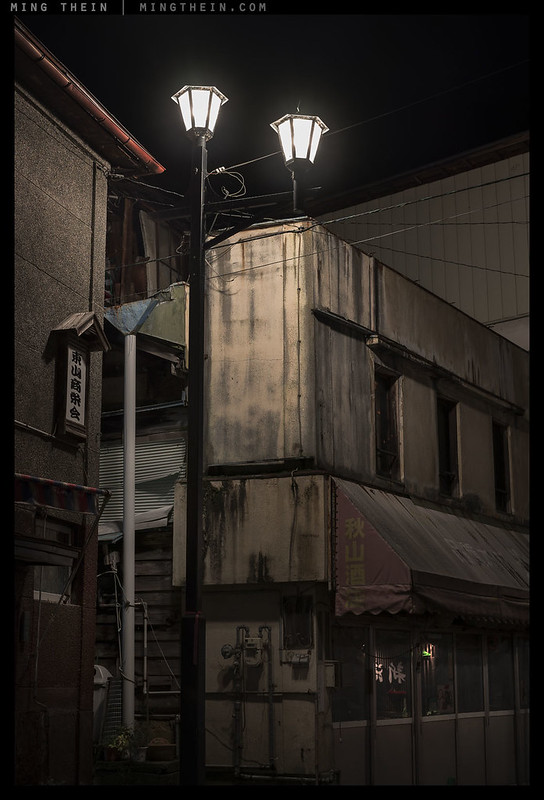
Aizu-wakamatsu is a relatively small town in the northern part of Honshu, Japan, that at one point was the seat of power of a regional military force before changing power after several civil war struggles. Whilst the town proper including the castle (destroyed in the the late 1800s and rebuilt in concrete in 1965) has seen several cycles of prosperity and decline, the hot spring resort area nearby of Aizu Higashiyama has seen relatively little change for several centuries – being popular with all. It is this little area which we explore in today’s photoessay – by night, because that was the only free time I had during this trip. Sometimes you feel like a walk after dinner, and happen to bring a tripod…MT

This series was shot with a Sony A7RII, Zeiss 2.8/21 Loxia and 1.8/55 FE and post processed with Photoshop Workflow II. You can also look over my shoulder at the underlying postprocessing in the Weekly Photoshop Workflow series.
[Read more…]

Photoessay: People of Tokyo II

_5502278 copy

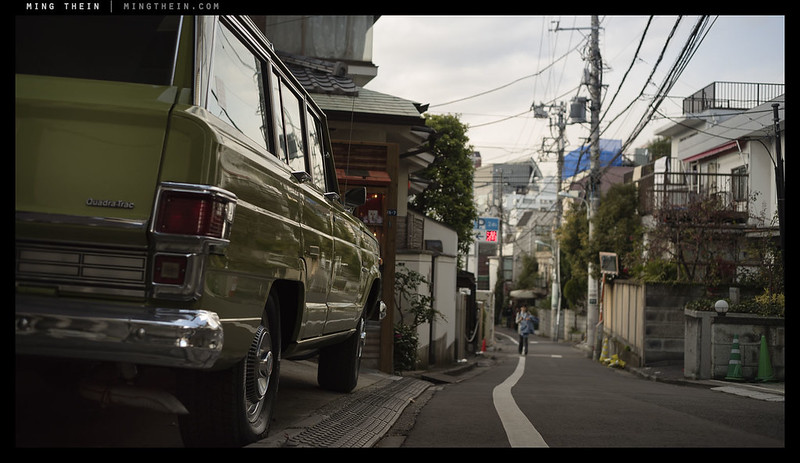
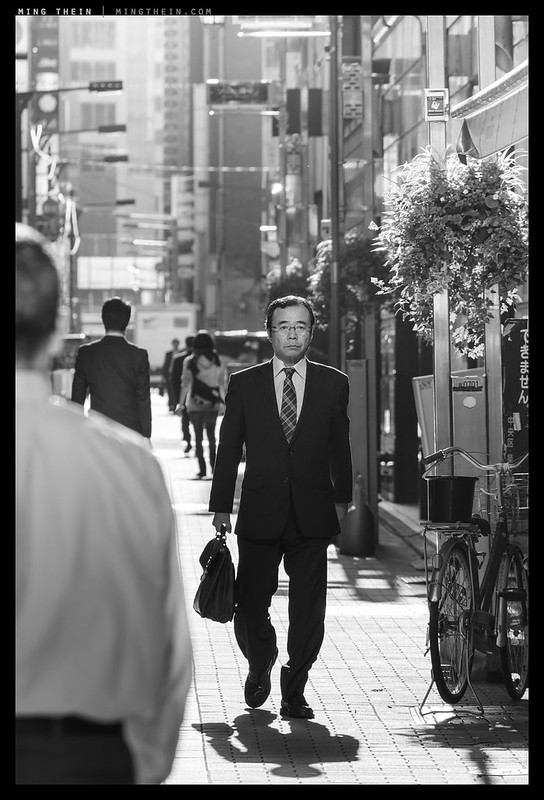
As usual, it is impossible not to be in a place like Tokyo and do at least some street photography; the very difference in the way people act and the things they do already attracts our attention because it breaks the pattern which we’re used to seeing. Furthermore, Japan’s tolerance for photography in general as a society and the close proximity in which people usually find themselves makes things even easier. It is however impossible to avoid people on phones: I still think this is the ‘hat-and-newspaper’ of the 21st century; just as life-documenting photographers eighty years ago could not avoid that cliche – which now seems quaint to us – we are locked into the era of the cellphone. It is harder to find somebody not using one. I’ve always said the best street work should be pretty close to documentary in nature, though much more personal in significance. If phones are the nature of reality today, so be it. That of course doesn’t mean there isn’t plenty else going on. I did get a feeling of longing and melancholy I didn’t observe the last time I was there; the usual conspicuous isolation was even stronger on this visit. A sign of the times for society, perhaps? MT

This series was shot with a Leica Q 116, Nikon D5500 and 55-200/4-5.6 DX VR II, Sony A7RII and Zeiss 2.8/21 Loxia and 1.8/85 Batis lenses and post processed with The Monochrome Masterclass workflow. You can also look over my shoulder at the underlying postprocessing in the Weekly Photoshop Workflow series.
[Read more…]

Photoessay: Tokyo cinematics II

_Q116_L1080008 copy

Continued from part one.

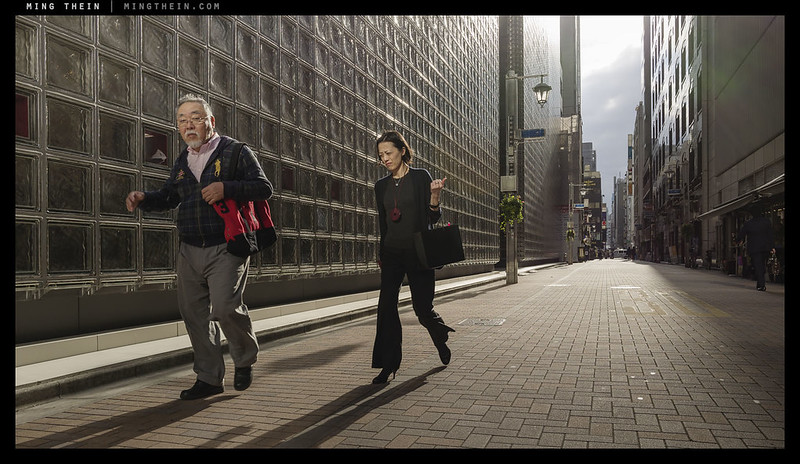
I frequently get asked if it is possible to work in the cinematic style with a wide lens; the answer is of course yes. There are a couple more considerations over the more traditional conception of the genre that is heavily dependent on longer focal lengths to split the scene into planes and blur the unimportant portions; it is true that the latter is much easier with a longer focal length due to simple rules of physics. However, use of the wide perspective is also important for several reasons, with the main one being trying to create a feel of involvement and immediacy for the audience. It can also be used in tight quarters and to create the impression of distance between observer and scene/subject. In all situations, the frame has to perceptually appear level – otherwise a very strong (and distracting) tipping sensation is produced. The wider the lens, the more care you need with levelling and keeping subjects away from the edges of the frame to avoid geometric distortion drawing attention to itself. Lens choice is also fairly critical because any out of focus areas are unlikely to be drastically out of focus; there will be a lot of transition zones. I personally prefer a smooth rendering here rather than a crisp one because it’s very difficult to reduce the prominence of background or foreground distractions after capture. Enjoy! MT

This series was shot with a Leica Q 116, and post processed using the Cinematic workflow in Making Outstanding Images Ep.5. You can also look over my shoulder at the underlying postprocessing in the Weekly Photoshop Workflow series.
[Read more…]

Photoessay: Tokyo architecture mono, mid 2015

_8B12402 copy
To infinity

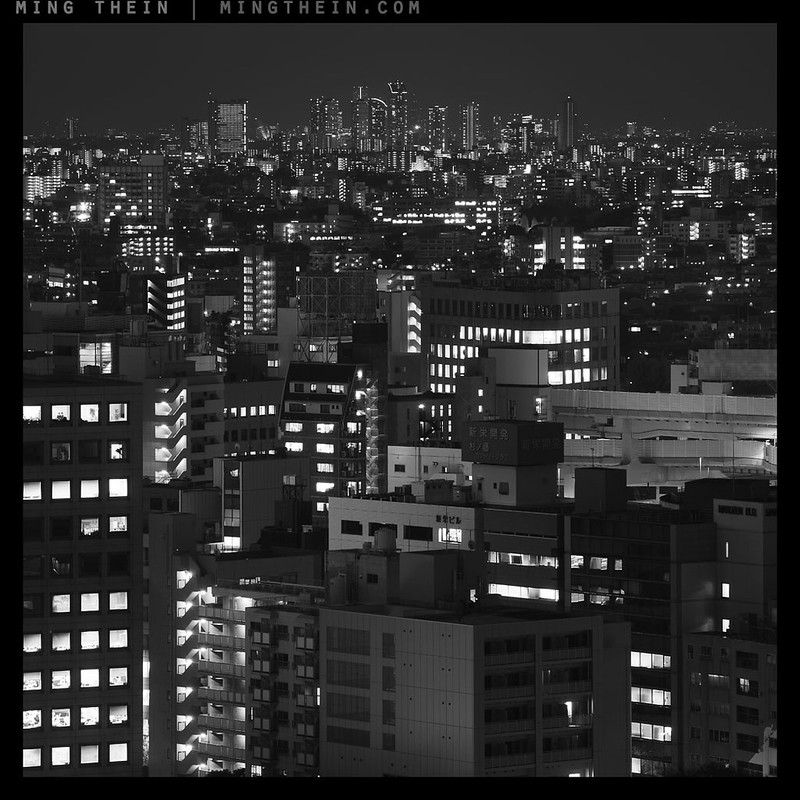
Today’s photoessay is a very limited architectural snapshot from Tokyo. I’m there roughly once a year, but the place changes so often that there’s always something new (and usually unrecognisable) from visit to visit. That is of course a very good reason to go back. This set is in monochrome I suppose as sort of contrarian approach to something constantly changing – monochrome still life or landscape tends to invoke something timeless rather than temporal; perhaps change is timeless. MT

This set was shot with a Nikon D810 and D750 and processed with techniques covered in the Monochrome Masterclass and PS Workflow II videos.you can also travel vicariously to Japan with How To See Ep.2: Tokyo.

[Read more…]

Photoessay: Tokyo cityscapes

_8B11327 copy
Skyline

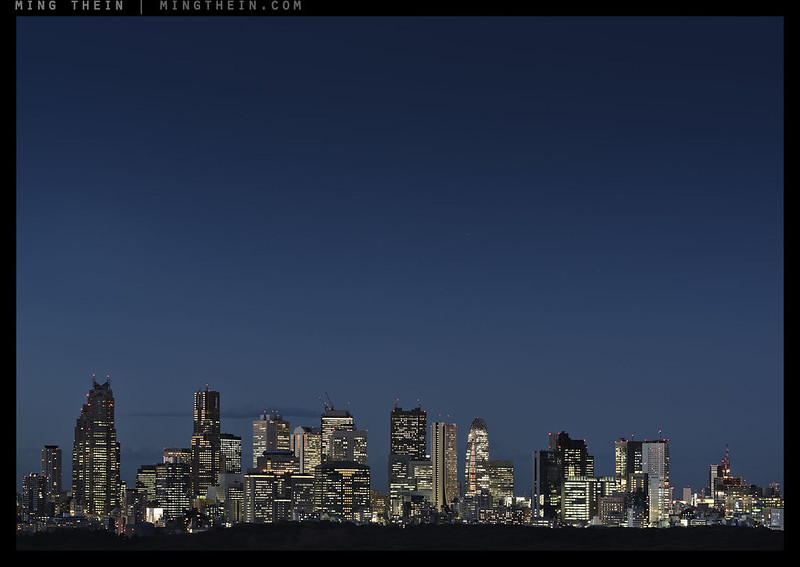
We’re nearing the end of the images from the last trip to Tokyo. Today’s images are a continued evolution of the urban theme into something a bit more widespread; an attempt to capture the combined endless scale and whimsy of Tokyo. There are bits you might find surprising and challenging to your preconceptions of Japan – anything with space or trees or emptiness, for instance – but that’s the whole point, isn’t it? It is me giving in to my endless fascination for man-made light, texture and reflection in complementary colours. Enjoy! MT

This series was shot with a Nikon D810, D750, 24/3.5 PCE, 45/2.8P, Zeiss 1.4/85 Otus and Voigtlander 180/4 APO-Lanthar and processed with PS Workflow II; you can also travel vicariously to Japan with How To See Ep.2: Tokyo.

[Read more…]

Photoessay: Cinematic in Tokyo

_7503021 copy
Not in Kansas anymore

One of the most important things for the creation of a cinematic feeling image is control over light: control light and you can control what stands out, the order in which your audience reads an image, and beyond that, how they feel when they view it. This is of course significantly easier to do when the light sources in question are not random: it’s much easier to make a cinematic image with ambient neon than it is with pure sunshine, as there’s just so much more directionality and variation of color. Fortunately, I had a decent amount of both in Tokyo; I’ve always found it to be one of the most easiest cities in which to make these kinds of images for that reason.

[Read more…]

Photoessay: a few unconventional landscapes

_8B11338 copy
I – floating tree

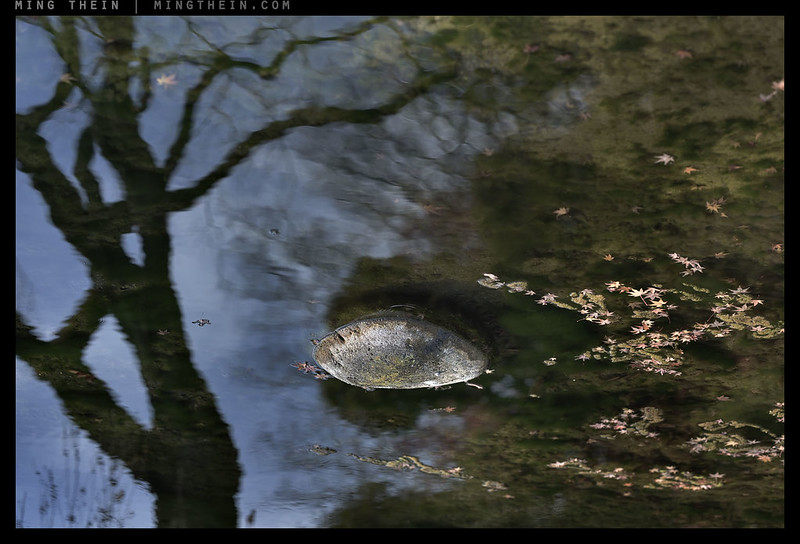
Today’s photoessay is a little shorter than the usual, for the simple reason that it wasn’t easy to make these images – the opportunities didn’t always present, and even then, they had to be teased out. I’m exploring what the definition of landscape really is: do we have to have near/mid/far all the time? In the same plane? In a ‘literal’ sense? I think if you’ve read the articles on what makes an interesting image from the previous two days, this set may make a little more sense. The upshot is that I’m seeking to present a series of images that are unquestionably about nature, a bit larger than just a single detail (but not necessarily expansive) and perhaps with some deliberate ambiguity of scale: after all, nature itself is recursive and fractal. Needless to say, they do all work much better as prints, which are available on request as usual. Enjoy. MT

This series was shot with a Nikon D810 and various lenses.

[Read more…]

Photoessay: Life in Tokyo

_G009732 copy
Sardines observing sardines

Tokyo ranks extremely highly on my top places in the world for street photography – the sheer visual difference notwithstanding, it is also an extremely tolerant society to photography, and photography of random people in public. Everybody is doing it to the point that nobody notices anymore; however, unlike in other parts of the world where camera phones dominate, there are plenty of people using more serious equipment, too. Blending in has never been much of a problem. That difference I mentioned earlier is eroding somewhat, though. Once again, globalisation has meant that a lot of the more unique ‘character’ areas of the city are becoming clones of international streets (or vice versa) or even other parts of Tokyo; the area around almost any major railway station is the same, for instance – an agglomeration of fast food eateries, convenience stores, and one or two major chains plus a business hotel. It’s a formula that probably works for practicality, but not so much to keep the world an interesting place for its inhabitants.

[Read more…]

Photoessay: Tokyo, on the move

_2K00270 copy
The taxi

Unusually for me, I shot very little monochrome on my last trip to Tokyo. Almost none at all, in fact. I suspect it was partially due to equipment choice – the Hasselblad’s digital back really excels at reproducing accurate color – that made me want to explore the use of color even more. Either that, or it was the subtle subconscious influence that Saul Leiter’s work has been having on me. His color was not at all accurate, but rather both pleasing and very evocative of an emotion or era; maybe because of the tonal shift, maybe because of the conscious choice of palette.

[Read more…]