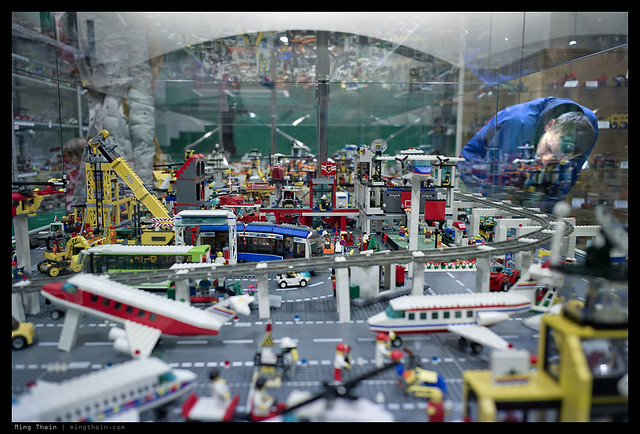
Lego Museum, Prague. Leica M9-P, 28/2.8 ASPH
I freely admit to having a fascination with Lego since a very young age. I’m pretty sure it’s because it gave the creative side of me an outlet, and the type A side of me a chance to solve problems and take on challenges which nobody else – or so I thought at the time – had done, for instance trying to build a working helicopter – which of course failed. I recently revisited it after a nearly 10 year hiatus – this time focusing on fully functional and mechanically accurate large scale cars. Part of the satisfaction for me was, and still is, being able to get around the limitations of the medium – no concentric shafts, for instance – to produce something that was still as accurate to reality as possible.
In many ways, building Lego is similar to photography. There are some technical rules and limitations, but for the most part, it’s entirely creative and up to you how you wish to follow them (or not). There are specialists, who only build one or two types of things. There are similarly dedicated online communities. It can consume a huge amount of time and money, especially if you decide to build a 12ft long aircraft carrier (I’ve seen it done) – I suppose the photographic equivalent would be going medium format digital. But above all, you get a sense of satisfaction from having created something that in all probability is both unique and will never be created again – but which still reflects your personality and personal style. (Assuming of course you’re not building a standard model from an instruction sheet).
It seems that these days, a large proportion of the sets sold are actually to adult enthusiasts. Maybe it’s because adults are wanting their childhoods back, but kids want to have Blackberries and iPads and want to grow up faster – little do they know what awaits them. Enjoy it while it lasts!
In the same way that I build very different models now to when I was five, I think I’d equip my kids with a camera as soon as they’re able to use one. It would be a very interesting exercise to see how their perspective on the world changes with age – what do they see when they’re 1 or 2 years old, vs twenty? Do I wish I’d had that opportunity? Absolutely. It’s the same reason that every year, I document life with my wife in a book – so we can look back and see how things have change twenty, thirty, forty years from now. It’s also insurance against Alzheimer’s.
I leave you with something I built a little while ago for the Porsche Club of Spain – a 917K.

For those interested, you can see some of my recent Lego Technic work here on MOCPages.








