
Following on from yesterday’s review of the Ricoh GR (Digital V) can only be one thing: the comparison shootout between the GR and its natural rival, the Nikon Coolpix A (full review here). Or is it the other way around, since the A came first? Doesn’t matter a single bit, it’s all about the images. Fight!
I’ll continuously upload images from both cameras to respective sets on my Flickr stream – the Coolpix A is here, and the Ricoh GR is here.

Coolpix A, shot by the GR. THe 501C looks on in the background.
On paper, they pretty much share a spec sheet: 16MP, APS-C, excellent (according to MTF charts at least) 28/2.8-equivalent lenses, no IS, no PDAF, no AA filter, premium build, and a raft of manual/ physical controls. Both are large-pocketable and pretty much as small as it gets when it comes to APS-C compacts. They even have roughly the same battery life. What separates them is $300. Simple, right? Surely it’s a lost cause for the Nikon? In practice, it’s not quite so clear cut. I approach this comparison with no biases: I don’t own either camera (yet), but I do plan to cut a cheque for one of them eventually. I want a 28mm, large-sensor compact to serve as a second body, something pocketable, and fill the wide-angle niche when I travel. (I’m increasingly shooting with two bodies both for redundancy and so I don’t miss shots while changing lenses; the wide body should be something fast and responsive, and preferably usable with one hand.) It replaces the function of the 12/2 on my OM-D, or the 28/2 ASPH on a Leica M body.

GR, shot by the Coolpix A. 501C has reloaded, dumped its detritus, and gone off to make pictures whilst these two navigate their menus.
Let’s see how the list stacks up (important items in bold):
In favour of the GR:
- Better ergonomics and higher levels of configurability, one handed operation
- Faster focusing in daylight
- $300 price advantage
- Better B&W conversions; tonal palette seems to be biased towards this
- The lens has slightly better corner resolution at distance – though nowhere near as much as existing comparisons online tend to make out, as you’ll see later. Resolution is identical otherwise.
- Very well implemented manual and zone focusing, snap modes etc.
- In-camera RAW development
- 21mm converter available
Built in levelEdit: it appears the A has this too, but it’s buried deep in the menus under a non-intuitive setting. I stand corrected.- 1/4000s shutter speed at f5.6 and above
- Built in ND filter
- 35mm and square crop options

Bar, GR
In favour of the Coolpix A:
- AF in low light (indoors and darker) is considerably faster and more accurate, overall AF speed consistent regardless of brightness – easier to anticipate shot timing
- Better AWB and colour accuracy, especially in the reds
- Images just seem to have slightly more pop
- More accurate matrix metering, doesn’t blow highlights as often
- LCD shows focus better
- Lens has better close range performance, less CA at all distances and better flare/ coma control. It also feels like there’s slightly more overall contrast, giving better ‘bite’ to images out of camera – it’s a combination of both macro and microcontrast
- Dedicated manual focus ring
- Compatible with GPS and wifi accessories
- Made in Japan (though this has little impact on immediate build quality, it may or may not speak for longevity)
- Slightly faster to power on
- ‘My Menu’ with the ability to add any other menu item
- Easy to decouple AF and spot meter – AF on via Fn1 focuses, shutter half press locks metering
- Very easy to move the focus point – just use the D-pad directly

Bar, Coolpix A. Not a lot of difference at this size, is there? Just keeping things in context.
Working against the GR
- Low light focusing is very slow and not very accurate
- In RAW, reds shift to pink without a profile to correct them . Oddly JPEG colors are fine – identical to the A
- Exposure meter settings are only shown after half pressing the shutter – not permanently live. In manual focus mode, the spot metering box isn’t shown, nor is the central AF target (you can use the AE/AFL button to focus with MF selected)
- Exposures tend to be a bit hot; highlights clip
- Very odd program mode operation – seems to stick within a narrow range of apertures (f4-f8) regardless of light; won’t open up brighter than f4 in low light. If you use this with Auto ISO and shift the program, it will increase shutter speed rather than decrease ISO even if you’re already above the selected minimum threshold
- Multiple button presses required to move focus point
- LCD is rather dim in bright light, making judging exposure and focus difficult unless you want to clutter the screen with magnification boxes and histograms – this affects composition
- Can’t easily decouple focus and spot meter without a lot of button gymnastics
- Noticeable vignetting, flare and coma around bright point sources
- NR settings appear to affect RAW files too
- Need to shoot RAW+JPEG to get over 3.4x playback magnification; 8x is roughly 1:1. No choice of embedded JPEG; wastes card space
- MF implementation is not as direct or fast as the A
Working against the A
- $300
- AF isn’t that fast
- Ergonomics and odd button/ menu behaviour – e.g. auto ISO switching, self-cancelling timer
- Menus have different options in different places and aren’t very intuitive, resulting in slow practical operation if you have to change a setting
- No DOF scales in any focusing mode
- No LCD off mode for use with external finders

First test scene, with the A. Shot on a tripod with AUTO-ISO for both cameras, wide open, and matrix metering; representative of your average night scene, minus the variable introduced by hand shake.

Center. The GR is resolving a tiny hair more (see trees) and there’s slightly less noise, but notice the default metering is also significantly hotter. Other peripheral parts of the frame are blown. Both cameras were set to matrix metering. Click here for 100%.

Lower left corner. The GR is definitely resolving high contrast structures a little bit more than the A, but notice the increase in lateral CA, too. Click here for 100%.

Bottom border. Again, almost too close to call. Click here for 100%.
Though both cameras have a built in flash, neither one will work as a TTL speedlight commander (shame on you, Nikon – even if you mount a compatible hotshoe flash, you still can’t get TTL commander modes). Similarly, neither camera remembers the chosen manual focus distance when the power is cycled, though the GR has the snap mode function which can be set to several possible distances. The A lacks this and requires you to either always set it after powering it on, or leave the camera on and draining power. You’ll also get moire on both cameras due to the lack of an antialiasing filter.
I’m sure you can see the problem here, right? Though the GR is cheaper, it has some critical issues – in bold – that are a big deal in practical use. The gap in image quality is significant enough that it should give you pause: if you’re primarily a B&W shooter, then the GR is your camera because it simply delivers richer midtones; given the base sensors are similar if not identical, it’s probably the in-camera processing making the difference. By comparison, the A’s default B&W output is rather flat and not particularly rich; you do need to do quite a lot of work in PS to make it sing. If you’re a color shooter, then the GR’s odd reds are probably going to drive you mad. The Coolpix A should be your choice; its colors are natural, accurate, and have a level of subtle clarity that’s quite addictive. I felt there was a ‘pop’ present in the A’s raw files that I simply didn’t get out of the GR (unless I desaturated with the intention of converting to B&W); it might well be because this was a preproduction unit with non-final color calibration.
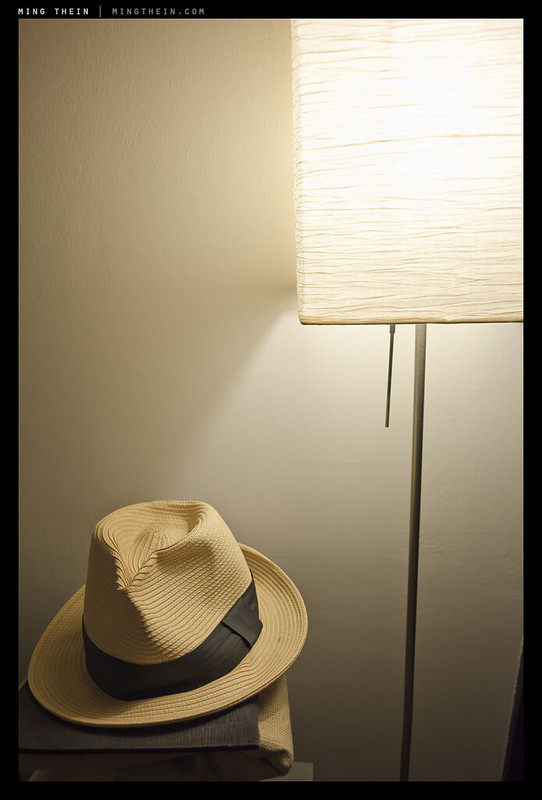
Second test scene, from the Coolpix A. Shot at base ISO and auto-ISO, both with matrix metering, again on a tripod, again wide open. Selected focus point for both cameras was the crease in the front portion of the hat.

Corner. I really don’t see any difference in resolution here – if anything, the Coolpix may be a hair better. Where are these soft corners everybody seems to be producing? Click here for 100%.

Dynamic range test, top right corner. Once again, the GR has metered hot and overexposed portions of the lamp. These weren’t recoverable in ACR. Click here for 100%.
As far as dynamic range and noise goes, there doesn’t appear to be much in it: however, it’s worth noting that the GR’s NR settings seem to affect its raw files, too. That said, even with NR switched off, the GR appears to be slightly cleaner at ISo 6400 and up – perhaps half a stop or less – with significantly less blue channel noise at the two highest settings of 12k and 25k. (That said, I wouldn’t use either of these in anything other than a dire emergency; dynamic range of both is severely compromised.)

Low ISO. Near as enough makes no difference to either noise or resolution. Click here for 100% crops.

High ISO. The A certainly has stronger blue channel noise than the GR; at ISO 6400 and above, I’d give an increasing advantage to the GR. That said, I wouldn’t exceed 6400 on either of these cameras. Click here for 100% crops.
Much ado has been made about the GR’s lens supposedly being better than the A’s; I openly question the testing method used, because I’ll be damned if I can see much of a difference between the two cameras wide open – you can see as much in the 100% crops presented here. There’s no difference in resolution at close range – if anything, I think I find the Nikon performs a bit better with less coma; at longer distances, the Ricoh has slightly better resolution, but also considerably more lateral CA. In the center zone, they’re about the same. Sample variation and focusing accuracy is going to matter much more than the design spec of the lens.

The problem with color, in a nutshell. Both cameras were shot in daylight at the same target within seconds of each other with a manual WB reading off the grey card to avoid any potential issues with post-capture WB. No corrections were required anyway as both gray cards came out with RGB values of 180,180,180 in post. Exposure and ACR settings were the same for both cameras. The JPEGs look nearly identical in colour. However, the raw files diverge considerably: note how the reds are pinkish and washed out/ flat; cyans shift to blue and yellows shift a bit to green. The real scene looks almost identical to the Nikon; the Ricoh looks off, period. (The red book in the center – ‘Survivor’ – is fire-engine red, not burnt orange.) Here’s the real problem, though: the Nikon makes it 5150K, +24 tint. The Ricoh makes it 4000K and +34 tint. In practical terms, it means that you might run out of WB shift adjustment in very warm light for the Ricoh, but it makes for a great B&W conversion. Click here for a 100% version.

Final test scene, shot in the same manner as the hat and lamp.

Note the difference in default AWB between the two cameras – once again, the Coolpix A (left) renders the reds far more accurately. Under incandescent light, the difference becomes far more pronounced. Once again, there’s almost no difference in resolution. Click here for 100% crops.
On the topic of focusing, I can’t clearly say one is better than the other, either: the GR is notably faster in daylight – subjectively, I think it’s comparable to the OM-D and a fast lens like the 12/2 – but it slows down dramatically by as much as an order of magnitude when the light or contrast level falls. Both the ‘hunting’ process slows down and sometimes it still fails to find focus in situations where the Coolpix has no problem. By comparison, the A is consistent: it doesn’t focus any slower in low light, but occasionally it fails to lock. If this happens, you can always try again in; even with the second attempt, you’ll still be faster than the GR. If I had to put this in a numerical scale, the GR in good light takes say 20 units, the A will be about 30. The GR in low light can be as slow as 100-150; the A might drop to 50, but always stays in this range. (We’re talking about normal focusing distances here; macro is significantly slower as the lens has to move through a greater distance.)

Half an arch. Ricoh GR
In practical terms, this means the GR can be used effectively for daylight street photography in AF mode; the Coolpix is a bit hit and miss. However, the GR can always be used in Snap mode, or zone focus, especially at night. You’ll probably find yourself with the camera struggling to focus once it gets any darker than your average indoors scene – EV7 or so. If you use the A with AF on the shutter half press, you’re going to be frustrated by the number of shots you miss due to slow response. That fraction of a second extra the A takes to focus – perhaps 40-50%, or maybe about 100ms in real terms – is enough to dramatically reduce your keeper rate. Rather, the A is best set to Fn1 as AF-ON, and the desired distance dialled in – shutter response is then instant. Effectively, both cameras can be made as responsive as is desired. For this kind of run and gun work, the one caveat is metering: the GR’s matrix meter is not as accurate as the A, and tends to expose a bit hot – clipping highlights in the process.

Stormy night (one curve). Ricoh GR
Given that exposure is read directly off the sensor, it’s unclear to me why it’s so difficult to program the camera to just clip the top end of the highlights rather than losing significant amounts completely; under identical circumstances, the Nikon is consistent to the point of not really needing to use the spot meter. To make things more confusing, the A has a sensible program mode that uses all of the available apertures (you don’t really get a huge amount of depth of field control with a real 18/2.8 anyway); the GR requires you to switch to aperture priority or continually shift the program when indoors to use anything larger than f4. At the same time, you don’t want to leave shade for sun and find yourself at f2.8 for a landscape. This switching gets annoying, and it’s too easy to find yourself at a higher ISO than you desired – defeating the point of a fast-response rapid-draw camera.

Over London – Coolpix A (with a LOT of tonal work).
This brings us to perhaps the most important factor: how they feel in use. The GR is a camera thoroughly conceived in the compact mould: you can use it one-handed, and everything is controlled by the shooting hand through various toggles, dials and joysticks. The A is set up like a mini-DSLR; you need two hands because there’s a row of buttons down the left side that are hold-down-and-turn in the style Nikon’s larger cameras with which it shares the same direct-access info panel and menu system. Unfortunately, it also shares some of the larger cameras’ idiocies – no one-button zoom in playback (you push the ADJ toggle in on the Ricoh to zoom to your desired zoom setting); not having AUTO-ISO as a choice on the ISO menu; U1 and U2 settings that don’t quite save everything. That said, the A remembers your playback info screen choice and uses it all the time, even for instant review (mine is the blinking highlight warning); the GR does sometimes, and doesn’t at others. You think your exposure was okay because the screen is relatively dim, but combined with the overly hot matrix meter, you might well have blown some things.

Momentary illumination. Ricoh GR
Truth be told, I have no idea which camera I’m going to keep. I can see uses for both and frustrations with both. (This was not the conclusion I was expecting; I honestly thought the GR would deliver image quality on par with the A, run away with focusing speed, and be $300 cheaper in the bargain. I’m now quite confused.) In real life, there’s very little to choose between their lenses or sensors (barring color, which is fixable by a custom profile). What you choose will come down to your tonal preferences: as it stands, the Ricoh GR (with FW 1.11) makes some of the richest B&W conversions I’ve ever seen from a digital camera, whereas the Nikon Coolpix A has beautifully transparent, accurate color. Actually, the GR’s output in square format reminds me a lot of my Hasselblad and CFE 50/4 Distagon; it’s very, very filmic, and this isn’t a term I use lightly. I enjoy it as much as I enjoy the Nikon’s color reproduction.

Geometry. Ricoh GR
What you probably don’t expect me to say at this point is that I believe both cameras represent excellent value for money: yes, they’re expensive, but if you stop to think about what other options you have that deliver the same level of image quality – an APS-C DSLR and a prime, or a Leica M – then it puts things in perspective. Both deliver resolution and optics comparable or slightly better than an M9+28/2 ASPH, with better dynamic range and noise. In fact, at higher ISOs, things are comparable to the M 240 and the same 28/2; that’s a system costing an order of magnitude more. I think the problem is that I prefer the AF behaviour (though it’s not excellent either) and color output of the A, but the B&W tones, ergonomics and hand-feel of the GR. Neither is perfect, but both are excellent in their own right. I’m going to bounce it back to the readers for discussion in the comments: given my observations and the photographic evidence, which would you buy, and why? MT
Update (8 May): One of my readers – Henrik – has commented below that he ran the DNGs through RPP and found there isn’t a color issue with reds as via ACR; this is plausible given that the camera’s JPEGs look just fine. So it’s quite possible the issue isn’t with the GR, but with ACR – this is good news because it means that a) it’s fixable, and b) profile away without any worry of losing certain channels. I’ll do a bit more experimentation on this, but without a camera at the moment, it’s difficult to test…
The Nikon Coolpix A is available here from B&H or Amazon in black and silver, and the Ricoh GR V can be preordered here from B&H and Amazon.
____________
Visit our Teaching Store to up your photographic game – including Photoshop Workflow DVDs and customized Email School of Photography; or go mobile with the Photography Compendium for iPad. You can also get your gear from B&H and Amazon. Prices are the same as normal, however a small portion of your purchase value is referred back to me. Thanks!
Don’t forget to like us on Facebook and join the reader Flickr group!

Images and content copyright Ming Thein | mingthein.com 2012 onwards. All rights reserved




 Ming Thein | Photographer