Shinto and Buddhist shrines, from Kyoto, Nikko, Nara and Tokyo. Think of it as a teaser for the upcoming Tokyo workshop with Leica. MT
Series shot at various times with the Nikon D3 and D200
reframing the world one picture at a time
Shinto and Buddhist shrines, from Kyoto, Nikko, Nara and Tokyo. Think of it as a teaser for the upcoming Tokyo workshop with Leica. MT
Series shot at various times with the Nikon D3 and D200
Tsukiji Market is the spiritual home of sushi, sashimi and most Japanese cuisines. Every single edible (and sometimes perhaps best not eaten) creature from the deep can be found for sale here; how anybody decides which supplier to go to is baffling, because there are just so many of them. It’s also a chaotic environment where photographers might get taken out by one of those three-wheeler carts if they’re not paying attention. The authorities closed off the early-morning tuna auctions – where fish fetch as much as US$150,000 each – to tourists and photographers because it was distracting business. Having been lucky enough to witness it firsthand, I think it’s safe to say that you wouldn’t have a clue what’s going on there anyway – they don’t even speak to each other in normal Japanese, and bids are conducted by a system of secret handshakes that are hidden behind a glove. One has to be there very early to see any action at all – simply because the food has to reach its destination in time for lunch. And no trip would be complete without a hearty breakfast at one of the many surrounding stalls that support the workers. Here’s an amuse-bouche for the upcoming Tokyo workshop with Leica. MT
Series shot at various times with the Nikon D3 and D200
This article is the first in a new series of photoessays – a short series of 5-10 images, a small amount of words, and a return to putting the focus on the pictures rather than just the how-tos and equipment masturbations. After all, the final image is what it’s all about.
Ginza, Tokyo is known for two things: being a temple to the height of luxury consumerism, and having the most expensive real estate on earth. Here’s an amuse-bouche for the upcoming Tokyo workshop with Leica. MT
Series shot at various times with the Nikon D3 and D200
Photojournalism (hereafter PJ) and street photography go hand in hand: they’re about capturing a moment of life. PJ goes a bit further by adding a story to that moment; street can just be an aesthetically pleasing moment in and of itself. Both though require the photographer to be observant and ready. This is what works for me.
Disclaimer: As with every other article in this series, I’m assuming you know the basics already.

Protest Kabila, Prague. Leica M9-P, 28/2.8 ASPH
10: Watch your shutter speeds. You’re going to need more than 1/focal length – maybe 1/2x to be safe, or even 1/3x if you’re running and gunning. You’re moving, your subject is moving, and nothing is steady. Remember also that the higher the resolution your camera, the less forgiving it is of focus errors and camera shake.
9: Small, nondescript cameras are best. They don’t draw attention to you – especially in the current day and age of everybody carrying a camera, nobody is going to take you seriously if you have a small black compact. You’d be surprised how much I get away with using the iPhone or Ricoh GR-Digital III. People simply don’t perceive it as threatening in the same way a pro DSLR and 70-200 might be. Compacts also give you more depth of field for a given aperture.

Morning paper, London. Ricoh GRDIII
8: Shoot wide and close. The perspective produces a stronger image; wide lenses are also more forgiving to focus errors and camera shake. And as a bonus, you get context in the frame as par for the course.

Learning English. London. Leica M8, 21/1.4
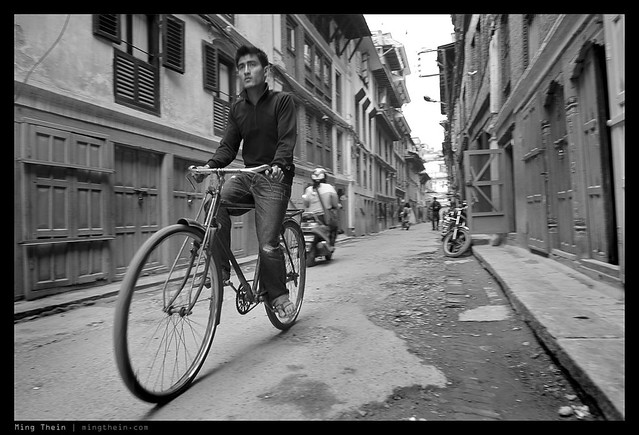
7: Anticipate and observe. To quote the Cartier-Bresson: pick the decisive moment. To do so, you need to be aware of everything around you; really look. Pay attention to the details. People are fairly predictable; it should be easy to spot if something out of the ordinary is about to happen. Anticipation of the action gives you a vital few seconds more to prepare and be in position, or have the camera out.

Bicycle, Kathmandu. Nikon D700, 24/1.4
6: Blend in. Act like you belong, dress nondescript, and nobody will pay you a second glance. It will make your job a lot easier. If you draw attention to yourself – be it by being uncertain or provocative – then people of course notice.

Oblivious. I was standing 3 feet in front of them. Canon IXUS 220HS
5: Always have the camera to hand. How are you going to get a quick shot off if the camera is in your bag? You should be able to get a shot in less than 5 seconds – sometimes your window is even shorter than that.

Trekking office, Kathmandu. Nikon D700, 85/1.4 G
4: In a real emergency, help. Yes, our duty as a PJ is to record, document, communicate and raise awareness about the events around you; you help by telling a story. But you don’t have to shoot all the time. Get your shot and then help out the people. Remember that at the end of the day, we’re all human.

Street party. They would need help the following morning. I didn’t stay that long. Nikon D700, 85/1.4 G
3: Practice, practice, practice. Use your camera until you’re fast and proficient; you should be able to visualize the frame and field of view without having to raise the camera to your eye. You should be able to set things by muscle memory and have a group of settings (if your camera supports this) that configures the camera to be ready to go.
2: If spotted, acknowledge your subject. A friendly smile, a sincere nod – all of these things make people feel comfortable with your presence and make your life easy. You don’t have to stop and talk or explain what you’re doing if nobody is asking. Smile and move one. Done.

Smoking break. Olympus E-PM1, 45/1.8
1: Be confident. It is better to say sorry rather than ask permission and miss the shot. With that, go out and be productive. MT

Martial law, Kathmandu. Nikon D700, 24/1.4
See more of my photojournalism work here on flickr: click here
MY RECOMMENDED GEAR LIST IS HERE Or, support the site via B&H or Amazon
You can also find a handy list of all my equipment here at B&H.
3 million words and 6,500+ images in 1,700+ posts. A further 10m words in 95,000+ comments below the line. If you're looking for something - might I suggest a search?
If you enjoyed the content, please consider
-ing or subscribing - thanks for your support!
Images and content copyright Ming Thein 2012-onwards. All rights reserved